Sales Process for B2B: A Modern Guide to Close Deals (sales process for b2b)
Discover the sales process for b2b with practical steps, metrics, and tools to speed deals and win more.
Published on January 1, 2026
- Why Your B2B Sales Process Is Your Growth Engine
- The Seven Stages of a High-Performing Sales Process
- Defining Roles for a Cohesive Sales Motion
- Using Modern Tools to Accelerate Your Pipeline
- Measuring the Health of Your Sales Process
- How to Unclog Common Sales Process Bottlenecks
- Common Questions About the B2B Sales Process
A B2B sales process is the step-by-step playbook your team follows to turn a complete stranger into a happy customer. It’s a repeatable system that takes the guesswork out of selling, making sure every lead is handled the right way from that first handshake to the final signed contract.
Why Your B2B Sales Process Is Your Growth Engine
Think of your sales team like a high-performance engine. Your reps' time, effort, and the company budget are the fuel. Without a structured process, you're just burning that fuel—revving the engine but going nowhere. Deals get stuck, forecasts become a shot in the dark, and new hires feel lost without a map.
A well-defined process changes everything. It turns the art of selling into a repeatable science, giving every rep a clear roadmap for navigating the customer journey. This isn’t about boxing people in; it’s about giving them a framework where they can truly succeed.
The Real Cost of Winging It
Flying blind without a structured sales process isn't just inefficient—it’s expensive. When every rep does their own thing, you end up with inconsistent quota attainment, a chaotic pipeline, and a customer experience that feels disjointed.
There's hard data to back this up. According to a study from The Sales Collective, a staggering 55% of US sales leaders say a lack of a formal process directly leads to lost revenue. On top of that, 38% admit it results in poor customer experiences. But here’s the flip side: after putting a formal process in place, 51% saw their forecast accuracy skyrocket, and 42% watched team performance surge.
A sales process is your company’s promise of a consistent experience. It tells your prospects and your team exactly what to expect, building trust and predictability at every single stage.
This structure also acts as a diagnostic tool. You can pinpoint exactly where deals are stalling and fix the bottlenecks before they tank your entire quarter.
Let's quickly summarize the key advantages you gain when you move from chaos to a structured system.
Key Benefits of a Formal B2B Sales Process
| Benefit | Impact on Business |
|---|---|
| Faster Onboarding | New reps have a clear playbook, so they hit the ground running and start closing deals sooner. |
| Accurate Forecasting | When every deal follows the same stages, your ability to predict revenue becomes much more reliable. |
| Improved Scalability | A solid process provides the foundation you need to grow your team without losing control or efficiency. |
| Clearer Accountability | Everyone knows their role and what’s expected at each stage, making it easier to manage performance. |
| Better Customer Experience | Prospects receive a consistent, professional journey, which builds trust and strengthens relationships. |
Ultimately, a formal process gives you a unified language and methodology for the entire sales floor, turning random acts of selling into a predictable revenue machine.
Turning Chaos into Predictable Revenue
At the end of the day, a strategic sales process answers the most important question for any business: how do we consistently turn prospects into customers?
Instead of relying on a few star performers, you're building a system that elevates the entire team. This consistency is what separates fast-growing companies from the ones that stagnate. You're not just selling; you're building a powerful, efficient growth engine that’s built to last. It’s the single most important asset for achieving sustainable success.
The Seven Stages of a High-Performing Sales Process
A solid sales process for b2b is your playbook. It’s the roadmap that guides your team—and your customer—from that first flicker of interest all the way to a signed contract. Without it, you’re just winging it.
This structure breaks the complex journey into a series of logical, bite-sized stages, each with its own clear goal. It injects predictability into your pipeline, makes sure no one skips a critical step, and builds momentum with every single conversation. Instead of a chaotic free-for-all, each stage flows naturally into the next, building trust and proving your value along the way.
The infographic below shows the stark difference between a team with a defined process and one without.
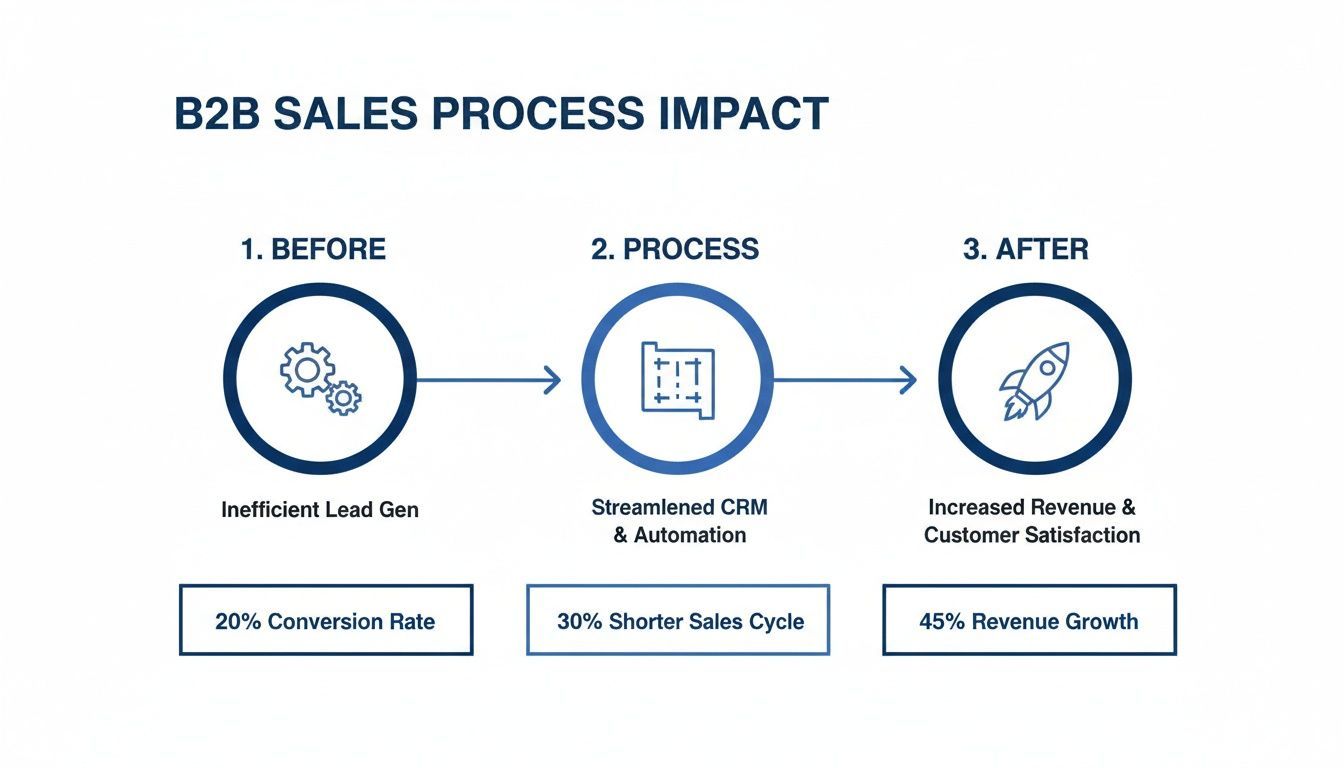
As you can see, a formal process is the blueprint that turns scattered efforts into predictable, accelerated growth.
Stage 1: Prospecting and Lead Generation
This is the very top of your funnel—where it all begins. The mission here is to identify potential customers, both companies and the people inside them, who perfectly match your Ideal Customer Profile (ICP).
You'll tackle this with a mix of inbound tactics, like content that pulls leads in, and outbound efforts, where your team actively hunts for prospects. This means researching target accounts, tapping into professional networks, hitting up industry events, and running sharp outreach campaigns. Success here isn't about volume; it's about quality. Finding the right people to talk to is everything.
Stage 2: Qualifying Leads
Let's be real: not every lead is a good fit. This stage is all about filtering your prospect list to make sure your team is spending time on opportunities that actually have a shot at closing. It’s a crucial checkpoint that stops reps from wasting weeks on dead-end conversations.
Most top-tier teams use a qualification framework to add some science to this step. A classic for a reason is MEDDIC:
- Metrics: What are the hard numbers the prospect needs to hit?
- Economic Buyer: Who holds the purse strings and gives the final "yes"?
- Decision Criteria: What specific boxes do they need to check to choose you?
- Decision Process: What are the exact steps they take to make a buying decision?
- Identify Pain: What's the deep-down business problem that's keeping them up at night?
- Champion: Who on their team loves your solution and will fight for it internally?
Getting answers to these questions early tells you if the deal is real.
Stage 3: Discovery and Needs Analysis
Once a lead is qualified, the conversation shifts from if they should buy to why they should buy from you. The discovery stage is a deep dive into the prospect’s world. This isn't about pitching; it’s about asking smart, probing questions to truly understand their challenges, goals, and daily pains.
This is arguably the most important stage of the entire process. A great discovery call hands you everything you need to build a rock-solid business case. Rushing this is why deals fall apart later on. (Curious how this looks in your CRM? Check out our complete guide to sales pipeline formats.)
Stage 4: Presenting the Solution
Now you're armed with real insights from discovery. It's time to present your product not as a laundry list of features, but as the direct answer to their specific problems. A killer presentation connects every feature back to a pain point you uncovered earlier.
This might be a formal demo, a detailed proposal, or a strategic pitch deck. Whatever the format, customization is king. A generic, one-size-fits-all pitch will land with a thud. A tailored presentation screams, "I listened, and I get your business."
Stage 5: Handling Objections and Negotiation
Prospects almost always have questions or pushback. Don't panic. Objections aren’t a "no"—they're usually a request for more information or reassurance. You'll typically hear concerns about price, timing, competitors, or how hard it will be to implement.
The goal is to tackle these concerns head-on with empathy and confidence. Once you've smoothed over the objections, you move into negotiation to finalize terms, pricing, and the finer details of the contract. This is a collaborative dance to find a win-win that works for everyone.
Stage 6: Closing the Deal
This is the moment of truth. The closing stage covers all the final admin work to get the deal across the finish line. We're talking about sending the final contract, chasing down signatures, and lining up payment and onboarding details.
To keep things from stalling out at the one-yard line, smart teams use a Mutual Action Plan (MAP). It’s basically a shared checklist that outlines every step, who's responsible for it, and the timeline, making sure both sides are perfectly aligned and accountable.
Stage 7: Nurturing the Customer Relationship
Closing the deal isn’t the finish line; it’s the starting pistol for a long-term partnership. The final stage of the sales process for b2b is all about a smooth handoff to your customer success or onboarding team. It also means checking in regularly to make sure the customer is actually getting the value you promised them.
A successful B2B sale isn’t just about the initial transaction. It’s about delivering on promises and fostering a relationship that leads to renewals, upsells, and valuable referrals down the road.
This ongoing engagement is what turns a one-time buyer into a true champion for your brand.
Defining Roles for a Cohesive Sales Motion
A high-performing B2B sales process is like a championship sports team. It’s not just about having talented players; it’s about making sure every single person knows their exact position and works in perfect sync. When roles are clear, handoffs are seamless, accountability is a given, and the entire team moves the ball down the field with precision.
Without that clarity, you get chaos. SDRs end up stepping on AEs’ toes, managers get bogged down in administrative tasks, and the tech stack becomes a tangled mess. A well-structured team, on the other hand, ensures every stage of the customer journey is expertly managed by a specialist.
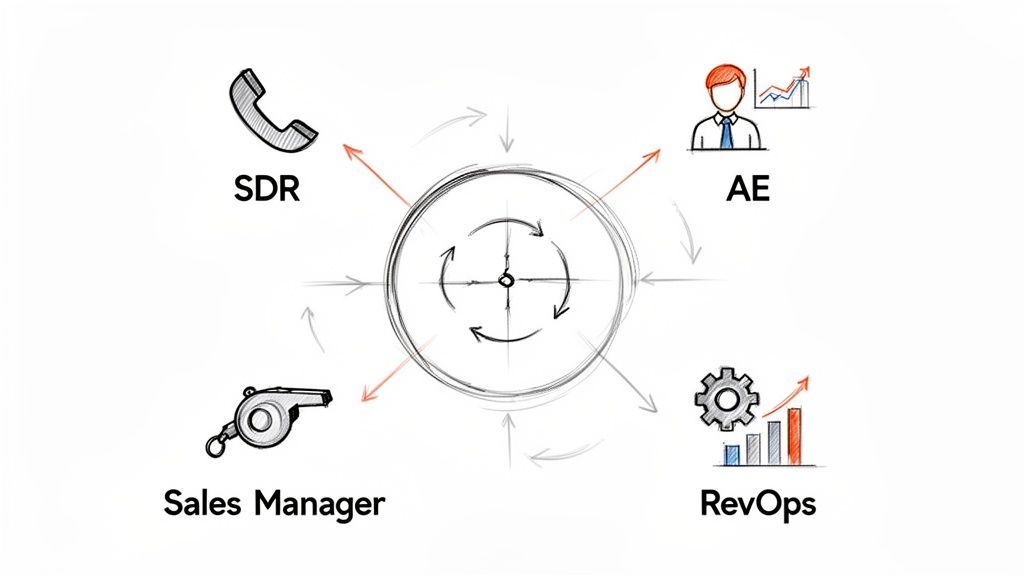
Let's break down the four core roles that make a modern B2B sales motion click.
The Sales Development Representative (SDR)
SDRs (or Business Development Representatives, BDRs) are the masters of the top of the funnel. Their entire world revolves around generating and qualifying initial interest. They are the very first human touchpoint a potential customer has with your company.
Their primary responsibilities include:
- Prospecting: Actively hunting for potential customers who fit your Ideal Customer Profile (ICP).
- Outreach: Engaging those prospects through cold calls, personalized emails, and social media.
- Initial Qualification: Asking the right questions to confirm a prospect has a genuine need and is a potential fit.
The SDR’s job isn't to close deals. Their sole purpose is to book qualified meetings and hand off warm, interested leads to the Account Executives. They are the gatekeepers who ensure the AEs’ calendars are filled with high-potential opportunities, not tire-kickers.
The Account Executive (AE)
Once an SDR qualifies a lead, the Account Executive takes the baton. The AE owns the customer relationship from that first discovery call all the way through to a signed contract. They are the strategic advisors and problem-solvers who guide the prospect through the often-complex buying journey.
An AE’s success is built on their ability to act as a consultant. They don't just sell a product; they diagnose a prospect’s deep-seated business pain and present a tailored solution.
Their focus is on the mid-to-bottom funnel activities: conducting deep discovery, delivering compelling product demonstrations, handling objections, negotiating terms, and ultimately, closing the deal. They build the business case and prove the value required to win the customer's trust and their business.
The Sales Manager
The Sales Manager is the coach and strategist of the team. Their role isn’t so much about individual deals but about elevating the performance of every rep and optimizing the overall sales process. Think of them as the ones looking at the whole field, not just the ball.
Key duties involve:
- Coaching: Providing ongoing training, feedback, and support on tough deals.
- Performance Management: Tracking KPIs, managing the pipeline, and making sure the team hits its targets.
- Process Refinement: Identifying bottlenecks and constantly looking for ways to improve the sales playbook.
An effective manager empowers their team, removes roadblocks, and ensures the B2B sales process runs like a well-oiled machine.
The Revenue Operations (RevOps) Team
Finally, we have Revenue Operations (RevOps), the central nervous system that connects sales, marketing, and customer success. This team manages the technology, data, and processes that underpin the entire revenue engine.
RevOps makes sure the CRM is clean, automations are firing correctly, and the sales team has the data-driven insights they need to make intelligent decisions. They own the tech stack, build the dashboards, and provide the analytical horsepower that fuels predictable growth.
Using Modern Tools to Accelerate Your Pipeline
A well-defined sales process for B2B is the map, but modern tools are the jet fuel. If there's one thing that kills a sales team's momentum, it's manual, repetitive work—especially the soul-crushing task of data entry. This is the friction that grinds productivity to a halt.
Think about it. An SDR finds a perfect prospect on a professional networking site. The old way? It's a frustrating dance of copy-pasting their name, title, and company into the CRM, checking for duplicates, and then hunting down a verified email. That's not selling; it's admin work.
From Manual Drudgery to One-Click Efficiency
Now, let's look at that same scenario with a modern tool. The SDR finds the prospect and clicks a single button in their browser. Instantly, a complete, enriched, and duplicate-free record appears in the CRM. This isn’t a small tweak—it’s a fundamental shift in how sales teams operate.
That simple change gets rid of the universal pain point of manual data transfer. Instead of wasting minutes on clerical tasks, reps get that time back to do what they're actually paid for: engaging prospects, building relationships, and closing deals.
When you automate the mundane, you free your team up to focus on the human side of selling. Technology should serve the process, not slow it down.
This approach means high-intent moments are captured on the spot, without the delays or data-entry errors that plague manual workflows.
Reclaiming Time and Boosting Productivity
The time savings here aren't trivial. Reps can easily spend a huge chunk of their week on non-selling activities. Automating prospecting and CRM updates can give back over 4 hours per rep each week. That adds up to two full workdays a month dedicated back to generating revenue.
- Eliminate Copy-Paste: Instantly grab lead data from professional networks, email signatures, or company websites.
- Automate Duplicate Checks: Smart tools automatically scan your CRM to prevent messy, duplicate contacts from cluttering your database.
- Enrich Data Instantly: Go beyond just a name and title. Automatically pull in verified email addresses, phone numbers, company revenue, and other critical data points.
This kind of automation has a direct impact on the bottom line by increasing the sheer volume and quality of sales activities your team can manage.
The image below shows how a tool like Add to CRM can verify and enrich prospect data in a single click, right where your team is already working.
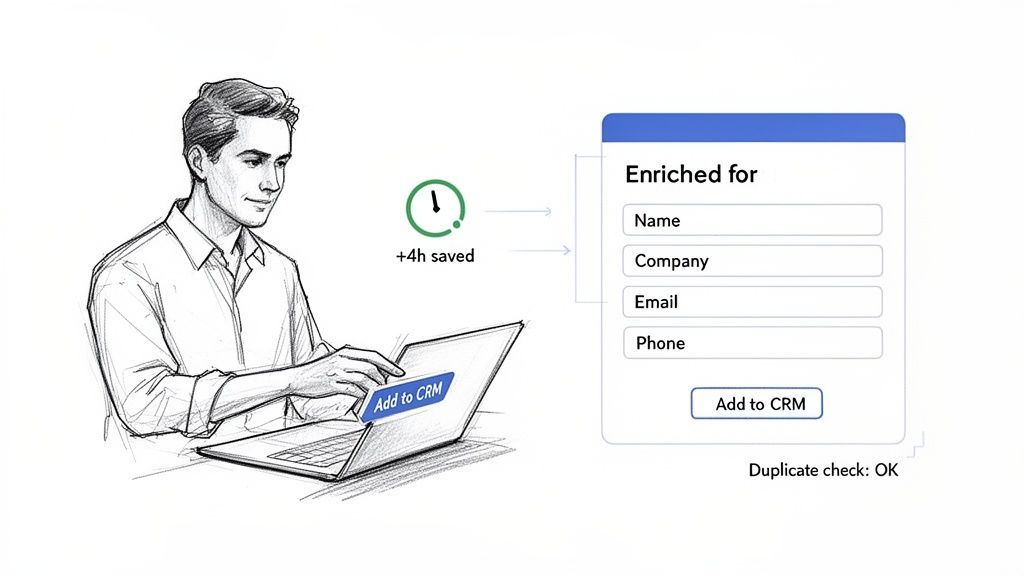
This visual captures the power of bringing CRM functions directly to a prospect's online profile, turning a tedious, multi-step chore into one seamless action.
The Hidden Benefit of Better Data Hygiene
Beyond just saving time, using modern tools dramatically improves the quality of your most valuable asset: your CRM data. Bad data leads to bounced emails, wasted calls, and reports you can't trust. When data is entered by hand, typos and incomplete records are just a matter of when, not if.
Automated tools enforce consistency and accuracy. Every new record is complete, correctly formatted, and enriched with up-to-date info. This creates a positive ripple effect across the entire business. Marketing campaigns hit their mark, sales forecasts become reliable, and the whole revenue engine runs on a foundation of clean data. For teams building out their tech stack, understanding the tools that support sales operations is a critical first step.
By integrating technology that removes friction, you’re not just making your reps faster. You’re making your entire sales process for B2B smarter, more efficient, and ultimately, more profitable.
Measuring the Health of Your Sales Process
Running a sales process for B2B without data is like driving at night with the headlights off. Sure, you're moving, but you have no clue what’s just around the corner. You can't fix what you don't measure, and that's where Key Performance Indicators (KPIs) and Service Level Agreements (SLAs) come in.
These aren't just buzzwords; they're the tools that turn a sales operation from a gut-feel guessing game into a predictable, data-driven engine. By tracking the right numbers, you can spot weaknesses before they become disasters, double down on what’s actually working, and build a system that’s truly built for growth.
Key Metrics to Monitor Your Process Health
To really understand your pipeline's health, you have to look beyond the final revenue number. A few critical metrics tell the whole story of what's happening at every single stage of your funnel. Think of these KPIs as your diagnostic toolkit.
Lead Response Time: This is simple: how fast does your team jump on a new inbound lead? Speed is everything. Studies have shown that getting back to someone within the first five minutes can massively increase your odds of qualifying them.
MQL-to-SQL Conversion Rate: This tracks the percentage of Marketing Qualified Leads (MQLs) that sales accepts as legitimate Sales Qualified Leads (SQLs). If this number is low, it’s a huge red flag signaling a disconnect between what marketing is generating and what sales actually wants.
Average Sales Cycle Length: How long does it take to get a deal done, from that first hello to a signed contract? A sales cycle that’s getting longer and longer often points to friction in the process, bottlenecks in certain stages, or deals just stalling out.
Customer Acquisition Cost (CAC): This is the total cost of your sales and marketing machine divided by the number of new customers you brought in. For a healthy business, your CAC has to be low enough that you can easily make it back (and then some) over the customer's lifetime.
Want to go deeper on these numbers? We break down how to track and improve your team's output in our detailed guide to sales efficiency metrics.
A handful of well-chosen metrics can give you a surprisingly clear picture of your sales process. Here's a quick look at the essential KPIs you should be tracking at each stage of the funnel.
Essential B2B Sales Process Metrics
| Metric | What It Measures | Why It Matters |
|---|---|---|
| Lead Response Time | The time it takes for a sales rep to follow up with an inbound lead. | Speed is critical. A fast response drastically increases the chances of connecting and qualifying a lead. |
| MQL-to-SQL Rate | The percentage of marketing-qualified leads that sales accepts as sales-qualified. | This is the ultimate health check for marketing and sales alignment. A low rate means you're wasting resources. |
| Sales Cycle Length | The average time from initial contact to a closed deal. | A lengthening cycle can indicate friction, inefficient processes, or deals getting stuck in a specific stage. |
| Win Rate | The percentage of qualified opportunities that turn into closed-won deals. | This measures the overall effectiveness of your sales team's closing ability and the quality of your pipeline. |
| Customer Acquisition Cost (CAC) | The total sales and marketing cost to acquire a new customer. | This fundamental metric determines the profitability and scalability of your business model. |
| Customer Lifetime Value (LTV) | The total revenue a business can expect from a single customer account. | When you compare LTV to CAC (the LTV:CAC ratio), you can see if your acquisition strategy is sustainable long-term. |
Tracking these numbers isn't about micromanagement; it's about giving your team the insights they need to win more often and more efficiently.
The Power of Service Level Agreements (SLAs)
Metrics are only half the story. To get your teams truly working together—especially marketing and sales—you need to establish clear Service Level Agreements. An SLA is just a formal pact that defines exactly what each team expects from the other.
An SLA is the handshake that turns "marketing leads" and "sales follow-up" into a unified revenue team. It sets clear, measurable rules of engagement that eliminate finger-pointing and ensure every lead gets the attention it deserves.
For example, an SLA might spell out that marketing is on the hook for delivering a certain number of qualified MQLs each month. In return, the sales team formally commits to following up on 100% of those leads within a tight timeframe, like 15 minutes.
This simple agreement makes sure that valuable, hot leads are handled immediately. It builds a powerful feedback loop where both teams are aiming for the same goal, using the same definitions and timelines to hold each other accountable. That’s how you turn a chaotic process into a predictable system where everyone knows their part to play.
How to Unclog Common Sales Process Bottlenecks
Even the most carefully designed sales process for b2b can spring a leak. Deals stall, proposals get ghosted, and momentum just fizzles out for reasons that can feel totally mysterious. These friction points, or bottlenecks, are frustratingly common, but they don't have to be a permanent part of your pipeline.
Think of your sales process like a plumbing system. When water flows freely, everything works perfectly. But a single clog can back the whole system up, creating pressure and grinding everything to a halt. The trick is knowing how to diagnose the specific blockage and apply the right fix.
Problem 1: Deals Stall in Qualification
One of the most common frustrations is a pipeline packed with leads that never seem to go anywhere. Your reps are busy, and conversations are happening, but nothing ever graduates to a serious opportunity. This almost always points to a problem at the very top of your funnel.
The root cause? Usually, it's a fuzzy Ideal Customer Profile (ICP). When your reps don't have a crystal-clear picture of who they should be talking to, they burn cycles on prospects who simply lack the budget, authority, or genuine need for your solution.
Here's how to fix it:
- Refine Your ICP: Get marketing and sales in a room together. Hammer out the precise firmographic and demographic traits of a perfect-fit customer and don't leave until you have a consensus.
- Strengthen Qualification Criteria: Arm your team with a firm qualification framework like MEDDIC or BANT. This forces a rigorous check on every lead before it's allowed to move forward, saving everyone time.
Problem 2: Proposals Fall Flat
This one really stings. You send over a detailed proposal after a great demo, feeling confident. Then... crickets. The prospect goes dark, and you're left wondering what on earth went wrong.
This issue almost always comes down to a failure to engage enough stakeholders. In B2B sales, decisions are rarely made by one person. If your entire deal is riding on a single point of contact who can't rally internal support, your proposal is dead on arrival.
The solution is multi-threading—the art of building relationships with multiple people across the target account, from the end-user who feels the pain to the economic buyer who signs the check. This way, if your champion leaves the company or gets overruled, your deal doesn't die with them.
Problem 3: Messy Handoffs Create Churn
Finally, a critical bottleneck can pop up right after you've celebrated the win. The handoff from the Account Executive to the customer success or onboarding team is clumsy and disorganized. The new customer ends up repeating information they already gave the sales team, creating a terrible first impression.
This friction is born from a lack of a standardized handoff process. Crucial context and customer expectations get lost in translation, setting the relationship up for failure and increasing the risk of early churn.
To fix this, create a simple "Closed-Won Checklist." Before marking a deal as closed, the AE must complete this checklist, detailing the customer's goals, key stakeholders, and any specific promises made during the sales cycle. This simple document ensures a seamless transition and starts the long-term relationship on the right foot.
Common Questions About the B2B Sales Process
Building and refining a sales process for B2B always brings up a few common questions. Let's tackle the big ones so you can lead your team with more confidence.
How Long Should a B2B Sales Process Take?
There's no single magic number here. The real answer depends entirely on your industry, price point, and how complex your deals are.
That said, the average B2B sales cycle tends to hover around 84 days.
Smaller, more transactional sales might wrap up in a month or two. But for big-ticket enterprise contracts with a whole committee of decision-makers, it's not unusual for the process to stretch out to six months, a year, or even longer. The key is to start tracking your own average cycle length—that’s your baseline for making improvements.
What Is the Most Important Stage of the Sales Process?
Every stage has its place, but if you ask a seasoned sales leader, most will point to one phase as the make-or-break moment: Discovery and Needs Analysis.
Think about it: a rushed discovery is the root cause of countless lost deals. When you really dig in and take the time to understand a prospect's actual pain points and what they're trying to achieve, you’re collecting the exact ammunition you need to build a business case they can't ignore. A solid discovery lays the groundwork for a proposal that hits home and a much, much smoother close.
The quality of your discovery determines the quality of your deal. It’s the difference between being seen as just another vendor and being valued as a strategic partner who actually gets their business.
How Can I Improve My Team's Process Adherence?
Getting reps to actually follow the process you’ve laid out isn't about nagging them. It really boils down to three things: clarity, enablement, and accountability. You can't just throw a document at them and hope for the best.
- Clarity: Is your process simple, visual, and easy to find? If it’s buried in a 50-page PDF somewhere on a shared drive, nobody's going to use it.
- Enablement: Do your reps have the right training and tools to succeed? Giving them tech that cuts down on manual work and makes following the process easier is the fastest way to get buy-in.
- Accountability: Are you actually tracking what's happening at each stage? Use performance data to coach reps, spot where they’re getting stuck, and highlight what’s working.
How Often Should We Review Our Sales Process?
Your sales process should be a living, breathing part of your strategy—not some static document you create once and then file away. Markets change, buyer behavior evolves, and your top performers are always finding better ways to get things done.
As a rule of thumb, it's smart to do a light review every quarter and a deep-dive analysis at least once a year. This rhythm keeps your sales process for B2B sharp, efficient, and perfectly aligned with where the business is headed.
Stop wasting hours on manual data entry and start building a smarter pipeline. Add to CRM eliminates copy-paste by turning any professional network or email profile into a clean, enriched CRM record in a single click. Save over 4 hours a week and ensure your sales process is fueled by accurate data. Try Add to CRM for free today.
Start saving time and closing more deals.
Find contact info for your prospects on the #1 business social network and add them to your CRM with 1-click.

 Loading...



Trusted by 1000s of founders, SDRs & more
