Master Your Sales Pipeline Format for B2B Growth
Discover a proven sales pipeline format to structure your sales process, define clear stages, and drive predictable revenue. Build your winning framework today.
A well-defined sales pipeline format is the blueprint for a predictable sales process. It’s what transforms chaotic, unpredictable lead management into a structured system that lets you actually forecast revenue with some confidence.
At its core, the format visually maps out every single step a prospect takes, from the moment they first hear about you to the day they sign a deal. This gives you and your team much-needed clarity and control over your entire sales motion.
Why Your Sales Pipeline Format Matters

Before you start building, it's worth getting a handle on what sales pipeline management entails. A solid format does way more than just list out your deals. It provides a strategic framework that standardizes your team's approach, making the whole process repeatable and scalable.
Without it, reps are basically left to guess what to do next. Forecasts become a shot in the dark, and promising deals inevitably slip through the cracks.
Think of it as the difference between a random collection of sales activities and a coordinated, high-performing sales engine. A clear format brings structure, letting you pinpoint bottlenecks, optimize conversion points, and coach your team on what’s actually working. It turns abstract goals into actionable stages.
The Core Components of Any Strong Pipeline
Every effective sales pipeline is built on a few non-negotiable pillars. These are the elements that provide the structure you need to manage opportunities from start to finish. Without them, your pipeline just won't have the detail required for accurate reporting and smart decision-making.
Here’s what you need to define:
- Defined Stages: These are the distinct steps in your sales process, like "Qualification," "Discovery Call," or "Proposal Sent." Each stage should represent a significant milestone in the buyer's journey.
- Entry and Exit Criteria: You need clear, objective rules that determine when a deal can move from one stage to the next. For example, a deal can only leave the "Discovery" stage after a budget has been confirmed.
- Key Activities: These are the specific actions your sales reps must take at each stage to push a deal forward, like sending a follow-up email or scheduling a product demo.
- Essential Data Fields: This is the critical information you absolutely have to capture at every step, including things like deal value, estimated close date, and lead source.
A well-structured sales pipeline format is the single most important tool for forecasting revenue with confidence. It replaces guesswork with a data-driven process, allowing you to see not just what you might close, but what you will close based on historical performance.
This structure also creates a unified language for your entire sales organization. When everyone on the team understands what each stage means and what it takes to advance a deal, collaboration improves, and sales cycles almost always get shorter.
Starting with a Foundational B2B Model
While every business should absolutely customize its pipeline, most B2B sales cycles follow a similar path. The table below outlines the core stages that form the basis of a typical sales pipeline format.
Use this as your starting point. You can build from here to create a framework that perfectly aligns with your unique sales motion.
Core B2B Sales Pipeline Stages
| Stage Name | Description | Key Activities |
|---|---|---|
| Lead In | A new, uncontacted lead enters the system from a source like a web form or cold outreach. | Lead generation, initial data entry, assignment to a sales representative. |
| Qualification | The sales rep makes initial contact to determine if the lead is a good fit (e.g., meets ICP criteria). | Initial discovery call, needs analysis, confirming basic budget and authority. |
| Meeting/Demo | A formal presentation or demonstration of the product or service is scheduled and conducted. | Preparing a tailored demo, presenting the value proposition, addressing initial objections. |
| Proposal | A formal quote or proposal detailing the solution, pricing, and terms is sent to the prospect. | Drafting the proposal, outlining the scope of work, clarifying ROI and value. |
| Negotiation | The prospect reviews the proposal, and both parties discuss terms to reach an agreement. | Handling objections, contract redlining, finalizing terms and pricing. |
| Closed Won/Lost | The deal is either successfully closed, or the prospect decides not to move forward at this time. | Sending the final contract for signature, logging reasons for lost deals. |
This six-stage model provides a solid, logical flow. Feel free to rename, combine, or add stages to better reflect how your customers actually buy from you.
How to Define Your Unique Sales Stages
Generic sales pipeline stages will only ever get you generic, unpredictable results. The truth is, your sales process has its own unique rhythm, and your pipeline format has to reflect that reality. Ditching the one-size-fits-all template is the first step toward building a forecasting machine you can actually trust.The key is to map out stages that mirror how your team actually sells, not some idealized version from a textbook. This means taking a hard look at how a deal truly moves from that first "hello" to a signed contract inside your company.
Tailor Stages to Your Sales Cycle
A high-velocity SaaS business slinging $100/month subscriptions operates in a completely different universe than an enterprise team closing seven-figure, multi-year contracts. It just does. The first team might have a rapid-fire, five-stage pipeline built around quick demos and self-service trials.
The enterprise team? They might need ten or more stages to account for all the hoops they jump through—legal reviews, security audits, procurement negotiations, you name it. Really understanding your business model is the foundation. For more on this, it's worth exploring what an average sales cycle looks like and how it shapes these definitions.
The most effective sales pipelines are buyer-centric. Instead of asking, "What did we do?" each stage should answer, "What commitment did the buyer make?" This simple shift in perspective makes sure your pipeline reflects real deal momentum, not just sales activity.
When you define stages based on your unique process, you stop deals from getting stuck in limbo. If stages are too broad, reps have no idea what concrete action to take next. If they're too granular, the pipeline becomes a monster of administrative busywork. The sweet spot is a series of clear, meaningful milestones that everyone understands.
Establish Concrete Entry and Exit Criteria
Here’s the secret to a functional sales pipeline format: create clear, non-negotiable rules for moving a deal from one stage to the next. Ambiguity is the enemy of an accurate forecast. Without objective criteria, reps will start advancing deals based on gut feelings, and your pipeline will fill up with false hope.
These criteria have to be based on tangible actions and commitments from the prospect.
- Entry Criteria: What absolutely must be true for a deal to enter this stage? For example, a deal can't enter the "Proposal" stage until a key decision-maker has confirmed the budget and timeline on a call. No exceptions.
- Exit Criteria: What specific event must happen for a deal to move on? For instance, a deal only leaves the "Proposal" stage once the prospect has reviewed it and scheduled a follow-up negotiation call.
Let’s get practical with an example for a B2B startup.
Stage Name: Solution Demo
- Entry Rule: The prospect has completed a discovery call, confirmed they have a specific pain point our solution solves, and an economic buyer has agreed to attend the demo.
- Exit Rule: The demo is done, the prospect has verbally confirmed our solution meets their technical needs, and they've agreed to a follow-up proposal review meeting.
This level of clarity just kills confusion and gets the whole team on the same page. Everyone knows exactly where a deal stands and what needs to happen to keep the momentum going. It transforms your CRM from a glorified to-do list into a strategic tool for managing and predicting revenue.

Find verified contact data on LinkedIn®
Add to CRM finds verified emails, phone numbers, and job titles on LinkedIn® — then adds them to your CRM in one click.
Start Free Trial


 Trusted by 2,500+ users4.7
Capturing the Right Data at Every Stage
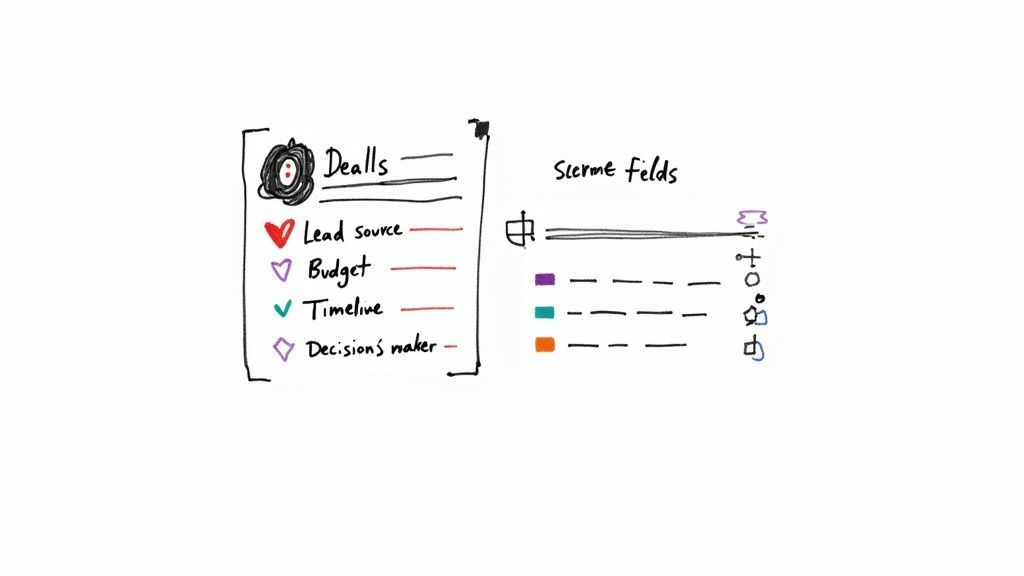
A sales pipeline without data is just a wish list. The real power comes from the information you collect at each step, turning a simple task manager into a tool that can actually forecast revenue and qualify leads.
Think of it this way: your pipeline stages are the skeleton. The data you capture is the muscle that moves deals forward. If you're only collecting a name and an email, you’re flying blind. You need more to understand a deal’s health and point your team toward the real opportunities.
Moving Beyond Basic Contact Details
To make smart decisions, you need context. Just knowing who a prospect is isn’t enough. You need to understand their situation, their challenges, and their intent. This is where you start identifying the specific fields that signal a real opportunity versus a dead end.
Here are the absolute essentials you should be capturing early on:
- Lead Source: Where did this lead come from? Knowing this helps you double down on your most profitable channels.
- Company Size & Industry: Does this prospect even fit your Ideal Customer Profile (ICP)? This is a basic but critical first filter.
- Pain Point: What specific problem are they actually trying to solve? If you don't know this, you can't position your solution.
- Primary Contact Role: Are you talking to an intern or the VP of Sales? Getting to the decision-maker is everything.
These details are the raw material you need to figure out if a lead is worth pursuing. They’re the foundation for any real qualification.
Adopting a Qualification Framework
Once you have the basics, a structured framework helps your team ask the right questions consistently. It brings discipline to the discovery process and ensures nothing critical gets missed. Frameworks like BANT or MEDDIC give you a reliable structure for this.
Let's use BANT as a quick example:
- Budget: Do they have money set aside for this?
- Authority: Is your contact the person who can actually sign the check?
- Need: Is their pain point a burning, high-priority issue for the business?
- Timeline: When are they looking to get a solution in place?
The goal isn't to create busywork for your reps. It's about finding the sweet spot—capturing just enough information to qualify deals accurately without making your CRM a chore to use. Too many fields create friction; too few leave you with massive blind spots.
This structured approach is becoming less of an option and more of a necessity. In fact, it’s predicted that by 2025, 60% of B2B sales organizations will shift to a data-driven selling approach, leading to a 30% higher ROI. You can dig into more insights on how data is reshaping sales management for modern teams.
Implementing Simple Lead Scoring
Let’s be honest: not all leads are created equal. Lead scoring is a straightforward way to help reps focus their time on the deals most likely to close. You just assign points to leads based on the data you’ve collected.
For example, a VP of Sales from a 500-person tech company who requested a demo (a high-intent action) might get a score of 95. Meanwhile, a marketing intern from a 10-person agency who downloaded an ebook might score a 20.
This simple system makes prioritization almost automatic. Your team always knows which leads are hot, helping you optimize your entire sales pipeline format.
Measuring Pipeline Health with the Right KPIs
A well-designed sales pipeline isn't just a roadmap—it’s a predictive engine. But without the right metrics, you’re just guessing. To really know if your process is working, you need to track a handful of key performance indicators (KPIs) that tell you the honest truth about the health and efficiency of your sales motion.
These numbers tell a story. They show you exactly where deals are getting stuck, why you're losing opportunities, and how long it really takes to close a deal. By keeping a close eye on them, you can shift from just reacting to problems to proactively fine-tuning your process for consistent growth.
Core Metrics Every Sales Team Must Track
To get a clear picture of your pipeline's performance, you have to start with the fundamentals. These four KPIs provide a complete snapshot of how your sales engine is running and are the building blocks of a truly data-driven sales pipeline format.
- Win Rate: This is the bottom line—what percentage of deals do you actually close? A low win rate can point to problems with your qualification process, a weak value proposition, or even intense competitive pressure.
- Average Deal Size: Knowing the typical value of a closed-won deal is absolutely essential for accurate revenue forecasting. If your average deal size is shrinking, it could mean your reps are discounting too aggressively or you're starting to target smaller accounts.
- Sales Cycle Length: This measures the average time it takes for an opportunity to move from that very first stage all the way to closed-won. A sales cycle that's getting longer is often a sign of new bottlenecks or friction in your process that need immediate attention.
- Sales Velocity: This powerful metric combines the other three to show you how quickly revenue is moving through your pipeline. It’s the ultimate measure of your pipeline's momentum. You can even use a sales pipeline calculator to get a quick read on how fast your deals are closing.
Interpreting Your KPIs to Find Bottlenecks
Just tracking these numbers is only half the battle. The real magic happens when you start interpreting them to diagnose the hidden issues within your sales pipeline format. Think of your KPIs as a health checkup for your entire sales process.
For instance, if you see a sharp drop-off in conversions between your 'Proposal Sent' and 'Negotiation' stages, that's a massive red flag. This specific data point tells you the problem probably isn't the quality of your leads; it’s something happening late in the game. Maybe your pricing is off, your proposals aren't compelling enough, or your reps are struggling to handle objections effectively.
Your sales pipeline KPIs aren't just report card grades—they are diagnostic tools. A low win rate isn’t a failure; it’s a signal to investigate your qualification criteria. A long sales cycle isn’t a weakness; it’s an opportunity to find and remove friction in the buyer's journey.
This level of insight is what separates modern sales operations from the rest. In fact, structured sales pipelines have been shown to improve forecast accuracy by over 50%, simply by providing clearer visibility into funnel performance. While the average sales close rate hovers around 20%, sales cycles have also lengthened by roughly 24% in recent years, making efficient pipeline management more critical than ever. You can learn more about the trends shaping sales pipeline metrics and see how you stack up.
By digging into your stage-to-stage conversions, you can pinpoint exactly where deals are stalling and take targeted action to fix the root cause, not just the symptoms.
Essential Sales Pipeline KPIs
Here’s a quick breakdown of the most important metrics for measuring the health and performance of your sales pipeline.
| KPI | What It Measures | Why It Matters |
|---|---|---|
| Win Rate | The percentage of total opportunities that result in a closed-won deal. | Reveals the overall effectiveness of your sales process and the quality of your leads. |
| Average Deal Size | The average revenue value of your closed-won deals over a specific period. | Crucial for revenue forecasting and understanding which customer segments are most profitable. |
| Sales Cycle Length | The average time it takes for a lead to move from initial contact to a closed deal. | Helps identify bottlenecks and inefficiencies in your sales process. |
| Sales Velocity | How quickly deals are moving through your pipeline and generating revenue. | A comprehensive health score that combines deal size, win rate, and sales cycle length. |
| Conversion Rate | The percentage of deals that advance from one stage to the next. | Pinpoints specific stages where deals are stalling or being lost, allowing for targeted coaching. |
| Pipeline Coverage | The ratio of your open pipeline value to your sales quota for a given period. | Indicates whether you have enough opportunities in the pipeline to hit your revenue targets. |
Tracking these KPIs isn't just about creating reports; it's about asking the right questions. A dip in one metric can often explain a problem in another, giving you a complete picture of what's really happening on the front lines.
Bringing Your Pipeline to Life in Your CRM
A well-designed sales pipeline format is just a theory until it’s plugged into your daily workflow. The real magic happens when you translate that strategic framework into a functional, automated system inside your Customer Relationship Management (CRM) platform. This is where your pipeline stops being a document and starts being a living, breathing tool that helps your team sell.
First things first: map the custom stages you defined directly into your CRM. Whether your CRM calls it a "Deal" or an "Opportunity," you need to create a one-to-one match for each stage, from “Lead In” to “Closed Won.” This alignment is non-negotiable—it ensures your CRM is the single source of truth for everyone.
Next up is configuring the data fields required at each stage. Based on the qualification criteria you already set, you'll want to add fields like "Budget Confirmed," "Decision-Maker Identified," or "Timeline Approved." Most CRMs let you make certain fields mandatory before a deal can be moved forward, which is a great way to enforce data discipline and make sure reps capture vital info. If you're new to this, a good primer on how to use CRMs effectively can give you a solid foundation.
The Power of Automation in Your Pipeline
Manually updating fields, sending follow-up reminders, and dragging deals across stages are time sucks. They pull your reps away from the one thing they should be doing: selling. This is where automation becomes your pipeline's best friend. With a few simple workflow rules, you can kill repetitive tasks, cut down on human error, and speed up your entire sales cycle.
This isn’t just a nice-to-have. A recent survey from Salesloft found that 46.5% of sellers feel bogged down by too much manual work. This admin burden is a key reason why 39.6% say their pipelines are weaker now than last year, forcing them to spend 76.2% of their effort on personalization just to stand out. Smart tech is the only way to manage bigger targets with the same (or fewer) resources.
Here are a few automation ideas you can set up today:
- Task Creation: When a rep sends a proposal, automatically create a "Follow-Up" task for them three days later. No more deals falling through the cracks.
- Stage Advancement: A prospect books a meeting through a scheduling link? The system can automatically move the deal from "Qualification" to "Meeting/Demo."
- Data Enrichment: Use tools that automatically pull in company and contact details when a new lead is created. This saves reps from endless, mind-numbing data entry.
Visualizing Your Pipeline Health
Once your pipeline is live and humming in your CRM, the final piece is building dashboards to see your key metrics in real time. A good dashboard gives you an instant, at-a-glance view of your pipeline's health. You can spot trends, identify bottlenecks, and make data-driven calls without digging through messy spreadsheets.
This infographic breaks down three core metrics you should be watching like a hawk.
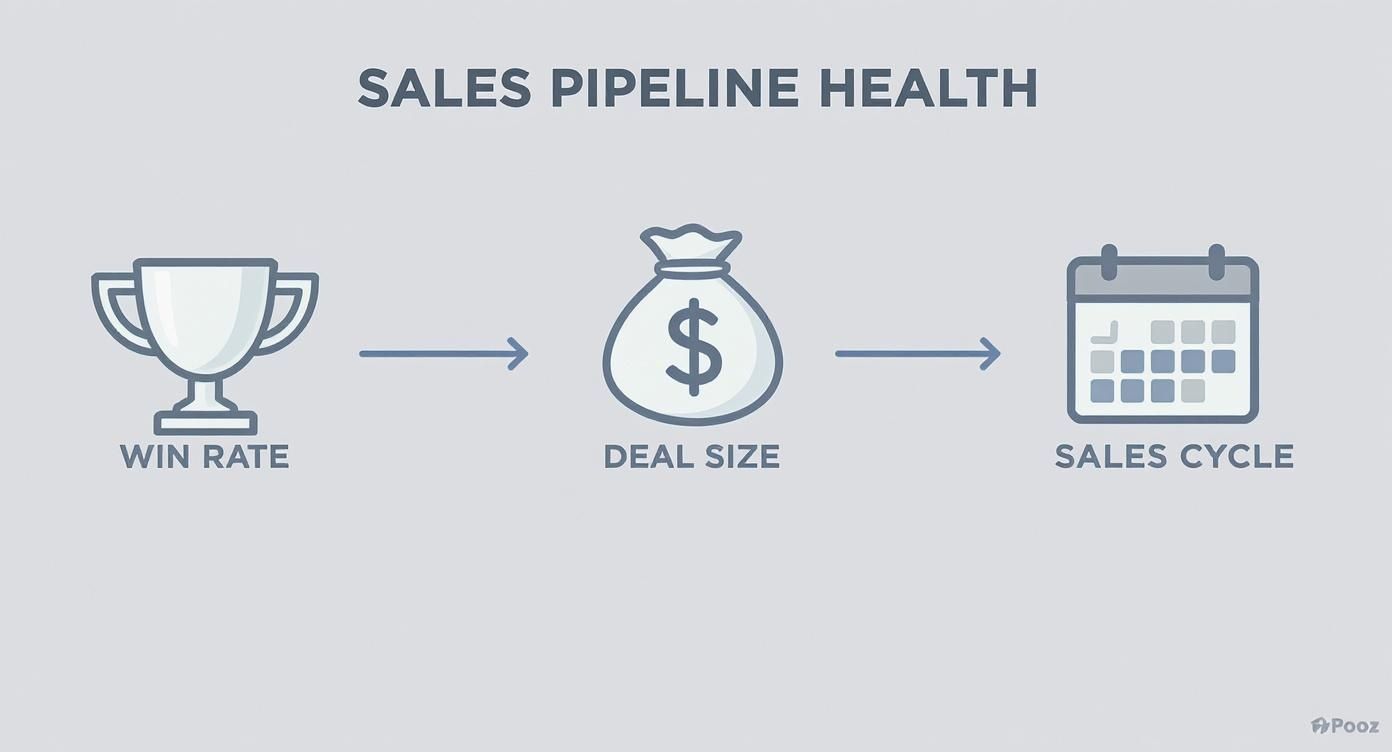
These three—win rate, average deal size, and sales cycle length—give you a clear, actionable picture of how your team is performing.
You’ll want to set up dashboard widgets to track your most important KPIs, like:
- Deals by Stage: A classic funnel view showing the number of deals and total value at each stage.
- Win Rate Over Time: A line chart that tracks your close rate month-over-month.
- Sales Cycle Length: A bar chart showing the average time it takes to close a deal.
A CRM shouldn’t just be a database; it should be your sales team's co-pilot. By automating administrative tasks and visualizing key data, you empower your reps to focus on building relationships and closing deals, turning your sales pipeline format from a static document into a dynamic revenue engine.
Works with 29+ CRMs
Add to CRM finds verified emails, phone numbers, and job titles on LinkedIn® — then adds them to your CRM in one click.
Start Free TrialTrusted by 2,500+ users4.7Common Questions About Sales Pipeline Formats
Even with a perfectly mapped-out process, questions always pop up when you're in the weeds, trying to get your sales pipeline format just right. Let's tackle some of the most common ones I hear from teams.
Getting these details sorted out can make a world of difference for everything from team adoption to the accuracy of your sales forecasts.
How Many Stages Should a Sales Pipeline Have?
This is the big one. While there's no single magic number, the sweet spot for most B2B sales pipelines is somewhere between 5 and 8 stages.
It's a balancing act. Go with fewer than five, and you're probably oversimplifying things. This leads to wildly inaccurate forecasting because you can't see where deals are really getting stuck. A deal in "Proposal Sent" could be worlds apart from one in "Discovery."
But if you stretch it past eight stages, you're just creating busywork. The pipeline becomes a complex beast that reps will dread updating. The goal is to create stages that mark clear, verifiable milestones in your customer's buying journey—each one demanding a specific action from your team to push the deal forward.
What Is the Difference Between a Sales Pipeline and a Sales Funnel?
This question comes up all the time, and it's a crucial distinction.
A sales pipeline is all about the specific actions your sales team takes to move a deal from A to Z. It’s built from the seller's point of view and tracks the qualified deals your reps are actively working on right now.
A sales funnel, on the other hand, represents the customer's journey. It’s a broader, marketing-centric concept that visualizes the path from initial awareness all the way to a final purchase. Think of it like this: thousands of leads might pour into the top of the funnel, but only a tiny fraction will ever become qualified opportunities in the pipeline.
How Often Should I Review My Sales Pipeline Format?
Your pipeline should be a living, breathing document—not something you set in stone and forget about. A good rhythm is to review it quarterly, or at least twice a year.
Your business doesn't stand still, so your pipeline shouldn't either.
Your pipeline format is a direct reflection of your sales motion. As your strategy, market, or product evolves, your pipeline must evolve with it to remain an effective and relevant tool for your team.
Key triggers for a review? A big shift in your sales process, a new product launch, or breaking into a new market. But most importantly, if you start seeing deals consistently pile up and stall in one particular stage, that’s your red flag. It’s a clear signal that the stage itself—or its exit criteria—needs a hard look.
Tired of manually entering prospect data from professional networking sites into your CRM? Add to CRM eliminates copy-paste by turning any profile into a clean CRM record in one click, saving your team hours every week. Start saving time today.
Start saving time and closing more deals.
Find verified contact info for your prospects on LinkedIn®, Gmail and Outlook — and add them to your CRM with 1-click.

 Loading...Trusted by 2,500+ founders, SDRs & more