Top 10 Sales Prospecting Best Practices for 2026
Discover 10 actionable sales prospecting best practices. Learn how to refine your outreach, improve data hygiene, and convert more leads in 2026.
Prospecting is no longer just a numbers game. In an era of informed buyers and crowded inboxes, generic outreach falls flat. Success now hinges on a strategic, data-driven, and multi-channel approach that prioritizes relevance over volume. This guide cuts through the noise to deliver ten essential sales prospecting best practices tailored for the modern sales landscape.
This listicle is built for founders, SDRs, AEs, and RevOps teams who need to build a more predictable pipeline and convert high-value leads with precision. We will provide actionable strategies, not abstract theories. You will learn how to leverage intent data from social platforms, structure effective multi-channel outreach sequences, and maintain pristine CRM hygiene to prevent costly data decay.
We’ll explore how to enrich lead data for hyper-personalization, define and target your Ideal Customer Profile (ICP) with accuracy, and use smart automation to save hours of manual work. For instance, we will cover how tools like Add to CRM can streamline prospect creation and enrichment while eliminating duplicates directly from your browser. Each best practice is designed to be implemented immediately, helping your team spend more time selling and less time on repetitive administrative tasks. This comprehensive roundup provides the framework you need to refine your process, improve efficiency, and ultimately, drive more revenue.
1. Leverage Professional Networks for Intent-Based Prospecting
Professional networking sites have evolved beyond a simple professional networking site into a powerful engine for intent-based sales prospecting. Instead of cold outreach, this practice focuses on identifying prospects who are actively demonstrating buying signals through their digital behavior. These signals include job changes, company news, content engagement, and connection patterns, allowing you to prioritize outreach to high-probability leads who are already warm.
This approach transforms prospecting from a numbers game into a strategic, intelligence-led process. By monitoring these activities, you can time your outreach perfectly, entering the conversation when a prospect is most likely to be receptive to a new solution.
How to Implement Intent-Based Prospecting on Professional Networks
Effective implementation requires a systematic approach to monitoring and engaging with prospects.
Track Key Buying Signals: Set up alerts or regular checks for specific triggers. For example, an SDR could monitor target accounts for new hires in decision-making roles (e.g., "VP of Marketing"), as new leaders are often looking to make an impact with new tools. Similarly, tracking who engages with your company's or a competitor's thought leadership content can reveal individuals actively researching solutions in your space.
Personalize Outreach Based on Activity: Generic connection requests are easily ignored. Reference a specific, recent activity in your outreach. A message like, “Hi [Name], I saw your company just announced its Series B funding - congratulations! My team helps rapidly scaling companies like yours manage their data infrastructure. Would you be open to a brief chat?” is far more effective than a generic pitch.
Pro-Tip: Building a consistent content schedule on professional networks establishes your credibility before you even send a connection request. When prospects see you as a knowledgeable resource, they are more likely to accept and engage.
- Integrate with Your CRM for Efficiency: Manually transferring prospect data from a professional network to your CRM is a major time sink and a source of errors. A tool like Add to CRM allows you to instantly create new contacts, enrich their profiles with verified data (achieving 95%+ email accuracy), and check for duplicates directly from a professional network profile. This eliminates manual copy-pasting and ensures your CRM remains a clean, reliable source of truth.
Combining powerful platform features with smart automation is one of the most effective sales prospecting best practices today. To dive deeper into refining your search process, explore our complete guide on using LinkedIn's advanced search capabilities.
2. Implement Multi-Channel Outreach Sequences
Relying on a single channel for outreach, like email, significantly limits your chances of connecting with a prospect. A multi-channel outreach sequence coordinates touchpoints across professional networks, email, phone, and social media to create a persistent, yet professional, presence. This approach acknowledges that different prospects prefer different communication methods and that it often takes multiple interactions to break through the noise.
This strategy boosts contact and response rates by surrounding the prospect in a way that feels helpful, not harassing. A well-orchestrated sequence ensures your message is seen and considered, increasing the probability of engagement by meeting buyers where they are most active.
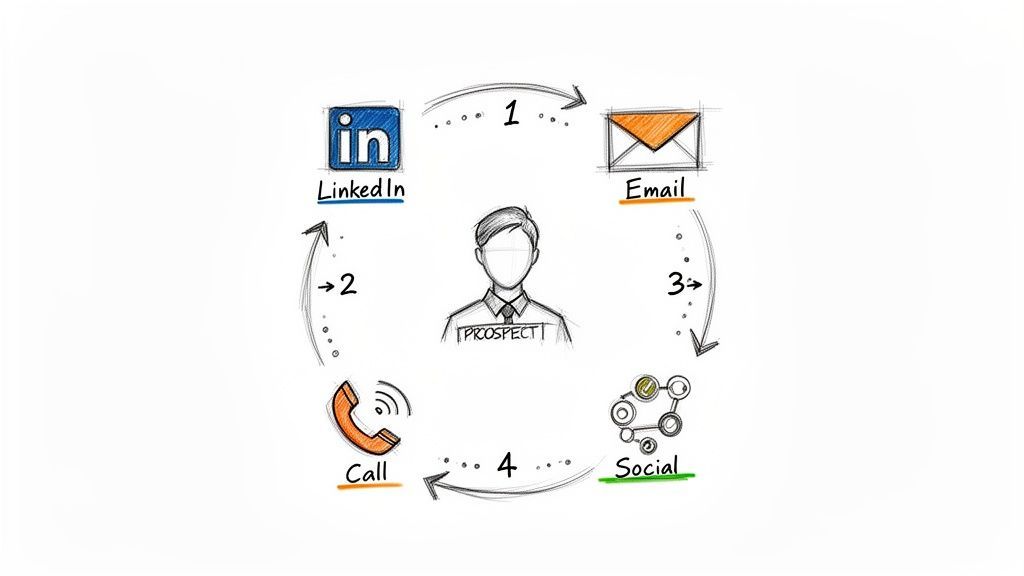
How to Implement a Multi-Channel Outreach Sequence
A successful multi-channel strategy requires careful planning and coordination to deliver a cohesive narrative across all touchpoints.
Design a Logical Flow: Map out your sequence with specific actions and timing. For example: Day 1: Connection request on a professional network with a personalized note. Day 2: Email with a clear value proposition. Day 4: Comment on a prospect’s post on a professional network. Day 6: Follow-up email or a targeted phone call. Each step should build upon the last.
Maintain a Consistent Narrative: While the message should be adapted for each channel, the core value proposition must remain consistent. A phone call should reference the email you sent, and a message on a professional network can allude to a shared connection or interest. This creates a unified and memorable brand experience for the prospect.
Pro-Tip: Use a prospect's initial engagement as a trigger for your next action. If they accept your connection request, follow up with an email sooner. If they open an email but don't reply, a gentle nudge on another channel might be the key to starting a conversation.
- Centralize Data for Seamless Execution: Managing multiple channels is impossible if your data is siloed. When you find a prospect on a professional network, you need their email and phone number readily available in your CRM to execute the sequence. A tool like Add to CRM is critical here; it instantly captures the contact, enriches the profile with verified contact details, and logs it in your CRM. This ensures your sales engagement platform has the accurate data needed to run automated, multi-channel campaigns without manual data entry.
This type of coordinated outreach is one of the most powerful sales prospecting best practices because it respects the prospect's time and preferences while maximizing your visibility.
3. Utilize Data Enrichment for Targeted Prospecting
Prospecting with incomplete or outdated information leads to wasted effort and generic outreach. Data enrichment solves this by appending missing details to your prospect and company records, transforming a basic contact list into a strategic asset. This practice involves layering in crucial data points like role, seniority, company revenue, tech stack, and recent funding events to build a comprehensive view of your ideal customer.
This intelligence-driven approach ensures your outreach is precisely targeted and highly relevant. Instead of guessing, you can segment your market with confidence, prioritize high-value accounts, and personalize messaging based on verified, accurate data. This is one of the most fundamental sales prospecting best practices for modern RevOps and sales teams.
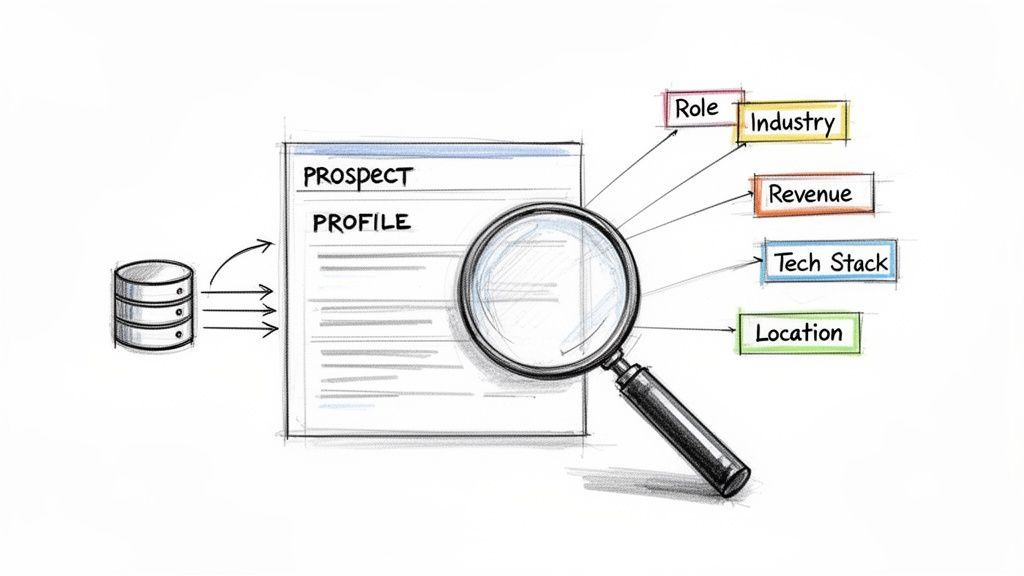
How to Implement Data Enrichment in Your Prospecting Workflow
A systematic data enrichment process ensures every outreach effort is built on a foundation of solid intelligence.
Define Your Ideal Customer Profile (ICP) Data Points: Identify the key attributes that define a high-value prospect. For example, a RevOps team could build a priority segment of companies with $10M-$100M in annual revenue that recently received Series B funding. An SDR might filter for companies that use a specific technology (e.g., Salesforce or HubSpot) to qualify fit instantly.
Automate Data Population and Verification: Manual data entry is slow and prone to errors. Use an enrichment tool to automatically populate prospect profiles with critical information. For instance, you can use seniority and role data to route leads to the appropriate account executive based on their experience with C-level buyers versus managers. Email verification is also crucial to reduce bounce rates and protect your sender reputation.
Pro-Tip: Don't treat enrichment as a one-time event. Schedule quarterly data refreshes for your key accounts and contacts to account for job changes, company growth, and new technology adoption. Accurate, up-to-date data is a competitive advantage.
- Map Enriched Data Directly to Your CRM: The true power of enrichment is realized when data flows seamlessly into your CRM. A tool like Add to CRM enriches profiles with 20+ data points and allows for custom field mapping, ensuring that intelligence like company size, industry, or tech stack is automatically populated in the correct fields in your CRM. This creates powerful, actionable segments for targeted campaigns without manual data cleanup.
4. CRM Integration, Hygiene, and Duplicate Detection
Prospecting efforts can quickly create a messy CRM, filled with outdated information, duplicate records, and incomplete profiles. This not only wastes time but also leads to embarrassing mistakes like multiple reps contacting the same person. Effective sales prospecting best practices require a disciplined approach to CRM integration, data hygiene, and duplicate detection, ensuring your system remains a reliable source of truth.
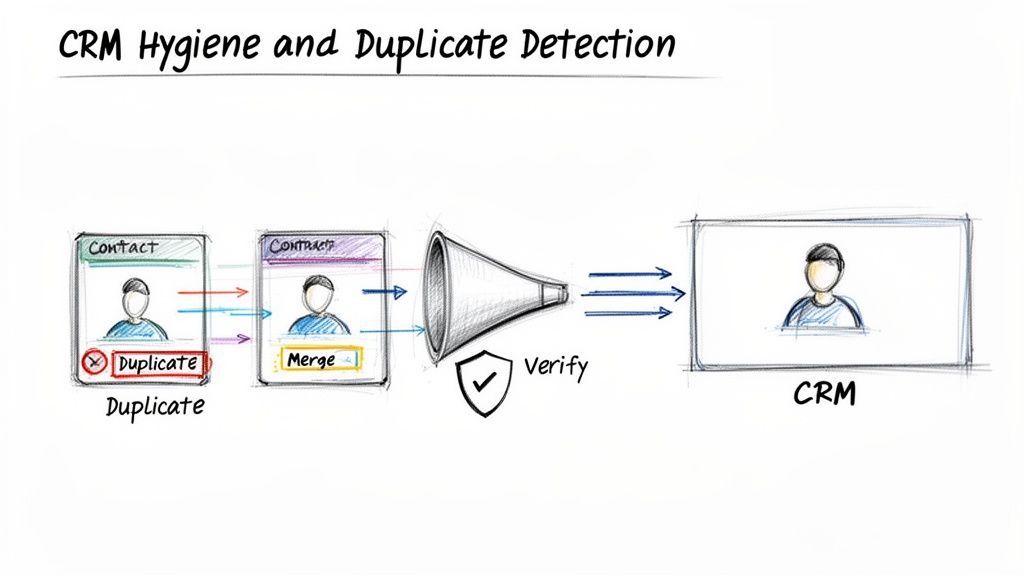
This practice transforms your CRM from a cluttered data graveyard into a strategic asset. By establishing a clean, automated flow of information from prospecting tools into your CRM, you eliminate manual data entry errors and ensure every team member has a complete, accurate view of every prospect and customer interaction.
How to Implement Proactive CRM Hygiene and Integration
A clean CRM starts with preventing bad data from ever entering it. This requires a combination of smart tooling and clear processes.
Automate Prospect Creation and Enrichment: Manually creating contacts is slow and prone to error. SDRs can use a tool like Add to CRM to convert professional network profiles directly into Salesforce or HubSpot records in a single click. This instantly captures key data points like email, phone, title, and company, while simultaneously enriching the record with verified information.
Implement Point-of-Entry Duplicate Detection: The best way to manage duplicates is to stop them before they are created. When a sales rep adds a new prospect, their system should automatically check for existing records. For instance, Add to CRM flags potential duplicates directly on a professional network profile, allowing reps to update an existing contact rather than creating a new one, thereby preserving valuable activity history.
Pro-Tip: Document your standard data entry procedures and field-mapping rules. A clear guide on how to name accounts and what information is mandatory ensures consistency across the entire team, making duplicate detection and data management far more effective.
- Establish a Regular Data Auditing Cadence: Even with the best prevention, some issues may slip through. Schedule regular audits (monthly or quarterly) to review data quality, check for integration errors, and merge any duplicates that have been created. This proactive maintenance keeps your CRM healthy and ensures your reporting is accurate.
By combining seamless integration with robust hygiene protocols, you create a reliable foundation for all your sales and marketing activities. To tackle existing issues, you can learn more about how to effectively merge duplicate records in your CRM.
5. Focus on Ideal Customer Profile (ICP) Definition and Targeting
Targeting everyone is targeting no one. A well-defined Ideal Customer Profile (ICP) is the foundation of efficient and effective sales prospecting, shifting your focus from quantity to quality. An ICP is a data-driven description of the perfect-fit customer who gains the most value from your product and provides significant value back to your business, resulting in higher conversion rates, shorter sales cycles, and better retention.
This strategic approach moves prospecting away from a scattergun method and towards a precision-led exercise. By deeply understanding the firmographics (e.g., industry, company size), technographics (tech stack), and psychographics (goals, challenges) of your best customers, you can concentrate all your outreach efforts on high-probability accounts that mirror their success.
How to Implement ICP-Driven Targeting
Building and applying an ICP requires a collaborative, data-first approach that is regularly reviewed and refined.
Define Your ICP Collaboratively: Your ICP shouldn't be created in a silo. Assemble a team from sales, marketing, and customer success to analyze your best historical customers. Look for common threads in company size, industry, revenue, and technology stack. For example, a B2B SaaS company might find its sweet spot is mid-market tech companies ($20M-$200M revenue) using Salesforce and experiencing high growth.
Identify and Prioritize Buying Triggers: Go beyond static firmographics by identifying events that signal a prospect is ready to buy. A financial services firm might prioritize targeting companies that recently received a new round of funding or were just acquired. These triggers create a compelling reason to reach out at the perfect moment.
Pro-Tip: Document not just your ideal profile, but also your anti-profile. Clearly defining the characteristics of companies that are a poor fit (e.g., those that churn quickly or have low product usage) is just as critical for saving your team’s time and resources.
- Operationalize Your ICP with Accurate Data: An ICP is only useful if you can apply it. Use your defined criteria as filters in your sales tools and on professional networks to build targeted prospect lists. When you find a potential fit on a professional network, a tool like Add to CRM can instantly enrich the record with verified data, helping you confirm if the company meets your ICP criteria for revenue, employee count, and more. This eliminates guesswork and ensures you're only spending time on genuinely high-fit prospects.
By grounding your outreach in a well-researched ICP, you ensure every prospecting activity is strategically aligned, making it one of the most impactful sales prospecting best practices.

Find verified contact data on LinkedIn®
Add to CRM finds verified emails, phone numbers, and job titles on LinkedIn® — then adds them to your CRM in one click.
Start Free Trial


 Trusted by 2,500+ users4.7
6. Use Email Verification and Compliance for Better Deliverability
Sending emails that land in spam folders or bounce back is a quick way to derail any outbound campaign. Effective sales prospecting best practices prioritize deliverability by combining rigorous email verification with strict adherence to anti-spam regulations like GDPR and CAN-SPAM. This protects your sender reputation, ensuring your carefully crafted messages actually reach their intended inboxes.
This dual focus on data accuracy and legal compliance is non-negotiable in modern sales. A clean email list dramatically reduces bounce rates, improves engagement metrics, and prevents your domain from being blacklisted by email providers. Teams that bake this into their workflow see sustained campaign performance and avoid costly legal penalties.
How to Implement Email Verification and Compliance
A systematic approach ensures your outreach is both deliverable and compliant, protecting your brand and improving results.
Verify Emails Before Every Campaign: Never assume an email address is valid, even if it looks correct. High bounce rates are a primary signal to email providers that you are a spammer. An SDR who consistently uses verified lists can see a 2-3% improvement in deliverability, directly impacting open rates and potential replies.
Maintain Strict Compliance: Understand and follow the rules for the regions you target. This includes providing a clear unsubscribe link in every email, honoring opt-out requests promptly, and including your physical mailing address. For prospects in Europe, maintaining records of consent is crucial for avoiding significant GDPR fines.
Pro-Tip: Make sender authentication a priority. Setting up SPF, DKIM, and DMARC records for your domain is a technical but essential step. These protocols prove to receiving email servers that your messages are legitimate, significantly boosting your chances of landing in the primary inbox.
- Automate Data Verification and Entry: Manually checking each email is inefficient and prone to error. When sourcing prospects from professional networks, a tool like Add to CRM is invaluable. It automatically finds and verifies professional email addresses with 95%+ accuracy as you create contacts, ensuring your CRM is populated with clean, deliverable data from the very start.
By focusing on the quality and compliance of your contact data, you build a sustainable foundation for successful email outreach. To find the right solution for your team, compare the best email verification software and integrate it into your prospecting process.
7. Implement Personalization at Scale with Template Variations
Balancing efficiency with genuine personalization is a core challenge in modern outreach. This practice involves creating a library of standardized email and messaging templates equipped with dynamic fields and designated customization zones. It allows sales reps to maintain high outreach volume without sacrificing the personal touch that captures a prospect's attention and drives responses.
This templated-yet-personalized approach turns a time-consuming task into a streamlined workflow. It ensures that every message is on-brand and effective while empowering SDRs to quickly insert relevant, prospect-specific details like recent company news, shared connections, or observed pain points. It’s one of the most impactful sales prospecting best practices for teams looking to scale effectively.
How to Implement Scalable Personalization
A strategic template library is built on structure, testing, and continuous improvement.
Create a Core Template Library: Start by developing 3-5 foundational templates for your most common outreach scenarios, such as a cold outreach message, a referral-based introduction, and an account-based marketing (ABM) touchpoint. Each template should have clearly marked sections for mandatory personalization. For example, a template might require the SDR to reference a specific post the prospect shared or mention a recent company achievement.
Use Dynamic Fields and Customization Prompts: Your templates should auto-populate standard information like
[First Name]and[Company Name]from your CRM. More importantly, include prompts like[Insert recent company news/accomplishment here]or[Mention shared connection or interest]. This guides the rep to add a unique, human element to every message. For instance: “Hi [Name], I noticed your team at [Company Name] just launched its new AI feature. Integrating new tech often creates challenges around user adoption, which is an area we specialize in.”
Pro-Tip: A/B test your subject lines and opening sentences constantly. Test a problem-focused opener against an achievement-focused one to see which resonates better with a specific buyer persona. Track the results in your sales engagement platform to refine your approach.
- Leverage Enriched Data for Deeper Personalization: Manually finding unique data points for every prospect is unsustainable. Using a tool like Add to CRM enriches contact profiles with verified data points that can be synced directly to your CRM. These custom fields (e.g., company size, industry, funding stage) can then be used to trigger different template variations or populate personalization tokens, ensuring your outreach is always contextually relevant without the manual research.
This structured approach empowers your team to send hundreds of personalized messages a day, not just generic blasts. To further optimize your data strategy, review our guide on maintaining CRM data hygiene.
8. Establish a Structured Prospecting Process with Clear Metrics
Effective prospecting isn’t about random acts of outreach; it’s a systematic, measurable engine for pipeline generation. Establishing a structured and documented process transforms prospecting from an art into a science, creating a repeatable workflow that ensures consistency, scalability, and predictable results. This approach involves defining specific activities, setting clear success metrics, and creating accountability.
By turning prospecting into a well-defined system, you can onboard new reps faster, diagnose performance issues accurately, and continuously optimize your outreach based on hard data. This practice is a cornerstone of high-performing sales organizations and is one of the most critical sales prospecting best practices for achieving scalable growth.
How to Implement a Structured Prospecting Process
Building a repeatable process requires documenting your workflow and defining key performance indicators (KPIs) to track success.
Define and Document the Workflow: Map out every step of your outreach sequence from lead sourcing to qualification. For example, an SDR process might involve a 21-day, 5-touch sequence per prospect: Day 1 (Connection request on a professional network), Day 3 (Email 1), Day 7 (Message on a professional network), Day 14 (Email 2), and Day 21 (Phone Call). This documented cadence ensures every prospect receives a consistent experience.
Set Clear Activity and Conversion Targets: Establish realistic targets based on industry benchmarks and historical performance. An SDR might be tasked with adding 50 new prospects to their sequence weekly, aiming for a 25% positive response rate. An Account Executive might be expected to prospect 10 new target accounts per week with the goal of achieving a 15% meeting conversion rate.
Pro-Tip: Your CRM is the foundation of a structured process. Implement regular (weekly or bi-weekly) reviews of your CRM dashboard to monitor activity metrics and conversion rates. This creates a tight feedback loop for coaching and process refinement.
- Enforce Process Compliance with Tooling: Manual data entry is the biggest threat to process adherence. Tools that simplify CRM updates are essential for maintaining data integrity and ensuring reps follow the established workflow. Using a tool like Add to CRM, reps can capture a lead from a professional network in one click, instantly enriching the record and checking for duplicates. This removes friction, ensures every new prospect enters the CRM correctly, and makes process compliance the path of least resistance.
A structured, data-driven approach is fundamental to building a sales machine that consistently delivers high-quality pipeline.
9. Leverage Account-Based Marketing (ABM) for High-Value Prospect Targeting
Account-Based Marketing (ABM) flips the traditional sales funnel on its head. Instead of casting a wide net to capture individual leads, ABM focuses sales and marketing resources on a predetermined list of high-value target accounts. This strategy treats an entire company as a single market, coordinating all outreach, messaging, and content to engage multiple decision-makers within that account simultaneously.
This hyper-focused approach ensures that marketing campaigns and sales outreach are perfectly aligned, creating a consistent and compelling experience for your most important prospects. By concentrating efforts where they matter most, ABM increases deal size, shortens sales cycles, and improves the overall efficiency of your prospecting efforts.
How to Implement Account-Based Marketing
A successful ABM strategy requires deep alignment between sales and marketing teams and a commitment to personalization at scale.
Define Your Target Account List: Start by identifying your highest-value accounts based on your Ideal Customer Profile (ICP). A B2B firm might create detailed account plans for its top 10 target companies, outlining specific pain points, key stakeholders, and customized messaging for each. This initial list should be manageable, often starting with 50 to 100 top-tier accounts.
Coordinate Multi-Channel Outreach: Your goal is to surround the account with a unified message. A tech company, for example, could run an ABM campaign using targeted ads on professional networks for key stakeholders, personalized direct mail to the C-suite, and coordinated sales calls from their SDR team. Every touchpoint reinforces the same core value proposition.
Pro-Tip: True ABM success comes from tracking engagement at the account level, not just with individual contacts. Monitor how many stakeholders from a target company are engaging with your content, visiting your website, or responding to outreach to gauge overall account interest.
- Build Out the Buying Committee in Your CRM: Identifying and engaging the entire buying committee is critical for complex enterprise sales. Manually finding and adding multiple contacts from one company is slow and prone to creating duplicates. Using a tool like Add to CRM, you can quickly find multiple decision-makers on professional networks, see if they already exist in your CRM, and add them as new, enriched contacts with verified data in a single click. This ensures your sales team has a complete view of the account from day one.
Implementing ABM is one of the most powerful sales prospecting best practices for B2B teams focused on moving upmarket and landing larger, more strategic deals.
Works with 29+ CRMs
Add to CRM finds verified emails, phone numbers, and job titles on LinkedIn® — then adds them to your CRM in one click.
Start Free TrialTrusted by 2,500+ users4.710. Implement a Continuous Learning and Process Improvement Culture
Static prospecting strategies quickly become obsolete in a fast-moving market. The most successful sales organizations treat their prospecting efforts not as a fixed set of tasks, but as a dynamic system that requires constant analysis, testing, and refinement. This involves building a culture where the entire team is dedicated to improving performance based on data and shared learnings.
Adopting this mindset transforms sales prospecting best practices from a static playbook into a living document. It ensures your team adapts to market changes, consistently identifies what truly works, and eliminates ineffective tactics. This data-driven approach fosters innovation and prevents the stagnation that often leads to declining pipeline performance.
How to Implement a Culture of Continuous Improvement
A systematic approach to learning and optimization is key to making this culture a reality.
Establish a Rhythm of Review: Don't wait for quarterly business reviews to analyze performance. Implement weekly team huddles focused on sharing what’s working and what’s not. Discuss top-performing subject lines, successful objection-handling tactics, and high-engagement messaging. This creates a tight feedback loop for rapid iteration.
A/B Test Everything Methodically: Encourage SDRs to systematically test variables in their outreach. For example, test a benefit-led subject line versus a curiosity-driven one for two weeks and measure open and reply rates. Document the results in a shared playbook so the entire team can benefit from the winning approach.
Pro-Tip: True process improvement requires psychological safety. Create an environment where team members feel comfortable sharing failed experiments and "what not to do." These lessons are often just as valuable as the wins.
- Analyze Wins and Losses for Patterns: Conduct monthly win/loss analyses that specifically examine the initial prospecting phase. Did the best deals originate from a particular sequence, value proposition, or channel? Understanding these patterns helps you double down on successful strategies and refine your ideal customer profile and outreach tactics.
By embedding continuous learning into your team's DNA, you build a resilient and highly effective prospecting engine. For more ideas on structuring these reviews, check out this guide on running effective sales team meetings.
10-Point Sales Prospecting Comparison
| Strategy | Implementation complexity | Resource requirements | Expected outcomes | Ideal use cases | Key advantages |
|---|---|---|---|---|---|
| Leverage Professional Networks for Intent-Based Prospecting | Medium — ongoing activity and profile management | Professional network access (often paid), time for engagement, CRM integration | Higher-quality, warmer leads; lower rejection rates | SDRs/BDRs targeting professional buyers, job-change signals | Real-time intent signals and professional context for personalization |
| Implement Multi-Channel Outreach Sequences | High — coordination across channels and sequencing | Outreach tools, phone/email systems, content, automation | Increased contact and response rates; reduced channel dependency | Outbound teams targeting varied preferences or buying committees | Greater reach and multiple touchpoints to capture engagement |
| Utilize Data Enrichment for Targeted Prospecting | Medium — integration and periodic updates | Enrichment provider, CRM mapping, budget per contact | More precise targeting, better lead scoring, higher personalization | RevOps, SDRs, targeted ICP campaigns | Rich, verified data to improve fit and deliverability |
| CRM Integration, Hygiene, and Duplicate Detection | High — initial configuration and cleanup | CRM admin time, integration tools, RevOps support | Cleaner data, fewer duplicate outreaches, better reporting | Organizations scaling sales operations and reporting | Maintains data integrity, saves manual entry time, prevents duplicates |
| Focus on ICP Definition and Targeting | Medium — research and cross-functional alignment | Analytics, historical win/loss data, stakeholder workshops | Higher conversion, shorter cycles, larger deals | Strategy-led GTM, account planning, segmentation efforts | Aligns sales/marketing and concentrates effort on high-fit accounts |
| Use Email Verification and Compliance for Better Deliverability | Low–Medium — processes and tooling | Verification service, compliance workflows, ESP integration | Improved deliverability, lower bounce rates, legal compliance | Email-heavy outreach, EU/regulated markets, cold campaigns | Protects sender reputation and reduces wasted sends |
| Implement Personalization at Scale with Template Variations | Medium — template setup and governance | Template engine, CRM fields, A/B testing tools | Faster outreach with maintained personalization, consistent messaging | High-volume outreach with need for relevance | Balances efficiency with tailored content via dynamic fields |
| Establish Structured Prospecting Process with Clear Metrics | Medium — documentation and tracking | CRM, reporting, training, regular reviews | Consistent, scalable results and measurable KPIs | Sales teams needing repeatable workflows and forecasting | Enables accountability, coaching, and continuous optimization |
| Leverage Account-Based Marketing (ABM) for High-Value Targeting | High — heavy research and coordination | Marketing/sales alignment, specialized content, ABM tools | Higher conversion and deal size, shorter enterprise cycles | Enterprise/mid-market targeting top accounts | Deeply personalized, coordinated account-level engagement |
| Implement Continuous Learning and Process Improvement Culture | Medium — ongoing cadence and experimentation | Time for reviews, A/B testing framework, documentation | Continuous performance gains and faster adaptation | Teams seeking long-term improvement and scalability | Institutionalizes learning, scales best practices and innovation |
Turn Prospecting Best Practices into Repeatable Revenue
Mastering modern B2B sales requires more than just a list of tactics; it demands a strategic, integrated system. Throughout this guide, we've explored the essential components that transform sporadic outreach efforts into a predictable revenue engine. From leveraging social platforms like professional networks for intent-based signals to executing sophisticated multi-channel sequences, the path to prospecting excellence is paved with precision, personalization, and process.
The sales prospecting best practices we've covered are not isolated suggestions but interconnected pillars. A well-defined Ideal Customer Profile (ICP) is the foundation, but its power is only unlocked when combined with robust data enrichment and rigorous CRM hygiene. Without clean, accurate data, even the most brilliantly crafted outreach message will fall on deaf ears or, worse, never reach an inbox.
From Theory to High-Performance Execution
The true challenge lies in bridging the gap between knowing these best practices and consistently executing them. This is where process and technology become your greatest allies. A structured prospecting framework, supported by clear metrics, provides the roadmap, while the right tools act as the vehicle, accelerating your journey.
Key takeaways to implement immediately include:
- Audit Your Foundation: Before launching new campaigns, revisit your ICP and data management protocols. Is your CRM a source of truth or a source of confusion? Implementing automated duplicate detection and enrichment is a non-negotiable first step.
- Systematize Your Outreach: Move away from random acts of prospecting. Build structured, multi-channel sequences that engage prospects across different platforms, ensuring your message is reinforced, not just repeated.
- Embrace Personalization at Scale: Ditch the generic templates. Use data enrichment to fuel hyper-relevant messaging, creating variations of your templates that speak directly to a prospect’s industry, role, or recent activity. This shows you've done your homework and respect their time.
The Compounding Effect of Consistent Prospecting
Ultimately, the goal is to build a sustainable system where each component reinforces the others. Clean CRM data leads to better targeting. Better targeting improves personalization. Enhanced personalization boosts engagement rates. Higher engagement provides clearer performance metrics, which in turn inform process improvements. This virtuous cycle is what separates top-performing sales organizations from the rest.
By fostering a culture of continuous learning and equipping your team with tools that eliminate friction, you move beyond simply doing prospecting. You begin to master it. The initial investment in defining your process, cleaning your data, and implementing the right technology pays compounding dividends in the form of higher conversion rates, shorter sales cycles, and, most importantly, predictable revenue growth. The principles outlined here are your blueprint for building that high-performance sales engine. It’s time to stop chasing leads and start building a system that consistently attracts and converts your ideal customers.
Ready to eliminate manual data entry and supercharge your prospecting workflow? See how Add to CRM can help you implement these sales prospecting best practices by capturing, enriching, and syncing lead data to your CRM in one click. Get started with Add to CRM today and turn your prospecting efforts into a repeatable revenue machine.
Start saving time and closing more deals.
Find verified contact info for your prospects on LinkedIn®, Gmail and Outlook — and add them to your CRM with 1-click.

 Loading...Trusted by 2,500+ founders, SDRs & more