8 Cold Emailing Examples That Actually Get Replies in 2026
Discover 8 proven cold emailing examples with templates, subject lines, and expert breakdowns. Learn to write emails that convert and book more meetings today.
In a crowded inbox, the line between a deleted email and a booked meeting is razor-thin. Most cold outreach fails because it relies on generic, one-size-fits-all templates that ignore the recipient's actual needs. The key to breaking through the noise isn't a magic script but a solid understanding of strategy, psychology, and precise personalization. This guide moves past simple templates to deconstruct the mechanics behind effective cold emailing examples.
We will dissect 8 powerful, field-tested cold email frameworks, revealing the tactical thinking that makes them convert. You won't just see a script; you'll learn the 'why' behind each one. This includes how to pinpoint urgent pain points, use social proof effectively, spark genuine curiosity, and frame your outreach to feel less like a sales pitch and more like a valuable conversation. Each example is a blueprint for action.
Furthermore, we'll connect these strategies to the essential tools of modern outreach: verified contact data and CRM integration. These elements are critical for executing personalized campaigns at scale without sacrificing quality. By mastering the principles behind these high-performing cold emailing examples, you will gain the ability to build your own compelling messages from the ground up, consistently fill your calendar, and drive measurable pipeline growth. Let's examine the emails that get replies.
1. The Problem-Agitate-Solve (PAS) Cold Email Template
The Problem-Agitate-Solve (PAS) framework is a classic copywriting structure that excels in cold email outreach. It works by first identifying a specific pain point, then amplifying the emotional consequences of that problem, and finally presenting your product or service as the clear solution. This approach builds immediate relevance and shows you understand the prospect's world before you ever ask for a meeting.
This method is highly effective because it focuses on empathy first. Instead of leading with your solution, you lead with their problem, which instantly makes the email about them, not you. This is a crucial distinction that separates many good cold emailing examples from the bad ones.
The PAS Framework in Action
Here’s how the structure breaks down in a real-world scenario. Imagine an SDR at HubSpot targeting a VP of Sales at a mid-sized tech company.
- Problem: "Noticed your team is hiring five new SDRs. Scaling a sales team often means CRM data gets messy fast, leading to inaccurate forecasting."
- Agitate: "When reps can't trust the data, they waste hours manually verifying contacts, follow-ups get missed, and good leads slip through the cracks. It makes hitting ambitious revenue targets feel like an uphill battle."
- Solve: "Our CRM automatically enriches contact data and flags duplicates, giving your team a single source of truth. This helps new hires ramp up faster and keeps your pipeline clean. Worth a 15-minute chat to show you how?"
Why It Works & How to Replicate It
The PAS model is powerful because it connects a business problem to a personal or professional frustration. The "agitate" step is where the magic happens; it moves the prospect from logically acknowledging a problem to emotionally feeling its impact.
Actionable Tips for Your PAS Emails:
- Pinpoint a Real Problem: Use verified company insights to identify specific challenges. For example, if a company just received Series B funding, their problem might be scaling operations without sacrificing quality.
- Make the Agitation Specific: Don't just say "it's inefficient." Quantify it. For example, "That means SDRs at a company your size likely spend over 4 hours a week on manual data entry instead of selling."
- Keep Your Solution Concise: The solve section should be a direct, clear answer to the agitated problem. Avoid listing every feature; focus on the outcome.
Key Insight: The goal of a PAS email isn't to sell your product on the spot. It's to prove you understand the prospect's pain so well that they become curious about your solution. Strong problem-framing is essential for deliverability too, as it reduces the chance of being marked as spam. For more on this, learn how to improve email deliverability and ensure your messages land.
2. The Curiosity Gap Cold Email Template
This template leverages psychological curiosity by opening with an intriguing statement or question that doesn’t immediately reveal the pitch. The email strategically withholds information to compel the reader to engage, exploiting the human need for closure. It piques interest first, earning you the attention needed to present your value proposition.
This method is effective because it disrupts the pattern of a typical sales email. Instead of leading with a direct pitch that can be easily dismissed, it creates an "open loop" in the prospect's mind, making them want to read on to find the answer. This approach is one of the more creative cold emailing examples that can break through a crowded inbox.
The Curiosity Gap in Action
Here’s how the structure works. Imagine a BDR at a competitive intelligence platform targeting a Director of Product Marketing.
- Intriguing Observation (Subject): "Your latest feature release"
- Curiosity Hook: "I saw you just launched the new analytics dashboard. Quick question: are you tracking how competitors like [Competitor Name] are positioning against it in their sales decks?"
- Credible Pivot: "Most product marketers we work with struggle to get this intel. We provide real-time tracking of competitors' sales collateral, so your team can counter their messaging on day one."
- Call-to-Action: "Happy to share the current deck [Competitor Name]'s reps are using. Worth a look?"
Why It Works & How to Replicate It
The Curiosity Gap model works because it feels less like a sales pitch and more like insider information. The hook must be relevant and specific to their business context to be effective; generic clickbait will backfire and damage your credibility. The key is to create a genuine information gap that your solution can fill.
Actionable Tips for Your Curiosity Emails:
- Use Specific Triggers: Base your hook on verified company data, like recent funding, new executive hires, or a major product launch. A hook like "Noticed you just hired 5 new SDRs" feels personal and timely.
- Balance Intrigue with Clarity: The body of your email must quickly connect the curiosity hook to a clear, credible value proposition. If the recipient feels tricked, they will ignore or block you.
- Deliver on the Promise: Your call-to-action should directly satisfy the curiosity you created. If you offer to share intel, be prepared to do so. This builds trust for a future conversation.
Key Insight: The goal of a curiosity-driven email is to start a conversation, not to close a deal. By providing a small piece of value or a compelling piece of information, you earn the right to ask for a few minutes of their time. The initial curiosity simply opens the door.
3. The Social Proof Cold Email Template
The Social Proof Cold Email Template works by building immediate trust and reducing a prospect's natural skepticism. It references familiar client names, impressive case study results, or industry recognition to show that your solution is already vetted and valued by others. This strategy taps into the psychological principle that people are more likely to adopt a solution if they see others, especially their peers, are already doing so successfully.
This approach is powerful because it shifts the conversation from a speculative pitch to a proven outcome. Instead of just describing what you can do, you’re showing what you have done for companies the prospect knows and respects. This makes your message one of the most compelling cold emailing examples for cutting through the noise.
The Social Proof Framework in Action
Here’s how the structure breaks down. Imagine a BDR at a logistics software company targeting a Supply Chain Director at a growing e-commerce brand.
- Open with Recognizable Names: "We helped e-commerce leaders like Allbirds and Warby Parker reduce their shipping costs by an average of 18% last year."
- Connect to Their Role: "As you prepare for the Q4 holiday rush, I imagine optimizing your fulfillment budget without sacrificing delivery speed is a top priority."
- Present a Quantified Solution: "Our platform integrates directly with your existing systems to find these savings automatically. Many of our clients reallocate that 18% savings toward customer acquisition. Would a 15-minute call to show you how they do it be useful?"
Why It Works & How to Replicate It
Social proof is effective because it shortcuts the trust-building process. Seeing that competitors or admired brands have already achieved success with your product creates a sense of FOMO (Fear Of Missing Out) and establishes credibility from the first sentence.
Actionable Tips for Your Social Proof Emails:
- Segment Your Proof: Don't send a Fortune 500 case study to a startup. Match the social proof to the prospect’s company size, industry, and role. A startup founder cares more about how you helped another startup scale.
- Quantify Everything: "Reduced costs by 18%" is much more powerful than "helped reduce costs." Specific, measurable results make your claims believable and impactful.
- Name-Drop Competitors (Carefully): Mentioning a direct competitor can be a very effective hook. A simple line like, "Saw that [Competitor Name] is a customer and thought you might be interested in the results they're seeing," can be enough to get a reply.
Key Insight: The best social proof feels highly relevant and almost personal. It’s not just about listing big logos; it’s about showing the prospect a reflection of their own potential success through the lens of a company they understand and relate to.
4. The Value-First Cold Email Template
The Value-First framework flips the traditional sales script by leading with immediate, tangible value before asking for anything in return. Instead of pitching a product, you provide a helpful tip, a relevant resource, or a strategic insight that genuinely benefits the prospect. This approach builds trust and positions you as a helpful expert, not just another salesperson.
This method is effective because it’s rooted in the principle of reciprocity. By offering value upfront without any strings attached, you create goodwill and make the prospect more receptive to a future conversation. It's a powerful way to stand out in a crowded inbox and is one of the most respected cold emailing examples for building long-term relationships.
The Value-First Framework in Action
Here’s how you can apply this structure. Imagine a marketing consultant reaching out to a Head of Content at a fast-growing SaaS company.
- Offer Specific Value: "I saw your team is focusing on organic growth this quarter. I analyzed your top three SERP competitors and found a content gap around 'AI-powered workflow automation' they are all missing. A targeted article here could capture significant traffic."
- Provide Proof (Optional but Recommended): "We used a similar 'content gap' strategy for a client in a related space, and it drove a 45% increase in their organic sign-ups in 90 days."
- Low-Friction Ask (or No Ask): "No need to reply, just thought this insight might be useful for your content planning. If you’re curious about the other gaps I found, I'm happy to share."
Why It Works & How to Replicate It
The Value-First email works because it shifts the entire dynamic from a transaction to a consultation. You’re not trying to take something (their time); you're giving something (your expertise). This instantly lowers the prospect's guard and demonstrates your competence.
Actionable Tips for Your Value-First Emails:
- Identify Relevant Value: Use company news, recent articles, or professional network activity to pinpoint what the prospect cares about right now. Is their company hiring? Offer a tip on attracting talent. Did they just publish a report? Share a relevant statistic they missed.
- Be Specific and Actionable: Vague advice like "I have some ideas to improve your SEO" is a sales pitch. Specific advice like "Adding internal links from your high-authority blog posts to your new pricing page could boost its ranking" is genuine value.
- Delay the Pitch: The goal of the first email is to be helpful. Save any mention of your product or a meeting for a follow-up email after you’ve established a connection.
Key Insight: True value is selfless. The more your insight helps the prospect without any immediate benefit to you, the more memorable and effective your outreach will be. To find the right person to send your value-packed email to, having accurate contact information is crucial; consider exploring the best email finder tools to ensure your message reaches its intended recipient.

Find verified contact data on LinkedIn®
Add to CRM finds verified emails, phone numbers, and job titles on LinkedIn® — then adds them to your CRM in one click.
Start Free Trial


 Trusted by 2,500+ users4.7
5. The Reference or Referral Cold Email Template
Leveraging a mutual connection is the fastest way to turn a cold outreach into a warm introduction. This template works by immediately establishing social proof and trust by mentioning a referrer. By borrowing credibility from a shared contact, you bypass the initial skepticism that often greets unsolicited emails, making the prospect far more receptive to your message.
This technique is powerful because it reframes the entire conversation. Instead of being an unknown sender, you become a recommended contact, which significantly increases open and response rates. These types of cold emailing examples capitalize on the simple human principle that we trust recommendations from people we know.
The Referral Framework in Action
Here’s how this approach plays out. Imagine a BDR at a SaaS company targeting a Head of Marketing, and they share a mutual connection on a professional networking site.
- Reference: "[Mutual Contact's Name] and I were discussing challenges in scaling marketing attribution, and she suggested I reach out to you."
- Context: "She mentioned you're focused on improving ROI measurement for your paid channels and thought you might find our approach interesting."
- Value & CTA: "We helped [Referrer's Company] uncover which channels were truly driving pipeline, saving them over 15% on ad spend. Would you be open to a brief chat next week to see if we could do the same for you?"
Why It Works & How to Replicate It
A referral instantly provides context and relevance. The prospect's first thought isn't "Who is this?" but "How do they know [Mutual Contact]?" This shift in focus is critical for getting your message read and considered. The key is to make the connection genuine and specific.
Actionable Tips for Your Referral Emails:
- Lead with the Name: Place the referrer’s name in the first sentence, or even the subject line (e.g., "Intro from [Referrer's Name]"), to grab attention immediately.
- Connect to a Pain Point: A great referral isn't just a name-drop. It connects the referrer's suggestion to a specific business challenge the prospect is facing. This shows the introduction was thoughtful, not random.
- Build a Referral Culture: Actively ask satisfied clients, partners, and network contacts for introductions. Make it easy for them by providing a short, forwardable blurb about what you do and who you help. Reciprocate by offering introductions from your own network.
Key Insight: The goal of a referral email is to transfer trust from a known source to yourself. Always get permission from your mutual contact before using their name. A "cold" referral where the connection is fabricated or weak will backfire and damage your credibility and your contact's.
6. The Compliment or Achievement-Based Cold Email Template
This approach opens with a genuine, specific compliment or recognition of a prospect's recent achievement. By referencing a promotion, published article, or company milestone, you immediately signal that you've done your research. This strategy positions respect and admiration before introducing how you might be able to help them.
This method is effective because it moves beyond a generic sales pitch and starts a human conversation. It shows you see the prospect as a person with a career and accomplishments, not just a name on a list. Many of the best cold emailing examples use this technique to stand out in a crowded inbox.
The Achievement-Based Framework in Action
Here’s how you can apply this structure. Imagine a founder of a PR agency targeting a recently promoted CMO at a B2B SaaS company.
- Compliment/Achievement: "Congrats on your recent promotion to CMO at [Company Name]. I saw the announcement and was really impressed by your vision for building a community-led growth model, especially given the current market."
- Bridge to Problem: "As you step into this new role, amplifying that vision and securing early press features to build momentum is likely a top priority."
- Solve: "Our agency specializes in securing placements in outlets like TechCrunch and Forbes for SaaS leaders who are establishing a new market category. Could a 15-minute chat be helpful to discuss how we could support your Q3 goals?"
Why It Works & How to Replicate It
The achievement-based email works because genuine praise is disarming and builds instant rapport. It validates the prospect's hard work and makes them more receptive to what you have to say next. The key is connecting their achievement directly to a challenge you can solve.
Actionable Tips for Your Achievement-Based Emails:
- Be Highly Specific: Avoid generic praise like "love your company." Instead, mention a specific podcast appearance, a quote from an article, or a recent funding announcement.
- Find Real-Time Triggers: Use company news alerts or social media monitoring to spot promotions, new hires, product launches, or funding rounds. These are perfect opportunities for outreach.
- Create a Natural Bridge: Your "solve" must logically follow the compliment. If you congratulate them on a new product launch, your solution should help with adoption, marketing, or support for that new product.
Key Insight: The purpose of the compliment isn't just to flatter; it's to create context. A promotion often means new responsibilities and a fresh budget. A new funding round means pressure to scale. Tying your pitch to that context makes your outreach timely and relevant. Making sure you reach the right person is critical, and you can learn more about finding company email addresses to ensure your message lands.
7. The Before-and-After Cold Email Template
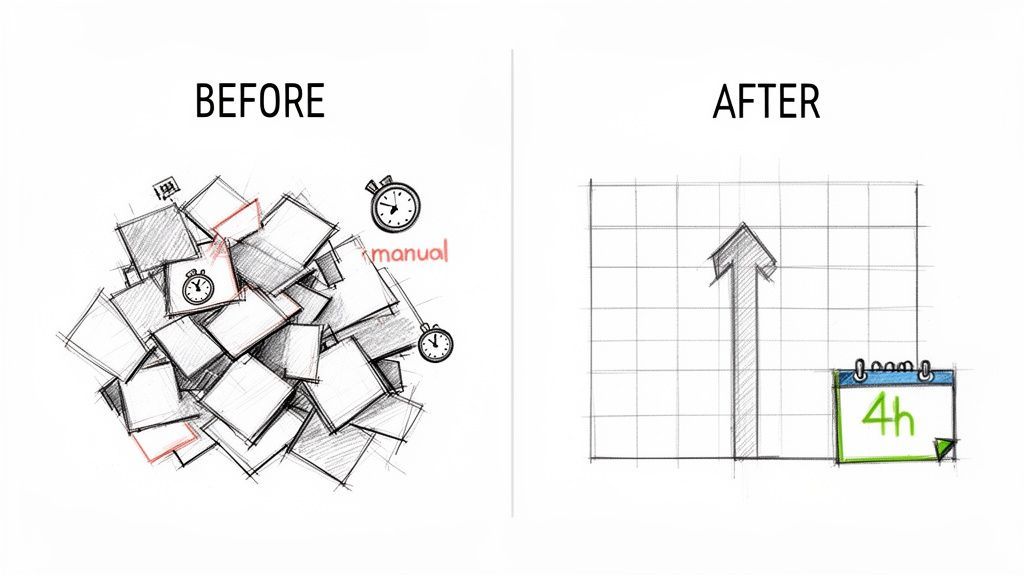
The Before-and-After framework is a powerful narrative device that paints a clear picture of transformation. It contrasts the prospect's current, problematic state with a future, improved state made possible by your solution. This approach tells a compelling mini-story, helping prospects visualize the direct impact of your offering on their business.
This technique is effective because it moves beyond features and focuses entirely on outcomes. By framing the conversation around a tangible change, you make the value proposition immediately understandable and desirable. It's one of the most persuasive cold emailing examples because it answers the prospect's core question: "What's in it for me?"
The Before-and-After Framework in Action
Here’s how this structure can be applied. Imagine you're selling a sales intelligence tool to a Head of Sales at a company with a large, remote sales team.
- Before: "Currently, your reps likely spend over 20% of their week on manual data entry and CRM updates. That's a full day every week lost to administrative tasks instead of selling."
- After: "With our tool, that time is reclaimed. Your team gets verified contact data synced directly to your CRM, freeing them up to focus on outreach. This typically increases pipeline by over 20% within the first quarter."
- Call-to-Action: "Could 15 minutes next week be a good time to show you how to get that day back for your team?"
Why It Works & How to Replicate It
This model works by creating a clear value gap between the prospect's present and a better future. The contrast makes the pain of the "before" state more acute and the appeal of the "after" state more urgent. The specificity of the data makes the story believable.
Actionable Tips for Your Before-and-After Emails:
- Anchor the 'Before' in Reality: Use data specific to the prospect's industry, company size, or role to establish a credible starting point. For example, "For a SaaS company your size, CRM data decay costs an average of..."
- Quantify the 'After': Use specific numbers to describe the positive outcome. "Increase pipeline by 23%" is much stronger than "increase pipeline."
- Set a Realistic Timeline: Add credibility by including a timeline for the transformation. "Within 60 days" is more believable than "instantly."
- Tie the CTA to the Transformation: Your call-to-action shouldn't just be "let's talk." It should be the first step toward achieving the "after" state, like "Worth a quick call to map out what that 20% increase would look like for you?"
Key Insight: The Before-and-After email is not just a comparison; it’s a story of progress. Your goal is to make the prospect the hero of that story, with your solution acting as the tool that helps them achieve a quantifiable victory.
8. The Specific Ask or Micro-Commitment Cold Email Template
The micro-commitment approach flips the traditional cold email goal on its head. Instead of pushing for a 30-minute demo, this template aims for a small, low-friction "yes" that opens the door to a larger conversation. By asking for something easy, like feedback on an idea or an answer to a single question, you reduce the prospect's cognitive load and make engaging with your email feel effortless.
This technique is effective because it respects the prospect's time and positions you as a collaborator rather than just another salesperson. It’s a subtle shift that makes your outreach stand out in a crowded inbox, building a small amount of rapport before any real "selling" begins. This is one of the most practical cold emailing examples for busy decision-makers.
The Micro-Commitment Framework in Action
Here’s how the structure works. Imagine an Account Executive at a data enrichment company targeting a Head of RevOps who likely deals with messy CRM data.
- Context: "Saw on a professional network that your sales team grew by 20% last quarter. From my work with other fast-growing RevOps leaders, that kind of growth often puts a strain on data quality."
- Value Prop: "We're helping teams like yours automate contact data cleansing, which typically saves each rep about 3-4 hours per week."
- Micro-Commitment Ask: "Quick question: What's your biggest bottleneck when it comes to keeping your CRM data clean and reliable? Just a one-line reply would be great."
Why It Works & How to Replicate It
The micro-commitment works because of the psychological principle of consistency. Once someone agrees to a small request (like answering a question), they are more likely to agree to a subsequent, larger request (like a 15-minute call). The initial ask is so simple that ignoring it feels less efficient than just answering.
Actionable Tips for Your Micro-Commitment Emails:
- Make the Ask Hyper-Specific: Don't ask to "pick their brain." Instead, ask a pointed question they can answer in 30 seconds. For example, "What tool are you currently using for X?" is better than "How do you handle X?"
- Keep the Time Commitment Clear: If you are asking for time, be precise. "Worth a 10-minute chat to share how?" is much more appealing than "Are you free for a call?"
- Offer Two Paths: Give them an easy out that still results in engagement. For example, "Would a 15-minute call work, or would you prefer I just send over a two-sentence summary of how we solve this?"
Key Insight: The goal of the micro-commitment is to start a dialogue, not book a meeting immediately. A simple reply to your question is a win, as it validates their interest and gives you permission to follow up with more substance. This conversational approach also helps your sender reputation, as replies are a strong positive signal to email providers.
Works with 29+ CRMs
Add to CRM finds verified emails, phone numbers, and job titles on LinkedIn® — then adds them to your CRM in one click.
Start Free TrialTrusted by 2,500+ users4.78 Cold Email Template Comparison
| Template | Implementation complexity | Resource requirements | Expected outcomes | Ideal use cases | Key advantages |
|---|---|---|---|---|---|
| The Problem-Agitate-Solve (PAS) | Medium — needs structured scripting and personalization | High — deep prospect research, role-specific data (e.g., Add to CRM) | Higher open/reply rates and relevant conversations; moderate conversion speed | SDR outbound focused on pain points and role-tailored outreach | Clear narrative from pain to solution; strong CTA flow |
| The Curiosity Gap | Low–Medium — craft intriguing hooks, short copy | Low — minimal data but requires solid follow-up content | High click/response rates but variable lead qualification | Breaking inbox noise, short cold emails, follow-up sequences | Stands out in crowded inboxes; concise and attention-grabbing |
| The Social Proof | Medium — assemble case studies and align proof to prospect | Medium–High — authentic client examples, metrics, company matching | Increased trust and higher conversions for mid-market/enterprise | Enterprise/mid-market sales where credibility matters | Reduces skepticism with third-party validation and quantified results |
| The Value-First | Medium–High — produce genuinely useful content or intros | High — subject-matter expertise, actionable resources, tracked assets | High reply rates and higher-quality conversations; longer sales cycle | Relationship-building, account-based outreach, follow-ups | Builds goodwill and positions sender as a helpful expert |
| The Reference / Referral | Medium — requires verified mutual connections and permissions | Medium — network data, CRM integration, tracking referrals | Significant open/reply lift; warmer introductions convert better | Referral programs, partner-driven outreach, warm introductions | Immediate credibility through a trusted intermediary |
| The Compliment / Achievement-Based | Medium — needs up-to-date research and specific recognition | Medium — activity feeds, press/funding/hiring data | Higher opens and replies with senior audiences when genuine | Executive outreach and personalized account outreach | Creates positive emotional response and demonstrates research |
| The Before-and-After | Medium — craft credible contrast with measurable outcomes | Medium — enriched company/role data and verifiable metrics | High engagement; helps prospects envision transformation | Efficiency/productivity solutions and transformation narratives | Memorable storytelling that quantifies potential impact |
| The Specific Ask / Micro-Commitment | Low — design a clear, narrow CTA and options | Low — minimal data; tracking micro-commitment responses | Higher reply rates and easier qualification; faster next steps | High-volume SDR outreach and multi-touch sequences | Low friction to respond; measurable and scalable CTA approach |
From Examples to Execution: Activating Your Cold Email Strategy
We've explored a wide array of powerful cold emailing examples, moving from the directness of the Problem-Agitate-Solve (PAS) framework to the subtle influence of the Social Proof and Referral templates. Each example serves not as a rigid script to be copied, but as a strategic foundation upon to build your own compelling outreach. The common thread connecting every successful template is the thoughtful application of personalization, relevance, and value.
A Curiosity Gap email falls flat without a genuinely intriguing hook tailored to the recipient's industry. A Compliment-based outreach feels hollow if the praise is generic. This is where the real work begins: transforming these proven structures into messages that feel personal and earn a reply. The goal is to move beyond simply sending emails and start building a system for creating meaningful conversations at scale.
Synthesizing the Core Principles
Across all the frameworks, a few core principles emerge as non-negotiable for effective cold outreach. Mastering these concepts is what separates a spam folder from a scheduled meeting.
- Personalization is Paramount: Every template, from the Before-and-After to the Specific Ask, depends on details specific to the recipient. This goes beyond
[First Name]. It means referencing a recent company achievement, a shared connection, or a specific pain point relevant to their role. - Clarity Over Complexity: The best cold emails are easy to understand in seconds. They use simple language, have a clear purpose, and make a single, low-friction request. Notice how the Specific Ask or Micro-Commitment template minimizes cognitive load for the prospect.
- Value is the Price of Attention: You are asking for a busy person's time. The Value-First template makes this explicit, but every email must offer something in return. This could be a unique insight, a helpful resource, or a solution to a nagging problem.
Actionable Next Steps: Building Your Outreach Engine
Reading about cold emailing examples is the first step. The next is to put them into practice with a structured, data-driven approach. Here is how you can begin executing what you've learned.
- Select and Test Two Frameworks: Don't try to implement everything at once. Choose two distinct templates that align with your product and target audience. For instance, you could A/B test the direct, pain-focused PAS template against the relationship-oriented Compliment template.
- Establish Your Measurement Baseline: Before you send a single email, define what success looks like. Track your open rates, reply rates, and positive reply rates. This data will be your guide for iteration and improvement.
- Build Your Personalization Stack: Manually finding verified contact details and company information for every prospect is a bottleneck. The key is to build a workflow that automates data gathering so you can focus on crafting the message. This means using reliable tools to find accurate emails and enrich contact profiles with the specific data points needed for your chosen templates.
- Systematize Your Follow-Up: A single cold email is rarely enough. Plan a sequence of 3-5 follow-ups that provide additional value, reference your initial message, and maintain a respectful tone. Each follow-up is another chance to test a different angle or value proposition.
Ultimately, the most successful cold emailers are relentless optimizers. They treat every send as an experiment, learning from what works and discarding what doesn't. They combine the art of compelling writing with the science of data and automation. By adopting this mindset and implementing a solid operational workflow, you can turn these cold emailing examples from static text into a dynamic engine for growth.
Ready to power your outreach with verified data? Add to CRM finds accurate contact information and enriches profiles with over 30 data points directly from professional networks, allowing you to perfectly execute any of the cold email templates we've covered. Stop wasting time on manual data entry and start building your pipeline with Add to CRM.
Start saving time and closing more deals.
Find verified contact info for your prospects on LinkedIn®, Gmail and Outlook — and add them to your CRM with 1-click.

 Loading...Trusted by 2,500+ founders, SDRs & more