The Modern Sales Process B2B Playbook for 2026
Master the modern sales process B2B for 2026. This playbook covers every stage from prospecting to close with proven strategies to boost your revenue.
Published on February 26, 2026
- Why Your B2B Sales Process Needs a 2026 Upgrade
- Stage 1: Finding Your Ideal Customers
- Stages 2 & 3: Qualifying Leads and Uncovering Needs
- Stages 4 & 5: From Smart Proposals to Collaborative Negotiations
- Stages 6 & 7: Closing the Deal and Championing Customer Success
- Building Your Sales Engine with the Right Tools
- Common Questions About the B2B Sales Process
A solid B2B sales process isn't a rigid script—it's your playbook for turning a stranger with a problem into a happy customer. And in 2026, with more people signing off on every deal and decision times stretching out, having a reliable playbook is the only way to build predictable revenue.
Why Your B2B Sales Process Needs a 2026 Upgrade
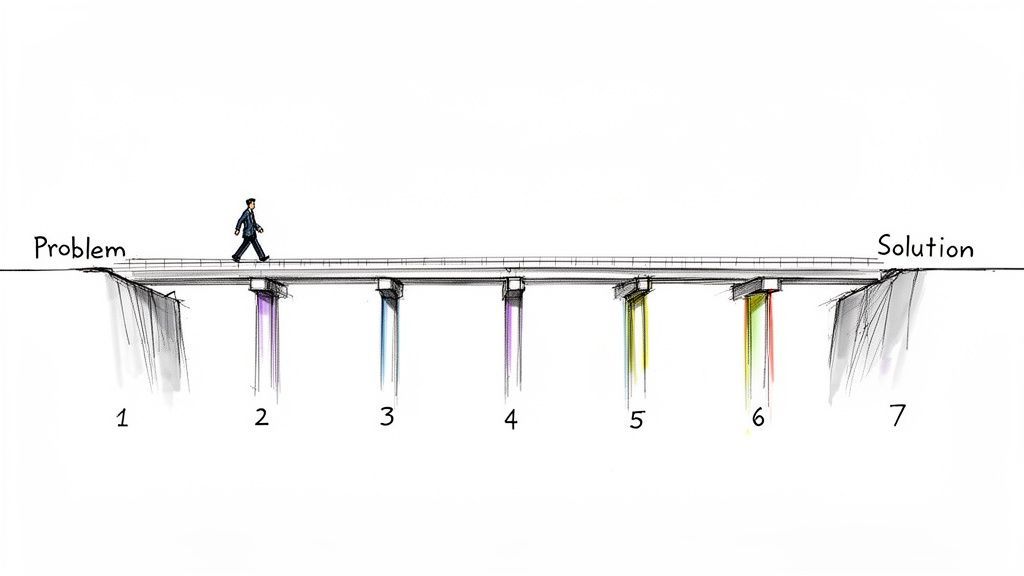
Think of your sales process like building a bridge. Each stage, from finding potential customers to getting the contract signed, is a pillar holding everything up. If one of those pillars is weak or missing, the whole deal can collapse halfway across.
A well-thought-out process gives your buyer a smooth, secure path straight to the solution you're offering. It's what separates the pros from the amateurs. It moves your team from a reactive, "fingers-crossed" approach to a proactive system where you know exactly what to do next. Without a process, you're just guessing. With one, you're building a revenue machine.
The Modern B2B Buying Journey
Let's be honest: the way businesses buy things has completely changed. The average B2B sales cycle now drags on for 60 to 120 days. It gets worse. 57% of sales pros say their deals are taking longer than ever, and 75% of B2B buyers admit they're taking more time to decide compared to just last year. These aren't just minor delays; they're fundamental shifts in how companies operate. You can read more about these B2B sales cycle trends to see the full picture.
This shift means your sales process can't be rushed. It has to be built around the buyer's timeline, not yours.
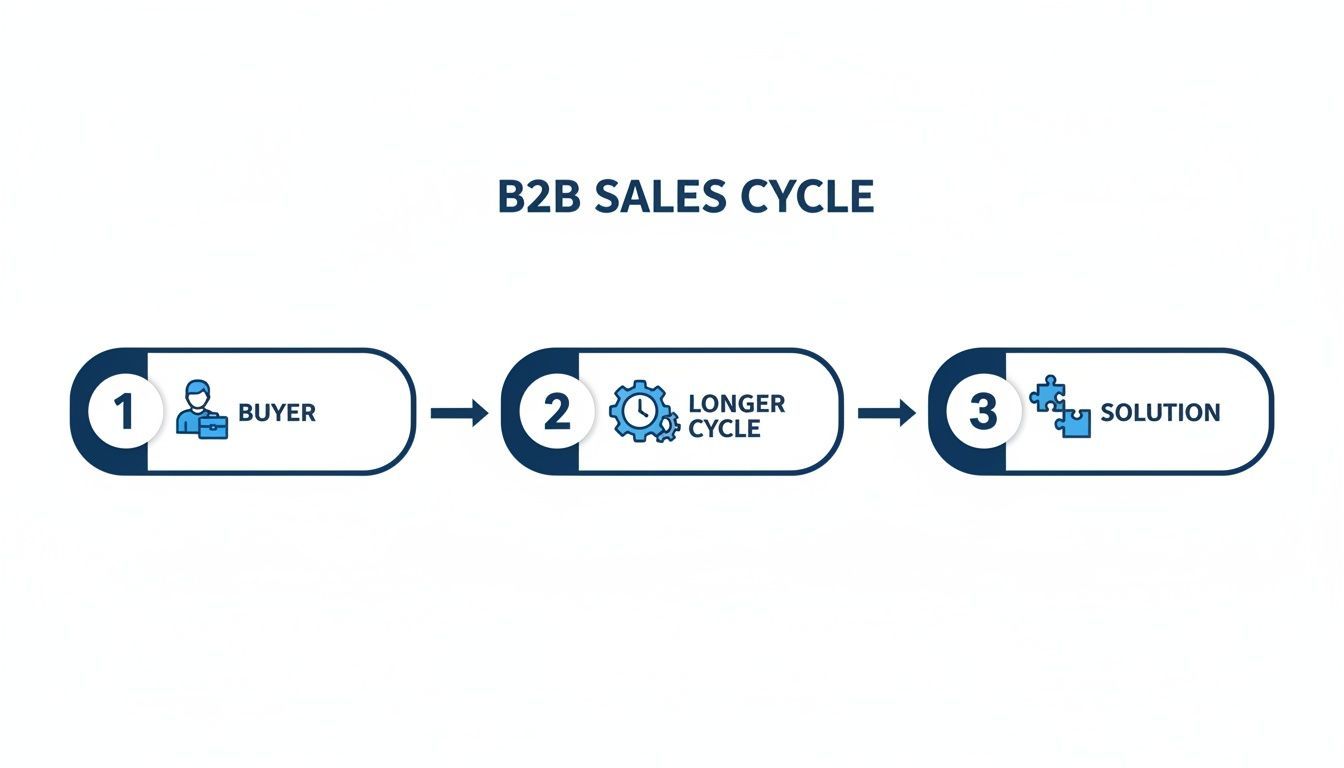
The takeaway here is simple but crucial: today's process has to be flexible enough to meet complex needs over a much longer and more deliberate evaluation period.
The 7 Stages of the Modern B2B Sales Process
So, how do you build that bridge to predictable revenue? You start by mastering the fundamental stages of a modern sales process. Each one has a clear purpose, moving the opportunity forward with intention.
Here’s a quick overview of the seven core stages we’ll be breaking down. Think of it as your high-level map for the journey ahead.
The 7 Stages of the Modern B2B Sales Process
| Stage | Primary Goal | Key Role |
|---|---|---|
| 1. Prospecting & Lead Gen | Identify potential customers who fit your ideal customer profile (ICP). | SDR/BDR, Marketing |
| 2. Qualification | Determine if a lead has the need, budget, and authority to buy. | SDR/BDR, Account Executive |
| 3. Discovery | Deeply understand the prospect’s specific pain points and goals. | Account Executive |
| 4. Proposal/Solution | Present a tailored solution that directly solves their problems. | Account Executive, Sales Engineer |
| 5. Negotiation | Align on terms, pricing, and scope to create a win-win agreement. | Account Executive, Sales Manager |
| 6. Closing | Finalize the contract and get the official sign-off. | Account Executive |
| 7. Post-Sale & Handoff | Ensure a smooth transition to the customer success team. | Account Executive, Customer Success |
Each of these pillars is critical for building a scalable and repeatable sales motion. In the sections that follow, we'll dive deep into each one, giving you the practical strategies and tools you need to get it right.
Stage 1: Finding Your Ideal Customers
The entire B2B sales process hinges on getting this first step right: knowing exactly who you're selling to. The days of smiling and dialing down a random list are long gone. Modern prospecting is a science, built on precision and delivering real value from the very first touchpoint.
This stage is all about identifying potential customers who are a perfect fit for what you offer. It’s about making sure your team invests its precious time and energy only where it will actually count. The goal is to move beyond gut feelings and build a data-driven machine that creates such a clear picture of your ideal buyer that your outreach feels less like a sales pitch and more like a genuinely helpful conversation.
Defining Your Ideal Customer Profile
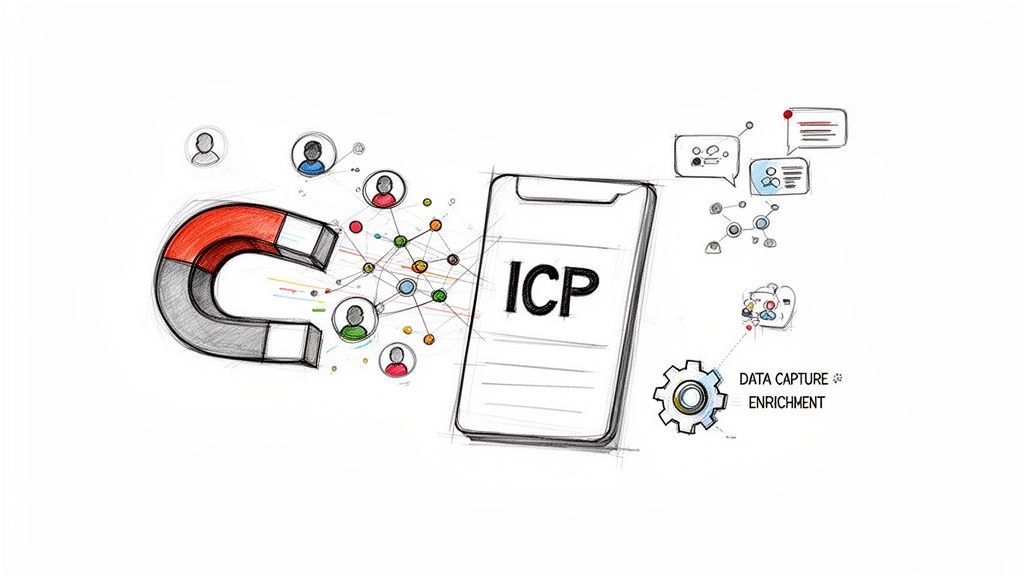
Before you can find your customers, you have to define them. This starts with creating an Ideal Customer Profile (ICP). Think of an ICP as a detailed description of the perfect company to buy your product—not the individual person, but the organization itself. It's the blueprint for your entire prospecting strategy.
To build a solid ICP, you need to focus on firmographics like:
- Industry or Vertical: Which specific sectors get the most bang for their buck from your solution?
- Company Size: What's your sweet spot in terms of employee count or annual revenue?
- Geography: Are there specific regions or countries you serve best?
- Technology Stack: What other tools or software do your best customers already use?
With your ICP locked in, you can then create buyer personas. These are semi-fictional deep dives into the key decision-makers and influencers within those ideal companies. What’s their job title? What are their daily headaches? What do they need to look like a hero in their role? This is the detail that makes your outreach connect on a human level.
An effective sales process begins with discipline. By focusing outreach exclusively on companies that fit your ICP, you ensure your pipeline is filled with high-quality opportunities from the start, not just high volume.
Modern Prospecting Techniques
Armed with a crystal-clear ICP and detailed buyer personas, you're ready to start your targeted outreach. Today’s top-performing sales teams use a multi-channel approach, connecting with potential buyers wherever they’re most active. For a closer look at specific tactics, you can explore our complete guide on outbound lead generation strategies.
Here are a few powerful techniques to get you started:
- Social Selling: Engage with prospects on professional networks by sharing useful content and adding thoughtful comments to their posts. This isn't about the hard sell; it's about building rapport and establishing yourself as a credible resource long before you ever ask for a meeting.
- Value-Driven Content: Create blog posts, whitepapers, or case studies that directly tackle your ICP’s biggest frustrations. When prospects stumble upon your content organically, they start to see you as a trusted advisor, not just another vendor.
- Targeted Outbound: Use your ICP to build hyper-specific lists for your email and phone outreach. The secret here is personalization. Don't just send a generic template—reference a prospect’s recent company announcement, a new hire, or a specific challenge relevant to their industry.
Automating Lead Capture and Enrichment
One of the biggest time-sinks in prospecting is manual data entry. Sales reps can easily burn hours just copying and pasting info from professional profiles or email signatures into their CRM. This doesn't just kill productivity; it’s also a recipe for inaccurate and incomplete data.
This is where automation becomes a total game-changer. Tools like a one-click CRM extension can instantly capture and enrich lead data right from the source. This simple step ensures every new contact record is accurate and complete from day one, setting the stage for a much more effective and efficient sales process b2b.
Stages 2 & 3: Qualifying Leads and Uncovering Needs
Once a prospect lands in your pipeline, the game shifts from finding them to truly understanding them. This is where the modern B2B sales process separates the pros from the amateurs. I’m bundling lead qualification and discovery together because, honestly, they're two sides of the same coin. You can't properly qualify someone without uncovering their needs, and you can't uncover needs if they aren't qualified in the first place.
This combined stage boils down to one critical question: Is this opportunity worth our time? A "yes" means the prospect not only fits your ideal customer profile but also has a compelling, urgent reason to buy. A "no" saves everyone from a long, painful, and ultimately fruitless sales cycle.
Separating Signal From Noise with Qualification Frameworks
Think of qualification as your first line of defense against a bloated, low-quality pipeline. Instead of just winging it, top sales reps use established frameworks to methodically figure out if an opportunity is real. These aren't rigid scripts; they're strategic checklists to guide the conversation.
Two of the most battle-tested frameworks are BANT and MEDDPICC.
- BANT (Budget, Authority, Need, Timeline): The classic. It’s a straightforward framework that's perfect for quickly answering the most fundamental questions to see if a real opportunity even exists.
- MEDDPICC (Metrics, Economic Buyer, Decision Criteria, Decision Process, Implicate Pain, Champion, Competition): This is the heavy-hitter for complex enterprise deals. It goes way deeper, helping you map out the internal buying process and, most importantly, find a champion who will fight for you internally.
Using a framework makes sure every rep on your team is asking the right questions, every single time. It turns qualification from an art into a repeatable science, giving you a predictable way to forecast your pipeline. To go deeper, check out our detailed guide on how to qualify sales leads effectively.
The Discovery Call: A Consultative Investigation
With a basic qualification in hand, the discovery call is your chance to really dig in. You need to reframe this conversation in your mind: you are not interrogating the prospect. You are a consultant investigating their business challenges. Your goal is to understand their world so well that you can connect your solution directly to their most painful problems.
This means you have to move beyond surface-level questions. Active listening becomes your most valuable tool. Take meticulous notes—ideally right in your CRM—so your entire team has a single, comprehensive picture of the opportunity.
A great discovery call feels less like a sales pitch and more like a strategy session. When you focus entirely on the customer’s problems and goals, you stop being a vendor and start becoming a trusted advisor.
Modern deals are complicated, making this stage more critical than ever. It's a shocking statistic, but 86% of B2B purchases stall before anyone makes a final decision. And it’s rarely because a competitor swooped in. Deals die because the value proposition just wasn't strong enough to get buy-in from the average of 13 decision-makers now involved in a typical purchase.
Asking Questions That Uncover True Pain
To build a business case that can survive that kind of internal scrutiny, you have to uncover the real cost of doing nothing. What happens if they don't solve this problem? The right questions can reveal the deep-seated pain points and strategic goals that actually drive major buying decisions.
Here are a few powerful, open-ended questions to guide your discovery:
- To Uncover Pain: "What’s the most frustrating part of how you handle [relevant area] right now?"
- To Identify Goals: "If we were talking a year from now, what would need to have happened for you to consider this project a massive success?"
- To Quantify Impact: "Can you help me understand how that issue is impacting your team’s productivity or the company’s bottom line?"
- To Understand Priorities: "Of all the challenges you've mentioned, which one is the most urgent for you to solve?"
By the end of these stages, you should have a unified, detailed view of the opportunity logged in your CRM. This record arms your account executives with everything they need to craft a personalized, high-impact proposal that speaks directly to what the customer actually cares about.
Stages 4 & 5: From Smart Proposals to Collaborative Negotiations
Alright, you’ve done the hard work in discovery. You know your prospect’s world inside and out—their pains, their goals, the metrics that matter. Now it's time to connect the dots and move the deal forward. This is where we shift into two make-or-break stages: crafting the proposal and navigating the negotiation.
Think of the proposal not as a brochure, but as a personalized business case. It’s a direct response to everything you’ve learned. Forget one-size-fits-all templates; a winning proposal proves you were listening. Your role here transitions from investigator to a collaborative partner, focused on building a win-win agreement, not a high-pressure showdown.
Crafting a Proposal That Actually Solves Problems
Your proposal should feel like the natural, logical conclusion to all your previous conversations. It’s not about you or your product; it’s about them. High-performing sales teams get this right every time. They frame their proposals as a clear solution to the customer’s specific challenges.
A strong proposal doesn't just list features—it translates each one into a measurable business outcome. Don't just say, "our software has an analytics dashboard." Instead, show them how that dashboard gives their leadership the exact data they need to slash operational costs by 15%. That's the difference between a feature and a solution.
To build a proposal that lands, make sure it nails these key elements:
- Executive Summary: A punchy, one-page overview that restates their primary challenges and how you’re going to solve them. Get straight to the point.
- Personalized Solution: Detail the specific products or services you're recommending, explaining why they are the perfect fit for the problems you uncovered.
- Clear ROI and Value: Use their own metrics to paint a picture of the expected return. We're talking cost savings, revenue growth, or efficiency gains—whatever they care about most.
- Implementation Timeline: Lay out a clear, realistic plan for onboarding. This builds confidence and shows you’ve thought through the entire process.
- Transparent Pricing: Break down the costs clearly. Every line item should tie directly back to the value it delivers. No surprises.
Shifting from Confrontation to Collaboration in Negotiations
Let's be real: negotiation is a normal part of any serious B2B deal. But it should never feel like a battle. The best reps position themselves as trusted advisors working with the buyer to build a partnership that makes sense for everyone. It’s about finding common ground, not trying to win every single point.
The key is to anticipate common objections and have value-based responses ready to go. When a prospect raises a concern, see it as an opportunity to reinforce your value, not just cave and offer a discount. Price is almost always a talking point, and the data is clear: 31% of prospects walk away simply because they don't see the value for the cost.
When a buyer pushes back on price, they're often questioning the value, not just the number. Your job is to reframe the conversation around the long-term ROI and the very real cost of doing nothing.
A Framework for Handling Common Objections
When objections pop up, don't get defensive. Use a simple, collaborative framework to guide the conversation, stay in control, and keep the deal moving.
- Listen and Acknowledge: First, just listen. Let them get it all out without interrupting. Then, acknowledge their concern with empathy. A simple, "I understand why budget is a key consideration for you," goes a long way.
- Clarify and Isolate: Ask good questions to get to the root of the issue. Is it really a budget problem, or is it a timing issue? Try something like, "When you say it's too expensive, could you help me understand how you're weighing the cost against the potential return we discussed?"
- Reframe and Respond: Circle the conversation back to the value you’ve already established. This is a perfect time to bring in social proof. Use a case study or a testimonial from a similar company to show how they overcame the same hurdle and achieved massive results.
- Confirm and Propose Next Steps: After you've addressed their concern, confirm you've resolved it. Then, confidently propose the next logical step to get the deal back on track.
Mastering these two stages is what separates the average salesperson from a true strategic partner. You stop being a vendor pitching a product and become someone who builds a lasting solution.
Stages 6 & 7: Closing the Deal and Championing Customer Success
After all the calls, demos, and back-and-forth, you’ve finally reached the end zone. This is where the deal gets done, but just as importantly, it's where the real partnership begins. Getting a signature isn't the finish line; it’s the starting pistol for a long-term, profitable relationship.
Bringing a high-value deal home is a delicate dance. You need to create a sense of urgency without being pushy or resorting to old-school, high-pressure tactics. By this point, your buyer should feel totally confident they're making the right call. The signing process itself? That should be the easiest part of the whole journey.
From Final Handshake to Lasting Partnership
Once the ink is dry, it's tempting for a sales rep to mark the deal "won" and immediately pivot to the next prospect. Big mistake. Top performers know the job is only half-done. What happens next is what separates a happy, renewing customer from a churn statistic waiting to happen.
The handoff from sales to the customer success team is everything. A smooth transition ensures all the promises you made are kept and that the customer starts seeing value from day one. This is your first, and best, shot at building real loyalty that pays dividends for years.
Closing Techniques That Actually Work
Closing a deal is about guiding, not forcing. It's the logical conclusion to a conversation where you've proven your value. The goal is to make signing the obvious next step, not a massive leap of faith.
Here are a few proven ways to get there:
- The Summary Close: This is a classic for a reason. You simply recap the biggest pains they mentioned and connect each one to the specific part of your solution that solves it. It’s a powerful way to remind them why they started talking to you in the first place.
- The Urgency Close: Use this one with care, and only when it’s genuine. An upcoming price increase or a limited-time implementation offer are good examples. Fake urgency feels slimy and kills trust instantly.
- The Alternative Close: Instead of asking a "yes or no" question like, "Are you ready to sign?" you frame it as a choice between two positive next steps. Think: "Great, so would you prefer to kick off the team training on Monday or Wednesday?" It assumes the sale and moves the conversation into logistics.
The moment a deal is marked "Closed-Won" isn't the end of the sales process. It’s the beginning of the customer relationship. How you handle the handoff directly impacts customer lifetime value, referrals, and future upsell opportunities.
Your CRM: The Linchpin of Customer Success
The single most critical asset in the handoff isn't a slide deck or a kickoff call—it's your CRM record. A clean, detailed, and up-to-date record is the bridge between what sales promised and what customer success can deliver. It’s what holds the entire post-sale experience together.
This record needs to be the single source of truth, containing everything the customer success manager needs to hit the ground running, including:
- The customer's main business goals and the specific pains they're trying to solve.
- A list of the key stakeholders and what each of them cares about.
- Notes on any unique requirements or customizations that were discussed.
- The exact success metrics the customer will be using to judge the investment.
When this is all logged accurately, the customer doesn't have to repeat themselves for the tenth time, and the success team can start adding value from their very first interaction. That proactive approach doesn't just cut down on churn; it's how you turn brand-new customers into your biggest fans.
Building Your Sales Engine with the Right Tools
A well-defined sales process is your strategic roadmap, but the right technology is the V8 engine that actually powers the whole operation. Without a solid tech stack, even your best reps get bogged down by administrative work, fighting a losing battle against manual data entry, duplicate records, and outdated info.
This is where you move your process from a theoretical plan into a high-performing, data-driven machine.
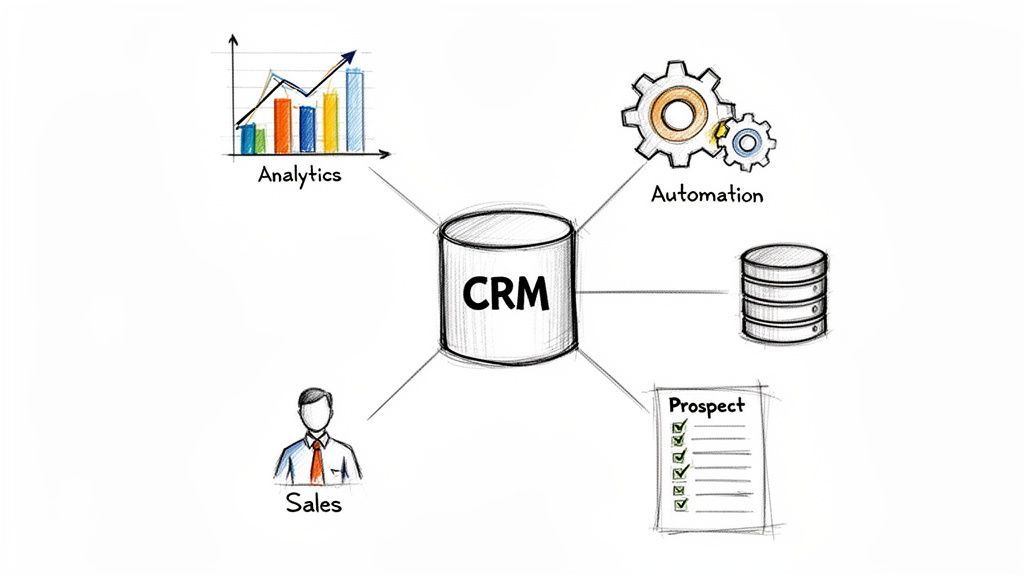
At the heart of that machine is your Customer Relationship Management (CRM) system. It has to be the undisputed single source of truth for your entire organization. When everyone—from marketing to sales to customer success—is working from the same clean, accurate dataset, the whole B2B sales process just gets faster and smarter.
Taming the Data Beast
The biggest enemies of a healthy CRM are what I call the “three Ds” of bad data: decay, duplicates, and incomplete records. Data decay is a constant threat—contacts change jobs, companies get acquired, and phone numbers go stale. Duplicates create confusion and lead to those embarrassing moments where two reps contact the same person on the same day. And incomplete records leave your team flying blind without the details they need to personalize their outreach.
This isn't just a minor annoyance; it's a massive productivity killer. On average, sales reps spend only 28-30% of their time actually selling. The other 70% gets eaten up by admin tasks, data entry, and internal meetings. It’s no wonder that 89% of revenue orgs are now using AI tools to fight back, with 68% of reps reporting that AI-driven insights help them close deals faster. You can dig into these stats and more in this sales productivity report.
From Manual Drudgery to Automated Efficiency
Modern automation tools are the answer to these data roadblocks. Instead of reps wasting precious hours copying and pasting contact details into the CRM, new tech can handle it in a fraction of a second. Imagine turning a prospect's professional profile or email signature into a complete, accurate CRM record with a single click.
That’s exactly what modern prospecting tools deliver. They enable:
- One-Click Contact Creation: Instantly grab lead information from professional networks or email without ever leaving the page.
- Real-Time Data Enrichment: Automatically pull in crucial data points like job titles, company revenue, and verified contact details.
- Proactive Duplicate Prevention: The system checks if a contact already exists before a new one is created, keeping your CRM clean from the get-go.
This is a fundamental shift in how sales teams operate. It frees them from low-value tasks so they can focus on what they do best—building relationships and selling. To see how these tools fit into a broader strategy, check out our overview of modern sales operations tools and best practices.
A CRM powered by automation is no longer just a digital rolodex. It becomes a dynamic, intelligent system that actively helps your sales team win more deals by ensuring every piece of data is accurate, complete, and instantly accessible.
To put this in perspective, let's compare the two approaches side-by-side. The difference in time and accuracy is staggering.
Manual vs Automated CRM Data Entry: A Productivity Comparison
| Activity | Manual Process (Time per Lead) | Automated Process (Time per Lead) | Data Accuracy |
|---|---|---|---|
| Find & Verify Contact Details | 3-5 minutes | < 5 seconds | Low (typos, outdated info) |
| Check for Existing Duplicates | 1-2 minutes | Instant & automatic | Inconsistent (human error) |
| Create New CRM Record | 2-3 minutes | < 2 seconds (one click) | Low (incomplete fields) |
| Total Time & Accuracy | 6-10 minutes | < 10 seconds | High (verified & complete) |
The table makes it clear: automation doesn't just save a few minutes here and there. It reclaims hours every single week for every single rep, all while dramatically improving the quality of the data your team relies on.
Building Your Integrated Tech Stack
Your CRM is the central hub, but it works best when it’s connected to a wider ecosystem of tools. An integrated tech stack creates a seamless flow of data across every stage of the B2B sales process, eliminating friction and giving your team a 360-degree view of the customer journey.
A typical B2B sales tech stack includes:
- Prospecting Tools: For identifying and enriching leads (e.g., one-click CRM extensions, intent data platforms).
- Engagement Platforms: For managing multi-channel outreach campaigns across email, phone, and social media.
- Analytics and Intelligence: For tracking performance, analyzing sales calls, and forecasting revenue.
- Contract Management: For streamlining the proposal and closing stages with e-signatures and document tracking.
When these tools talk to each other, the result is a well-oiled sales engine. Data flows automatically from your prospecting tool into your CRM, which then informs your engagement platform, and finally feeds performance data into your analytics dashboard. This cohesive system doesn't just save time; it delivers the deep insights you need to continuously optimize every step of your sales process.
Common Questions About the B2B Sales Process
Even the best playbook is going to leave you with a few questions when the rubber meets the road. I get it. Putting a new B2B sales process into practice always brings up some specific “what ifs.”
This section tackles the most common questions that pop up, with clear answers you can use right away.
Think of these as quick troubleshooting tips to keep your sales engine humming.
How Do You Adapt the Process for Different Industries?
A rigid, one-size-fits-all process is a recipe for disaster. While the core stages—prospecting, qualifying, closing—are universal, the how and why behind each one changes dramatically depending on who you're selling to.
For instance, selling to a fast-moving tech startup is all about speed, agility, and a clear path to ROI. But if you try that same approach with a heavily regulated industry like healthcare or finance, you'll hit a brick wall. They demand a more formal, security-first process with layers of stakeholder approvals.
The key is to tweak your messaging, qualification criteria, and proposal content to mirror the specific priorities and pain points of each industry. It's the same skeleton, just dressed for a different party.
What Are the Most Important KPIs to Track?
You can’t improve what you don’t measure. But drowning in data is just as bad as having none. To get a real pulse on your sales process, you need to focus on a handful of Key Performance Indicators (KPIs) that actually matter.
Your KPIs are the vital signs of your sales engine. Tracking them consistently allows you to diagnose problems early, optimize performance, and accurately forecast future revenue based on real-world data, not just guesswork.
Start with these four essentials:
- Lead-to-Opportunity Conversion Rate: This tells you how good your qualification is. If this number is low, it’s a classic sign that marketing and sales aren't aligned on what a "good lead" actually looks like.
- Sales Cycle Length: How long does it take to get a deal from first contact to signed contract? This metric is brilliant for spotting bottlenecks. If deals are always getting stuck in the proposal stage, you know exactly where to start digging.
- Average Deal Size: This one’s crucial for revenue forecasting and understanding the real value of your pipeline.
- Win Rate: The ultimate bottom line. This is the percentage of your qualified opportunities that turn into closed-won deals.
When Is It Time to Evolve Your Sales Strategy?
Your sales process should be a living, breathing document, not something you set in stone and forget. The market shifts, your product evolves, and your buyers’ needs change. Your process has to keep up.
Be on the lookout for these clear signals that it’s time for a refresh:
- Declining Win Rates: If you’re suddenly losing more deals than you're used to, it’s a massive red flag. Your messaging or qualification process has likely fallen out of sync with the market.
- Lengthening Sales Cycles: When deals start dragging on for longer than usual, it’s often because new objections or unexpected decision-makers are popping up—and your current process isn’t equipped to handle them.
- Negative Customer Feedback: Is the post-sale team constantly hearing that new customers had mismatched expectations? That’s a sure sign of a breakdown during the discovery or proposal stages.
Make a habit of reviewing your process—at least once a quarter—and get feedback from your entire revenue team. That’s how you stay ahead of the curve.
A powerful sales process starts with clean, actionable data. Add to CRM eliminates hours of manual data entry, allowing your team to capture leads from professional networks, Gmail, or Outlook with a single click. Save time, improve data quality, and let your reps focus on what they do best—selling. Find out how it works at https://addtocrm.com.
Start saving time and closing more deals.
Find contact info for your prospects on the #1 business social network and add them to your CRM with 1-click.

 Loading...



Trusted by 1000s of founders, SDRs & more
