Outbound Lead Generation: 10 Actionable Multi-Channel Plays
Discover 10 actionable outbound lead generation plays to build a multi-channel pipeline with frameworks, steps, sample messaging and metrics. Learn how.
In a market where every inbox is a battleground, relying on a single outbound channel is no longer a viable strategy for growth. Your ideal customers are spread across multiple platforms, and your outreach needs to reflect that reality. While cold email has its place, a one-dimensional approach leads to diminishing returns, lower response rates, and a pipeline that’s dangerously dependent on one point of failure. To build a resilient and predictable revenue engine, modern sales teams must adopt a diversified playbook of outbound lead generation strategies.
This is not another list of generic tips. We are diving deep into ten specific, actionable outbound plays that startups, SDRs, and established sales teams can implement immediately. Each strategy is broken down into a practical framework, complete with use cases, implementation steps, sample messaging, and the key metrics you need to track for success. We’ll cover everything from advanced social selling on professional networks and multi-channel ABM campaigns to leveraging intent data and strategic partnerships for warmer introductions.
Throughout this guide, we'll also highlight how you can use simple, powerful tools to streamline execution. For instance, we'll show how a tool like Add to CRM can eliminate the tedious, manual data entry that slows down prospecting, allowing you to focus on what truly matters: building relationships and closing deals. Prepare to move beyond the basics and construct a multi-channel outbound machine that consistently delivers high-quality leads.
1. LinkedIn Strategies: Outbound Prospecting & Influencer Amplification
LinkedIn has evolved beyond a simple professional network into a powerful engine for outbound lead generation strategies. This dual approach combines direct, personalized outreach to decision-makers with the broader reach of influencer collaborations. It’s about creating conversations at scale, using both one-to-one messaging and one-to-many content amplification to build a robust pipeline.
This blended strategy allows you to engage high-value prospects directly while simultaneously building brand authority and generating warmer, inbound-style leads through partnerships.
How It Works: Implementation Steps
- Direct Prospecting Sequence: SDRs identify ideal customer profiles using Sales Navigator and execute a multi-touch sequence. This often involves a personalized connection request, a follow-up message highlighting a specific pain point, and a final message offering a high-value resource like a case study or webinar recording.
- Influencer Identification: Identify 5-10 micro-influencers (10k-50k followers) in your niche whose audience mirrors your target demographic. The goal is authentic engagement, not just massive reach.
- Co-Marketing Execution: Partner with these influencers on co-hosted webinars, joint research reports, or live Q&A sessions. The influencer promotes the content to their audience, driving sign-ups and leads directly into your funnel.
Actionable Tips for Success
- Keep it brief: Initial connection messages should be under three sentences and focus on a commonality or clear value proposition, not an immediate sales pitch.
- One-Click Data Capture: Instantly capture profiles from LinkedIn and save them to your CRM using tools like Add to CRM. This eliminates manual data entry and ensures your prospecting data is clean and accurate from the start.
- Authenticity Wins: When co-creating content with influencers, prioritize authenticity over a hard sell. Focus on providing genuine value to their audience to build trust and generate higher-quality leads.
- Track and Optimize: Monitor key metrics like connection acceptance rate, message response rate, and lead conversion rate from influencer campaigns to continuously refine your approach.
2. Cold Email Outbound Campaigns with Personalization
Cold email remains one of the most scalable and cost-effective outbound lead generation strategies when executed correctly. This method involves sending targeted, personalized emails to prospects who haven't explicitly opted in, leveraging data enrichment and deep segmentation to deliver a message that resonates with specific business challenges and generates high-quality replies.
This strategy moves beyond generic templates by incorporating details specific to the prospect's role, company, or industry. A well-personalized email campaign can achieve reply rates rivaling warmer outreach methods, making it a powerful tool for startups and established sales teams alike to book meetings and build a predictable pipeline.
How It Works: Implementation Steps
- Ideal Customer Profile (ICP) & List Building: Define your ICP with precision. Use professional networks and specialized databases to build a clean list of prospects who match this profile, focusing on criteria like company size, industry, job title, and recent company events (e.g., funding rounds, new product launches).
- Data Enrichment & Verification: Enrich your list with personalization points, such as a recent article the prospect wrote or a new company initiative they are leading. Crucially, use email verification tools to clean your list and ensure a bounce rate below 5%, which is vital for maintaining sender reputation and deliverability.
- Sequence Creation & Execution: Develop a multi-touch sequence of 3-5 emails spread over 2-3 weeks. The first email should have a highly personalized hook, while follow-ups provide additional value or a gentle reminder. Launch the campaign, starting with a small test batch to measure initial performance before scaling.
Actionable Tips for Success
- Start Small and Test: Before launching a massive campaign, send 100-200 highly researched and personalized emails. Analyze the reply rates and feedback to refine your messaging, subject lines, and call-to-action.
- Hyper-Personalize the Hook: Use company-specific details in the first few sentences. Mentioning recent funding, a new executive hire, or a specific case study on their website shows you’ve done your homework and aren't just spamming.
- Keep Subject Lines Short: Aim for 30-50 character subject lines that are intriguing and benefit-focused. Examples include "Quick question about [Company Name]" or "Idea for [Their Department]".
- Verify Everything: A clean email list is non-negotiable for sender reputation. Find reliable contact data and validate it using the best email finder tools before you send a single message.
- Capture Replies Instantly: When a prospect replies positively, use a tool like Add to CRM to instantly capture their information and update their record. This prevents warm leads from falling through the cracks and keeps your data clean.
3. Account-Based Marketing (ABM) Outbound Strategy
Account-Based Marketing flips the traditional lead generation funnel on its head. Instead of casting a wide net, ABM is a highly targeted, multi-channel outbound strategy focused on a curated list of high-value accounts. It aligns sales and marketing efforts to deliver hyper-personalized campaigns across email, social platforms, ads, and direct outreach, treating each target company as a market of one.
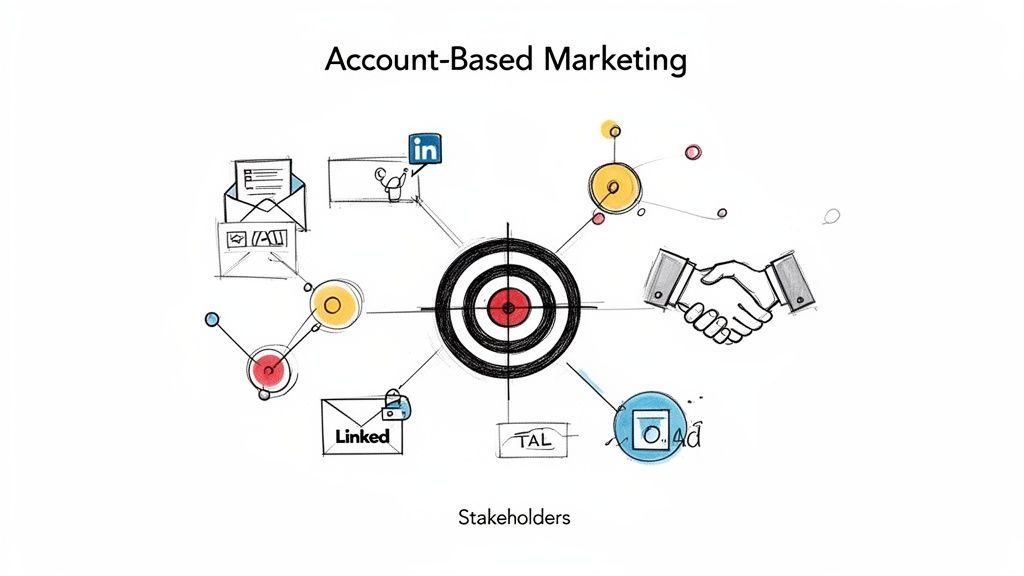
This focused approach is perfect for B2B companies with complex sales cycles and high lifetime value customers, as it maximizes resource efficiency and significantly increases conversion rates by engaging multiple stakeholders within an organization simultaneously.
How It Works: Implementation Steps
- Identify & Select Target Accounts: Sales and marketing collaborate to build a target account list (TAL) based on firmographics, technographics, and buying signals. This list typically contains 50-500 high-value, ideal-fit companies.
- Map Key Stakeholders: For each target account, research and identify the key decision-makers, influencers, and champions within the buying committee. This involves mapping out roles, responsibilities, and reporting structures.
- Execute Coordinated Campaigns: Launch a synchronized, multi-touch, multi-channel campaign. This could involve personalized emails to the CTO, targeted ads to the engineering team, and direct social outreach to the VP of Product, all delivering a consistent, account-specific message.
Actionable Tips for Success
- Create Account-Specific Value: Don't use generic messaging. Develop value propositions and content that directly address the unique challenges, goals, and industry context of each target account.
- Maintain Account Hierarchies: Use a tool like Add to CRM to instantly capture all key stakeholders from a company's social profile directly into your CRM. This ensures your account maps are accurate and all contacts are correctly associated, preventing data chaos.
- Coordinate Outreach Timing: Align the timing of your outreach across all channels. A prospect seeing your ad, receiving an email, and getting a social media message in the same week creates powerful brand recognition and boosts response rates.
- Align Sales and Marketing: Hold regular sync meetings between sales and marketing to review account engagement, share insights, and adjust tactics. Success in ABM depends on tight alignment and shared goals.
4. Strategic Partnerships and Channel Outbound
This outbound lead generation strategy moves beyond direct customer outreach to leverage the audiences and credibility of complementary businesses. By forming alliances with companies, resellers, or agencies that serve a similar customer profile but offer non-competing products, you gain access to new, often warmer, lead sources. It’s about creating a referral engine that benefits both partners.
This approach transforms cold outreach into warm introductions. For instance, a SaaS company might find that 30% of its new business comes from partnerships with implementation agencies, or a tech vendor could build a reseller program that generates over 100 qualified leads per month by empowering partners to sell on its behalf.
How It Works: Implementation Steps
- Partner Identification: Identify 5-10 strategic partners with overlapping Ideal Customer Profiles (ICPs). Look for technology integration partners, service agencies, or consultants whose offerings complement your own. For example, a marketing automation tool might partner with a CRM provider.
- Program Development: Define the terms of the partnership. This could be a simple referral agreement (e.g., a commission for closed deals), a co-marketing plan (joint webinars, ebooks), or a full-fledged reseller or channel program.
- Enablement and Activation: Equip your partners with the resources they need to succeed. This includes sales collateral, product training, dedicated landing pages for tracking, and clear points of contact. The goal is to make it incredibly easy for them to send qualified leads your way.
Actionable Tips for Success
- Define Clear Metrics: Establish and track partner success metrics directly within your CRM. Focus on lead-to-customer conversion rates, not just the volume of leads, to understand true partner value.
- Simplify Lead Submission: Offer partners tools that simplify their workflow. An integration or a browser extension like Add to CRM allows them to capture a lead from a website or social profile and send it directly to your system with proper attribution, eliminating friction.
- Automate Lead Routing: Set up automated workflows in your CRM to instantly route partner-submitted leads to the correct sales rep. This ensures rapid follow-up, which is critical for converting referred leads.
- Establish Feedback Loops: Create a system for your sales team to provide feedback to partners on lead quality. This continuous communication helps partners better understand your needs and send more qualified prospects over time.
5. Phone Prospecting and Warm Calling Sequences
Despite the rise of digital channels, direct phone outreach remains one of the most effective outbound lead generation strategies for creating genuine human connections. This approach combines strategic research, targeted calling, and integrated technology to bypass inbox noise and engage prospects in real-time conversations. It’s about transforming a cold call into a warm, relevant dialogue.
This method is particularly powerful for high-value B2B sales where building rapport and addressing complex pain points is crucial. It allows SDRs to qualify leads instantly, handle objections directly, and accelerate the sales cycle far more efficiently than email-only sequences.
How It Works: Implementation Steps
- Prospect Research and Segmentation: Before dialing, SDRs research prospects on platforms like LinkedIn to identify relevant details, such as recent company news, job changes, or shared connections. This information is used to craft a personalized and compelling opening.
- Multi-Touch Sequence Design: The phone call is integrated into a broader sequence that includes pre-call emails and post-call follow-ups. A typical sequence might be: Email 1 (Intro) -> Call 1 -> Voicemail -> Email 2 (Follow-up) -> Call 2.
- Execution and Logging: SDRs execute the calling block, focusing on hitting a target number of dials. Every call outcome, including conversations, voicemails, and next steps, is meticulously logged in the CRM to ensure data integrity and inform future outreach.
Actionable Tips for Success
- Reference Your Research: Start your call by referencing a specific detail you found during your research. For example, "I saw your company just secured Series A funding, congratulations." This immediately shows you've done your homework.
- Keep Openings Under 30 Seconds: Your initial pitch should be concise and focused on sparking curiosity, not delivering a full presentation. State who you are, why you're calling, and ask a thought-provoking question related to a likely pain point.
- Time Your Calls Strategically: The highest answer rates are typically in the early morning (8-9 a.m.) and late afternoon (4-5 p.m.) when decision-makers are either starting or wrapping up their day.
- Log Outcomes Instantly: Use a tool like Add to CRM to capture call notes and outcomes directly into your prospect’s profile while the details are still fresh. This keeps your CRM updated and ensures seamless team collaboration. Explore more resources for effective sales prospecting tools.

Find verified contact data on LinkedIn®
Add to CRM finds verified emails, phone numbers, and job titles on LinkedIn® — then adds them to your CRM in one click.
Start Free Trial


 Trusted by 2,500+ users4.7
6. Event-Based Outbound Prospecting
Event-based outbound prospecting is a timely and context-rich strategy that leverages industry conferences, trade shows, and virtual summits as powerful lead generation catalysts. Instead of cold outreach, this approach identifies prospects attending specific events and engages them through targeted pre-event, during-event, and post-event campaigns. This creates a highly relevant "reason to connect" that cuts through the noise.
This strategy capitalizes on the heightened buyer intent and learning mindset that attendees possess during an event. By aligning your outreach with their current focus, you transform a generic pitch into a timely, relevant conversation, making it one of the most effective outbound lead generation strategies for B2B sales.
How It Works: Implementation Steps
- Pre-Event Prospecting: Acquire attendee lists 2-4 weeks before the event. Use these lists or social listening tools to identify key decision-makers. Initiate a multi-touch sequence, starting with a personalized LinkedIn connection request mentioning your mutual attendance.
- During-Event Engagement: If attending in person, use the event app to schedule brief meetings. For virtual events, monitor event hashtags and engage with attendees discussing relevant topics. The goal is to create warm touchpoints and gather context for follow-ups.
- Post-Event Follow-Up: Within 24 hours of the event's conclusion, launch a follow-up sequence. Reference specific sessions, speakers, or conversations you had to make the message highly personalized and memorable, then pivot to a call-to-action for a discovery call.
Actionable Tips for Success
- Be Specific in Your Outreach: In your connection requests and emails, mention a specific session you're both interested in or a speaker you're looking forward to. For example, "Hi [Name], saw we're both attending [Event Name]. I'm looking forward to the keynote on [Topic] and wanted to connect."
- Batch Import and Enrich Contacts: Use a tool like Add to CRM to instantly capture attendee profiles from social platforms or import lists directly to your CRM. This saves hours of manual data entry and allows you to enrich profiles with verified contact information for multi-channel follow-up.
- Schedule Meetings On-Site: Don't wait until after the event to book follow-ups. Use the momentum and high interest during the conference to schedule brief discovery calls directly on your calendar while the conversation is still fresh.
- Segment Your Follow-Up: Create different post-event email sequences based on the level of interaction. A prospect you had a deep conversation with should receive a different message than someone you only connected with digitally.
7. Intent Data and Buying Signal-Based Outreach
Traditional outbound prospecting is like fishing with a wide net; intent-based outreach is like fishing with a sonar that pings exactly where the prize fish are swimming. This advanced outbound lead generation strategy shifts the focus from "who fits our profile" to "who is actively looking for a solution like ours right now." By leveraging third-party data on buying signals, sales teams can prioritize accounts demonstrating active purchase intent, dramatically increasing efficiency and conversion rates.
This approach transforms cold outreach into warm, timely intervention. Instead of interrupting a prospect’s day with an irrelevant pitch, you arrive with a relevant solution at the very moment they are researching it, making your message a welcome answer rather than an unwelcome intrusion.
How It Works: Implementation Steps
- Define Intent Topics: Work with an intent data provider (like Bombora, 6sense, or ZoomInfo) to identify and track keywords and topics relevant to your product. These could include competitor names, feature categories, and industry pain points.
- Set Up Signal Alerts: Configure real-time alerts for when target accounts show a spike in research activity around your chosen topics. Signals can include visiting review sites, reading specific articles, or searching for competitor comparisons.
- Prioritize and Segment: Funnel high-intent accounts directly to your SDR team's priority list. Segment outreach based on the specific signals detected, such as "competitor research," "pricing page visits," or "integration-related queries."
- Execute Hyper-Personalized Outreach: SDRs craft messages that directly reference the prospect's likely challenges, informed by the intent signals, without being intrusive. For example, "Saw your team is exploring solutions for X, which often leads to challenges with Y."
Actionable Tips for Success
- Look for Signal Clusters: Prioritize outreach to accounts showing three or more distinct buying signals. A single signal might be noise, but a cluster indicates a genuine evaluation process is underway.
- Enrich for Accuracy: Once an in-market account is identified, use a tool like Add to CRM to instantly capture key contacts from their company profile and enrich their records with verified emails and phone numbers, ensuring your timely message reaches the right person.
- Personalize to the Signal: Tailor your opening line to the detected intent. If a company is researching a competitor, your message can highlight your key differentiators. If they're researching a problem, lead with a case study solving that exact issue.
- Track Your Lift: Create custom fields in your CRM to tag leads sourced via intent data. This allows you to measure the conversion rate lift of intent-based outreach compared to your standard outbound campaigns and prove its ROI.
8. Referral and Warm Introduction Programs
Referral programs transform your best customers and partners into a high-powered, trust-based sales channel. This outbound lead generation strategy formalizes the process of getting warm introductions, leveraging the built-in credibility of an existing relationship to bypass cold outreach barriers. Instead of starting from scratch, your team engages prospects who already have a positive impression of your brand.
This approach dramatically shortens sales cycles and lowers customer acquisition costs (CAC). For example, many SaaS startups find their referral CAC is just $1-$2, compared to over $100 for traditional outbound methods. It’s about systematically activating your network’s goodwill to generate a consistent flow of high-intent leads.
How It Works: Implementation Steps
- Advocate Identification: Identify your top customers, partners, and network contacts who are most likely to refer business. These are often your "promoters" with high satisfaction scores or long-term partners with aligned interests.
- Program and Incentive Design: Create a clear, structured program. Decide on incentives that motivate your advocates, which can range from cash bonuses and service credits to exclusive feature access or public recognition.
- Process Creation: Build a simple, frictionless process for advocates to submit referrals. This could be a dedicated landing page, a unique referral link, or a simple email template they can forward. The easier it is, the more referrals you will get.
- Outreach and Follow-Up: Equip your advocates with pre-written introduction templates. Once a referral is made, your sales team must follow up within 24 hours to maintain momentum and show respect for the advocate’s relationship.
Actionable Tips for Success
- Make It Easy: Create a one-click referral submission process. The more steps involved, the less likely your advocates are to participate.
- Provide Templates: Give your advocates specific introduction email and message templates. This removes the guesswork and ensures your value proposition is communicated clearly and consistently.
- Track Everything: Use your CRM to tag referral sources and track advocate performance. Tools like Add to CRM can help capture this data instantly, allowing you to see which advocates are driving the most valuable leads.
- Communicate and Appreciate: Keep your advocates in the loop on the status of their referrals. Acknowledge their effort and celebrate successes, whether a deal closes or not, to encourage future participation.
9. Direct Mail and Multi-Channel Outbound Sequences
In an era of overflowing inboxes and digital fatigue, direct mail has re-emerged as a powerful tool for differentiation in outbound lead generation strategies. This approach combines the tangible impact of physical mail with the scalability of digital follow-ups across email, social media, and phone calls. It’s about creating a memorable, high-touch experience that cuts through the noise and grabs the attention of high-value prospects.
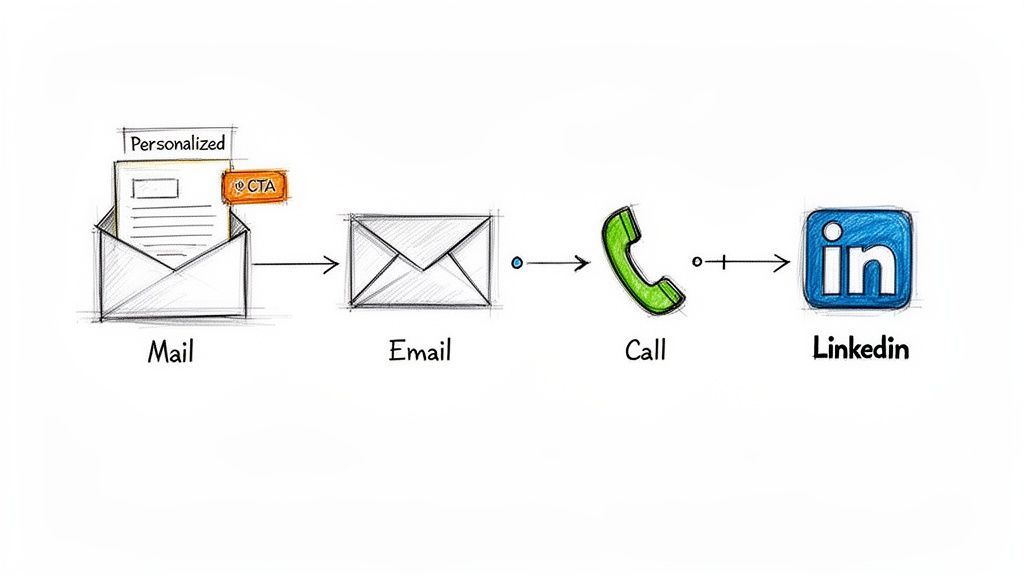
This coordinated strategy ensures your outreach is seen and felt, significantly increasing engagement and meeting booking rates compared to purely digital sequences. It is particularly effective for targeting C-suite executives or key decision-makers at enterprise-level accounts.
How It Works: Implementation Steps
- Prospect Tiering: Identify your top 20-50 highest-value prospects. This strategy is resource-intensive, so focus it on accounts with the greatest potential ROI.
- Address Verification: Use data enrichment tools or manual verification to confirm the correct mailing addresses for your target contacts. An incorrect address wastes both time and money.
- Mail Piece Execution: Send a personalized item. This could be a handwritten note, a relevant book, or a small, thoughtful gift related to the prospect's interests or industry challenges.
- Timed Digital Follow-up: Track the delivery of your package. Begin your digital sequence (email, LinkedIn connection, phone call) 2-3 days after the mail is scheduled to arrive, referencing the item you sent to create a warm opening.
Actionable Tips for Success
- Validate Before Mailing: Before launching your campaign, use a tool like Add to CRM to capture prospect data and cross-reference it with address validation services. This minimizes returned mail and ensures your investment reaches its target.
- Time Your Follow-up: Send the physical mail piece 3-5 business days before your first digital touchpoint. This timing is crucial for the "warm" reference to land effectively.
- Personalize Thoughtfully: Go beyond just using their name. Reference a recent company achievement, a quote from an article they wrote, or a shared hobby to show genuine research.
- Track Everything: Create a clear call-to-action, like a unique landing page URL or a specific person to contact. This makes it easier to measure the direct ROI of your direct mail efforts.
Works with 29+ CRMs
Add to CRM finds verified emails, phone numbers, and job titles on LinkedIn® — then adds them to your CRM in one click.
Start Free TrialTrusted by 2,500+ users4.710. Competitor Customer and Win-Back Outreach
This outbound strategy targets two highly qualified audience segments: customers currently using a competitor's product and former customers who have churned. It capitalizes on existing market awareness and buying intent, allowing you to position your solution as a superior alternative or to recover valuable lost accounts. The core principle is leveraging comparison and context to shorten the sales cycle.
This targeted approach bypasses the need to educate prospects from scratch. Instead, the conversation starts from a place of shared understanding, focusing on specific feature gaps, pricing inefficiencies, or service issues they are already experiencing. It’s one of the most direct outbound lead generation strategies for capturing market share.
How It Works: Implementation Steps
- Identify Target Accounts: Build a list of companies known to use a key competitor. This can be done by monitoring G2 reviews, analyzing competitor case studies, or looking for employees with competitor software skills listed on professional networks. For win-back campaigns, segment churned customers by their reason for leaving.
- Develop Comparison Assets: Create materials that make a direct, evidence-based comparison. This could be a feature matrix, an ROI calculator, or a whitepaper detailing how your solution solves a common pain point that the competitor’s product creates.
- Execute a Multi-Channel Outreach Sequence: Launch a targeted campaign that references the prospect’s current or former solution. The messaging should acknowledge their experience and present a clear, compelling reason to consider a switch or to return. For example, a tech vendor might achieve a 20%+ conversion rate by messaging competitor customers with a clear ROI proposition.
Actionable Tips for Success
- Tailor Your Win-Back Offer: Analyze churn reasons to create specific, irresistible win-back incentives. If customers left due to price, offer a limited-time discount. If it was a missing feature you’ve since built, highlight that specific update.
- Enrich Your Data: Use a tool like Add to CRM to find and verify contact data for key decision-makers at competitor customer accounts. Enriching your list with accurate emails and phone numbers is critical for multi-channel outreach.
- Be Specific in Your Messaging: Don't just say you're "better." Reference a specific known weakness of the competitor, such as "Tired of the manual data export process in [Competitor's Tool]? We offer a one-click integration."
- Leverage Social Proof: Follow up your initial outreach with case studies and testimonials from customers who successfully switched from that specific competitor to your solution. This provides powerful, relevant validation.
10-Strategy Outbound Lead Generation Comparison
| Strategy | Implementation complexity | Resource requirements | Expected outcomes | Ideal use cases | Key advantages |
|---|---|---|---|---|---|
| LinkedIn Strategies: Outbound Prospecting & Influencer Amplification | Medium–High: sequences + influencer coordination | Moderate: LinkedIn tools, CRM, time for relationship building | Targeted meetings and inbound leads; ROI varies with influencer fit | B2B SaaS, thought leadership, SDR teams | Direct access to decision‑makers; influencer credibility; personalized at scale |
| Cold Email Outbound Campaigns with Personalization | Medium: setup sequences, A/B tests, deliverability work | Low–Moderate: verified lists, ESP/automation, copywriting | High-volume outreach with measurable opens/clicks; typically low reply rate unless highly personalized | Scalable lead gen, early-stage growth, volume-based outreach | Very scalable and measurable; low cost per outreach; easy to iterate |
| Account-Based Marketing (ABM) Outbound Strategy | High: account mapping, multi-channel coordination | High: dedicated ABM team, content, tooling and analytics | High conversion and larger deal sizes; predictable pipeline over long cycles | Enterprise B2B, high ACV deals, multi-stakeholder sales | Best conversion rates; aligned sales/marketing; multi-stakeholder engagement |
| Strategic Partnerships and Channel Outbound | Medium: partner identification and onboarding processes | Moderate–High: partner enablement, incentives, co-marketing assets | Warm, referral-driven leads; CAC typically lower over time; variable volume | Companies with complementary ecosystems, reseller models | Warm introductions with built-in credibility; scalable through partner networks |
| Phone Prospecting and Warm Calling Sequences | Medium: playbooks, coaching, compliance management | High: trained reps, dialer, call analytics, phone data | Fast qualification and high engagement; immediate feedback; variable conversion | Enterprise sales, complex deals needing human interaction | Highest direct engagement and fastest path to decision-makers |
| Event-Based Outbound Prospecting | Medium: pre/during/post coordination and timing | Moderate: attendee lists, event tools, staff time | High-intent meetings and follow-ups; short engagement window | Conference-driven industries, networking-focused outreach | High intent and easy personalization; superior response vs cold outreach |
| Intent Data and Buying Signal-Based Outreach | High: integrations and signal validation | High: intent platforms, integrations, ongoing subscription costs | Higher conversion and shorter cycles when signals are accurate | Enterprise sales, prioritizing in-market accounts | Targets accounts actively researching solutions; improved timing and relevance |
| Referral and Warm Introduction Programs | Medium: program design and advocate management | Low–Moderate: incentives, tracking, CRM workflows | Very high conversion and lower CAC; volume depends on advocate network | Customer-centric SaaS, strong-NPS businesses | Highest conversion rates; built-in credibility and retention benefits |
| Direct Mail and Multi-Channel Outbound Sequences | Medium–High: creative, timing, and coordination | High: production, verified addresses, logistics | High differentiation and memorable responses; costly per prospect | Executive outreach and very high-value deals | Breaks through digital noise; strong lift when combined with digital follow-ups |
| Competitor Customer and Win-Back Outreach | Medium: list acquisition and competitive messaging | Moderate: data providers, CRM segmentation, targeted offers | Higher conversion vs cold outreach; faster decisions but limited scale | Companies with clear differentiation or churned customer base | Leverages existing intent and familiarity; faster path to re‑engagement |
Building Your Outbound Engine: From Strategy to Execution
Navigating the landscape of outbound lead generation strategies can feel overwhelming. We've explored a diverse toolkit, from the digital precision of LinkedIn prospecting and intent data-driven outreach to the tangible impact of direct mail and the human connection of strategic partnerships. The core lesson is clear: there is no single "best" strategy, only the best strategy for you. The true power lies not in picking one tactic, but in building a cohesive, multi-channel outbound engine tailored to your ideal customer profile, your product, and your market.
Success in outbound sales is a game of strategic integration. A cold email campaign (Strategy #2) gains immense power when preceded by targeted engagement on social platforms (Strategy #1). An Account-Based Marketing push (Strategy #3) becomes unstoppable when it incorporates insights from event-based triggers (Strategy #6) and is supported by a warm referral program (Strategy #8). This interconnected approach creates multiple touchpoints, building familiarity and trust long before you ask for a meeting.
Synthesizing Strategy into Action
The transition from theory to revenue requires a disciplined, iterative process. Your immediate goal should not be to implement all ten strategies at once. Instead, the focus should be on creating a sustainable system for growth.
Here’s a practical framework to get started:
- Prioritize and Select: Re-evaluate the strategies discussed. Which two or three align most closely with where your buyers spend their time and how they make decisions? If you sell a high-ticket, complex solution to enterprise clients, a combination of ABM, event prospecting, and strategic partnerships might be your ideal starting point. A high-velocity startup targeting SMBs might find more initial success with hyper-personalized cold email and LinkedIn outreach.
- Establish a Data Foundation: Your outbound efforts are only as effective as the data they are built on. Inaccurate or incomplete CRM records lead to bounced emails, wasted calls, and irrelevant messaging. Before launching any campaign, commit to a process that ensures every lead is clean, enriched, and accurate. This is the non-negotiable foundation of a predictable pipeline.
- Measure, Analyze, Iterate: Outbound is a science of continuous improvement. For each strategy you deploy, define your key performance indicators (KPIs). Track open rates, reply rates, meetings booked, and ultimately, conversion rates. Don't be afraid to A/B test your messaging, experiment with different channels, and pivot your approach based on what the data tells you. A strategy that isn't working is not a failure; it's a learning opportunity that guides your next move.
The Unifying Thread: Efficiency and Data Integrity
The most significant bottleneck in any outbound motion is manual, repetitive work. Time spent manually copying contact details, cleaning data, or logging activities is time not spent personalizing outreach, having meaningful conversations, and closing deals. This is where modern sales tools become a competitive advantage, transforming your operational efficiency.
The most successful outbound lead generation strategies are not just about what you do, but how efficiently and effectively you do it. By combining a multi-channel approach with a relentless focus on data quality and operational speed, you move beyond sporadic lead generation. You begin to build a predictable, scalable, and powerful outbound engine that consistently fuels your company's growth and establishes a dominant position in your market. Your journey starts not with a single campaign, but with the commitment to building this integrated system.
Ready to eliminate manual data entry and supercharge your outbound prospecting? Add to CRM allows you to instantly capture, enrich, and sync leads from LinkedIn, Gmail, and across the web directly to your CRM with a single click. Start building a cleaner, more actionable pipeline today by visiting Add to CRM and starting your 7-day free trial.
Start saving time and closing more deals.
Find verified contact info for your prospects on LinkedIn®, Gmail and Outlook — and add them to your CRM with 1-click.

 Loading...Trusted by 2,500+ founders, SDRs & more