How to Qualify Sales Leads for Higher Conversions
Learn how to qualify sales leads with our practical guide. Discover proven frameworks and scoring models that will shorten your sales cycle and boost revenue.
To qualify sales leads right, you have to ditch the "quantity over quality" mindset. It's a strategic pivot from chasing every single form fill to systematically disqualifying most of them.
This allows your sales team to pour all their energy into the handful of leads with real potential. It’s the difference between a clogged pipeline and a high-converting sales engine.
Stop Chasing Every Lead, Start Qualifying Smart
Jumping straight into demos without vetting leads is a recipe for a burnt-out sales team and missed revenue targets. Mastering how to qualify sales leads isn't just a sales tactic; it's a core strategy for sustainable growth.
When you get it right, you see better resource allocation, higher conversion rates, and a much healthier return on your sales and marketing spend.
Every hour a sales rep wastes on a prospect who will never buy is an hour they could have spent with a future champion. The goal is to build a process that filters out the noise so you can zero in on the signal.
The Real Cost of a Weak Process
Think about two different sales development reps (SDRs).
The first one chases every form submission, booking demos with anyone who shows even a flicker of interest. Their calendar is packed, but it’s full of low-quality conversations that rarely go anywhere.
The second SDR is more disciplined. They understand their time is their most valuable asset. This rep might disqualify 75% of incoming leads right off the bat because they don't fit the ideal customer profile. They then focus all their effort on the top 25%—the ones with the right company size, industry, and a demonstrated need.
This strategic disqualification leads to fewer meetings, sure, but the conversations are much higher quality. And ultimately? They close more deals.
The biggest shift in sales has been moving from “any lead is a good lead” to a strict focus on fit and intent. This isn't a new idea; for years, data has shown that the vast majority of marketing-generated leads are not ready for a sales conversation and will never convert.
From Volume to Value
This pivot from volume to value has a profound impact. Sales organizations that thoroughly qualify leads—confirming fit, need, authority, and timing—see their conversion rates soar.
Historically, this disciplined approach has pushed conversion rates to around 40%. That’s a nearly fourfold improvement over the 11% average for unqualified prospects, a statistic you can dig into deeper over at landbase.com. A refined process truly can transform your pipeline.
This structured approach also makes your forecasting more accurate and builds a more predictable revenue engine. By understanding the fundamentals of a strong qualification process, you lay the groundwork for a more efficient sales motion.
And when you're ready to really dial things in, you can explore our guide on outbound lead generation for strategies that complement a strong qualification framework. The synergy between how you generate leads and how you qualify them is where the real growth happens.
Find the Right Lead Qualification Framework
Alright, so you’re committed to filtering out the noise. What’s next? You need to actually build the filter. A lead qualification framework gives you a structure for your discovery calls, turning them from random Q&A sessions into strategic fact-finding missions.
Think of these frameworks less like rigid scripts and more like flexible toolkits. They’re designed to help you uncover the information that really matters.
Choosing the right one comes down to your business. A simple, transactional sale is worlds away from a complex, six-month enterprise deal with a dozen stakeholders. The goal here is to pick a framework that matches your sales motion and helps your reps have more meaningful, productive conversations from the very first call.
This decision tree breaks down the fundamental choice every sales team faces when a new lead comes in: apply a structured qualification process or just chase everything that moves.
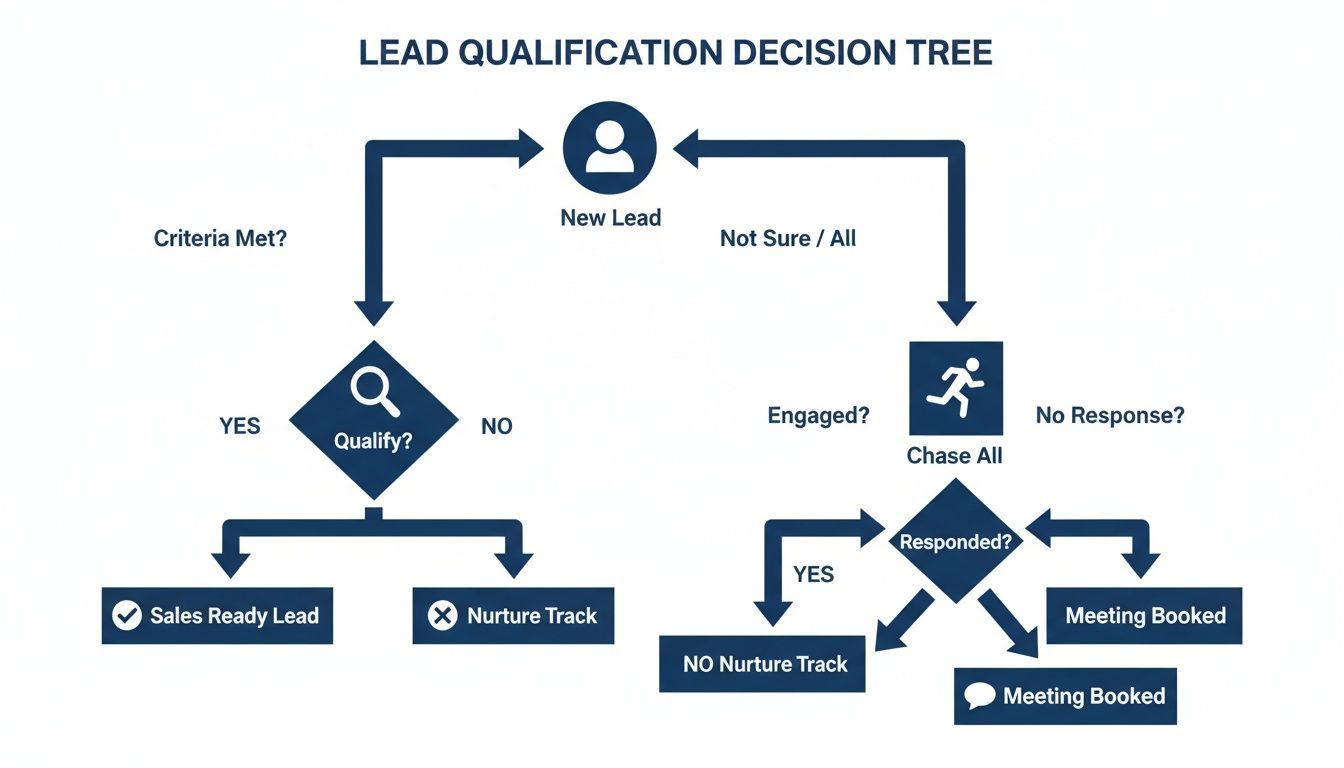
As you can see, qualifying leads is the only strategic path forward. It stops you from wasting resources and focuses your team’s energy where it’s most likely to pay off. It’s the first real step toward building a predictable sales engine.
BANT: The Classic Approach
BANT is probably the most famous framework out there, and for good reason—it’s simple and it works for a lot of sales cycles. It’s an acronym for:
- Budget: Does the prospect have the money to actually buy your solution?
- Authority: Is the person you're talking to the real decision-maker, or at least a key influencer?
- Need: Is there a clear, painful business problem that your product or service solves?
- Timeline: Do they have a specific timeframe for when they need to find a solution?
BANT is perfect for businesses with shorter sales cycles and a more straightforward buying process. It gives reps a quick way to disqualify leads who are missing one of these key pieces, saving time for everyone. In fact, one study found that 67% of lost sales happen because reps didn't qualify their leads properly from the start—a problem BANT directly solves.
BANT is a conversation guide, not an interrogation checklist. A rookie asks, "Do you have a budget?" A pro asks, "To get a sense of what a solution like this might cost, have you invested in similar tools before?" That small shift keeps the conversation flowing naturally.
MEDDIC: For Complex Enterprise Sales
When the deal size is huge and the buying committee is even bigger, you need a more heavy-duty framework. Enter MEDDIC. It’s built for the chaos of enterprise sales, helping reps navigate complicated org charts and high-stakes decisions.
MEDDIC stands for:
- Metrics: What are the specific, quantifiable business outcomes the prospect is trying to achieve?
- Economic Buyer: Who is the person with the ultimate P&L responsibility for this purchase?
- Decision Criteria: What are the official criteria the company will use to evaluate vendors?
- Decision Process: What are the exact steps the company follows to make a buying decision?
- Identify Pain: What is the core business problem, and what happens if they do nothing?
- Champion: Who is the influential person on the inside who will fight for your solution?
This framework forces a deep level of discovery that’s absolutely critical for closing those six or seven-figure deals. It shifts the entire conversation away from features and squarely onto measurable business impact.
CHAMP: Putting the Customer First
CHAMP is a more modern, customer-centric framework that puts the prospect's challenges front and center. It stands for:
- Challenges: What are the biggest hurdles the prospect is facing right now?
- Authority: Who else is involved in making this decision?
- Money: What does the financial picture for this project look like?
- Prioritization: How important is solving this challenge compared to everything else on their plate?
By leading with Challenges, CHAMP encourages reps to act more like a consultant than a salesperson. This approach is killer for consultative sales models where building trust and deeply understanding the prospect’s world is what gets the deal done. It helps you frame your solution as the direct answer to their most urgent problems.
Choosing and Adapting Your Framework
Look, no single framework is a silver bullet. The best move is to pick one that feels right for your sales process and then tweak it to fit your specific needs. The real key is consistency—once you've chosen a framework, get your entire team trained up and using it on every call.
To help you decide, here’s a quick-reference table breaking down how these popular frameworks stack up.
Comparing Lead Qualification Frameworks
| Framework | Best For | Core Focus | Example Question |
|---|---|---|---|
| BANT | Shorter sales cycles and transactional deals. | Quick, essential qualification points. | "What's your timeline for implementing a new solution?" |
| MEDDIC | Complex, high-value enterprise sales. | Deep discovery of buying processes and ROI. | "What specific metrics will you use to judge the success of this project?" |
| CHAMP | Consultative sales and relationship building. | Understanding and solving customer pain points. | "What are the biggest challenges your team is facing right now?" |
Regardless of which framework you land on, remember that qualification isn’t a one-and-done event. It’s an ongoing conversation. As you learn more about the prospect and their organization, you’ll constantly refine your understanding of whether they’re a true fit. This iterative process is what separates the good sales teams from the great ones.

Find verified contact data on LinkedIn®
Add to CRM finds verified emails, phone numbers, and job titles on LinkedIn® — then adds them to your CRM in one click.
Start Free Trial


 Trusted by 2,500+ users4.7
Build a Lead Scoring Model That Actually Works
Once you've got your qualification framework down, the next step is to turn that strategy into a system. That’s where lead scoring comes in. Think of it as the engine that translates your ideal customer profile and all those qualification questions into a simple, data-driven number.
At its core, lead scoring tells your reps, "Pay attention to this lead, right now."
Instead of relying on gut feelings, a solid scoring model uses concrete data to prioritize outreach. It’s a systematic way to make sure your team always focuses on the leads most likely to convert, helping you build a predictable pipeline instead of just guessing.
The Two Pillars of a Strong Scoring Model
A great lead scoring model isn't some crazy-complex algorithm. It really just boils down to two key parts. When you combine them, you get a powerful snapshot of a lead's true potential.
- Firmographic Scoring (The Fit): This is all about how well the lead aligns with your Ideal Customer Profile (ICP). You assign points for static attributes—things like their job title, company size, or industry. This is the "quality" half of the equation.
- Behavioral Scoring (The Intent): This side of the coin tracks what a lead is actually doing. High-intent actions, like requesting a demo or visiting your pricing page, are worth way more points than passive ones, like just opening an email.
Here’s a visual breakdown of how these two scores work together to paint a clear picture of a lead's value, guiding your reps on where to focus their time.
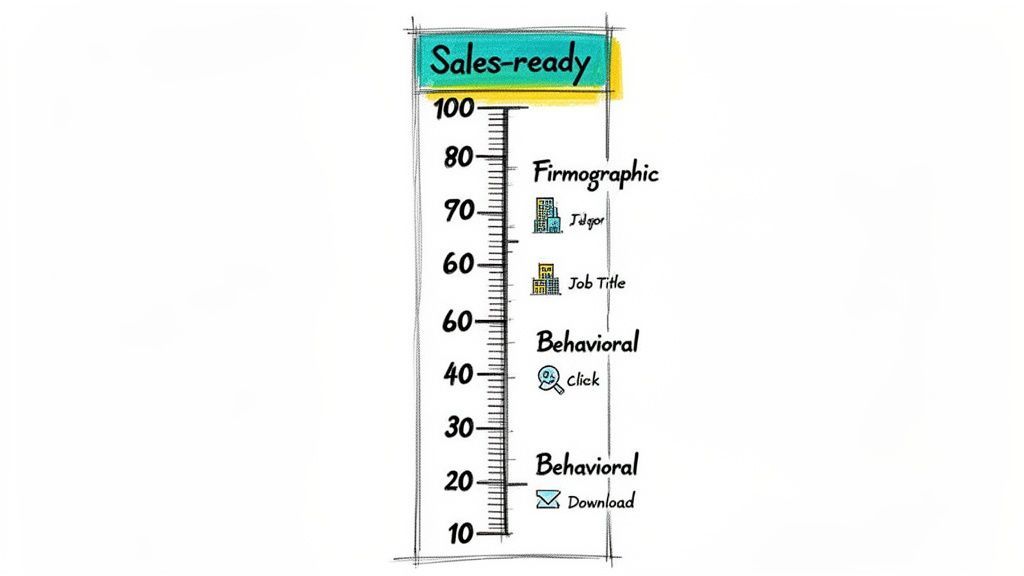
As you can see, a lead's score climbs as they accumulate points from both their profile fit and their engagement, eventually hitting that "Sales Ready" threshold.
Designing Your Scoring Template
The absolute key to making this work? Sales and marketing have to be on the same page. You must agree on what actions and attributes actually signal a "sales-ready" lead. If you skip this step, marketing will just keep tossing leads over the fence that sales immediately rejects, creating friction and wasting everyone's time.
Here’s a basic template you can steal and adapt:
Firmographic Score (Explicit Data)
- Job Title: C-Level/VP (+20), Director (+15), Manager (+10)
- Industry: Target Industry A (+15), Target Industry B (+10)
- Company Size: 100-500 Employees (+15), 501-2000 Employees (+10)
- Country: USA, Canada, UK (+5)
Behavioral Score (Implicit Data)
- High-Intent Actions: Demo Request (+30), Pricing Page Visit (+20)
- Medium-Intent Actions: Webinar Attendance (+15), Case Study Download (+10)
- Low-Intent Actions: Blog Subscription (+5), Email Open (+1)
This simple setup lets you define a clear handoff point. For example, any lead with a total score over 75 gets automatically flagged as an SQL and routed to a sales rep.
Not sure what a lead is worth? To get a better handle on the numbers, you can use our calculator to determine your lead value and tweak your scoring model from there.
The Role of Data Enrichment
Look, your scoring model is only as good as the data you feed it. A lead might fill out a form with just their name and email, which gives you almost nothing to score. This is where data enrichment tools are a game-changer.
These tools take a tiny piece of information (like that email address) and automatically add all the crucial firmographic details—company size, industry, revenue, location, you name it. They instantly fill in the blanks, so your scoring engine can accurately assess a lead's fit without anyone on your team having to do manual research.
Modern lead qualification runs on data, not intuition. Industry benchmarks show that for many B2B teams, about 40% of leads fall into a "sweet spot" score of 41–60 out of 100. And the payoff is huge: businesses that embrace this data-driven approach can see 5–8x higher ROI. Even better, AI-powered scoring can boost qualification accuracy by around 40% compared to old-school methods.
Ultimately, a well-built lead scoring model, fueled by clean and enriched data, becomes the engine of an efficient sales machine. It automates the messy work of prioritization, making sure your reps spend their precious time talking to prospects who are both a great fit and actively showing they're ready to buy.
Automate Your Qualification Workflow
Having a solid lead scoring model is one thing, but actually putting it to work automatically is where the magic happens. This is the moment you stop just planning your qualification strategy and start embedding it directly into your tech stack.
You’re essentially turning your process from a manual checklist into a well-oiled machine that runs 24/7. The goal is to build a seamless flow that hums along without someone needing to constantly poke it. From the second a lead comes in to the moment it lands in a sales rep's queue, automation should be doing the heavy lifting. This guarantees consistency and speed, making sure hot leads never go cold sitting in a generic inbox.
Configure Your CRM for Qualification
Think of your CRM as the central nervous system of your sales process. Before you can automate a single thing, it needs to understand what "qualified" actually means to you. This goes beyond the default fields—you need to customize your CRM to mirror the qualification framework you've chosen.
For example, if you're using BANT, you should build custom fields for each letter:
- Budget Confirmed: A simple dropdown menu ("Yes," "No," "Partial").
- Authority Identified: A text field to jot down the key decision-maker's title.
- Need Defined: A checkbox or a score to show how urgent the prospect's pain is.
- Timeline Specified: A date field for their expected implementation window.
Setting up an automation workflow in your CRM might look something like this, where custom fields trigger specific actions.
This flowchart shows a simple but powerful rule: once a lead hits certain criteria, the system takes over. No more manual hand-offs or delays. By mapping your qualification framework directly onto your CRM fields, you’re creating the data structure you need to build some seriously powerful automations.
Create Simple Automation Recipes
With your custom fields ready to go, you can start building automation rules that will save your team hundreds of hours. These "recipes" are just simple if/then statements that trigger actions based on the lead data coming in. Your CRM's workflow builder is the perfect spot to set these up.
Just think about all the repetitive tasks your team does every day. How many can you offload to a machine? We know reps spend way too much of their day on non-selling activities. Even a 20% improvement in personalization from automation can lead to huge gains in engagement.
Here are a few practical automation recipes you can build today:
- Instant Lead Assignment:
- Trigger: If
Lead Scoreis greater than80ANDIndustryequalsSaaS. - Action: Create a task for your go-to SaaS Account Executive and change the lead status to "Sales Qualified."
- Nurture Sequence Enrollment:
- Trigger: If
Lead Scoreis between40-79ANDTimelineisMore than 6 months. - Action: Add the lead to a long-term email nurture campaign that focuses on educational content.
- Data Enrichment Trigger:
- Trigger: When a
New Leadis created from a web form. - Action: Automatically run the lead through a data enrichment tool to fill in the firmographic details.
The best automations connect different parts of your process. For instance, enriching a lead's data can automatically update their score, which in turn can trigger an assignment to a rep. It's this chain reaction that makes for a fast and efficient handoff every single time.
By automating these steps, you eliminate the soul-crushing copy-paste work that slows everyone down. If you want to go deeper on this, our guide on how to automate data entry offers more advanced techniques. This frees up your reps to focus on what they were hired to do: build relationships and close deals.
Avoid These Common Qualification Pitfalls
Building a qualification process is a huge step forward, but even the best-laid plans can go sideways in the real world. Knowing how to qualify sales leads is as much about dodging common mistakes as it is about following a framework. These pitfalls can subtly sabotage your pipeline, leading to frustration and missed targets.
Think of qualification not as a rigid gate but as a flexible filter. The most successful sales teams I've worked with understand this distinction and navigate the gray areas with skill. By learning to spot these common mistakes, you can build a more resilient and effective qualification machine.
Treating Qualification as a Checklist
The single biggest mistake I see reps make is turning a framework like BANT into a robotic interrogation. They just march through their questions—"Do you have a budget? Are you the decision-maker?"—without actually listening or building any real rapport. The whole thing feels transactional and immediately puts prospects on the defensive.
Qualification is a conversation, not a cross-examination.
Your goal is to understand the prospect's world, not just tick boxes. Instead of bluntly asking about budget, a skilled rep might say, "Have you invested in similar tools before? That can help us get a ballpark idea of what a solution like this might look like." This subtle shift keeps the dialogue natural and consultative.
Your qualification framework should guide the conversation, not dictate it. If you're so focused on getting through your list of questions that you miss a critical insight the prospect shares, the framework has failed you. True qualification is about active listening.
Relying on a Single Data Point
Another classic trap is putting too much weight on one piece of information. A lead might have the perfect job title and work for a company that fits your ideal customer profile to a T. But if they have no identified need or their timeline is two years out, they aren't a qualified opportunity right now.
On the flip side, don't immediately disqualify a lead just because one element is missing.
Consider this real-world scenario:
- The Situation: A prospect has a clear, painful problem that your product solves perfectly. They're enthusiastic and see the value immediately. But then they admit they don't have the authority to sign the check.
- The Mistake: Disqualifying them and moving on.
- The Smart Move: See it as an opportunity. Ask, "Who would be the right person to bring into this conversation? Could you help me understand what they care about most?"
This approach turns a potential dead end into a chance to build an internal champion. This person can advocate for your solution and give you valuable intel on the real decision-maker.
Failing to Revisit Your Process
Your qualification criteria and lead scoring model are not set in stone. The market changes, your product evolves, and your ideal customer profile might shift. A model that worked perfectly last year could be completely out of sync with your current business goals.
When you fail to regularly review and adjust your process, you end up with a stale, ineffective pipeline. It's a massive issue. One study even found that 67% of lost sales are due to reps not qualifying leads properly—a problem often rooted in an outdated process.
You should audit your qualification process at least quarterly. Here’s how to do it:
- Analyze Closed-Won Deals: Look at your last 50 closed deals. What did they all have in common? Are those attributes properly weighted in your lead scoring model?
- Talk to Your Sales Team: Get feedback directly from the reps on the front lines. Are they finding that MQLs are consistently unprepared for a sales conversation? Their insights are pure gold.
- Review Disqualified Leads: Randomly sample some recently DQ'd leads. Did you make the right call? Could any of them have been nurtured into an opportunity with a bit more time?
By treating your qualification process as a living, breathing document, you ensure it stays sharp, relevant, and effective at identifying your next best customers.
Works with 29+ CRMs
Add to CRM finds verified emails, phone numbers, and job titles on LinkedIn® — then adds them to your CRM in one click.
Start Free TrialTrusted by 2,500+ users4.7Frequently Asked Questions About Qualifying Leads
Even with the best frameworks and automation humming along, you're going to run into tricky, real-world scenarios. It happens to every sales team.
Getting quick, clear answers to these common questions is what separates a good qualification process from a great one. Think of this as your go-to reference for those "what do I do when..." moments.
What Is the Difference Between an MQL and an SQL?
This is one of the most fundamental (and important) distinctions in the entire sales and marketing world. Getting it right is the key to a healthy pipeline and a happy team.
The handoff between a Marketing Qualified Lead (MQL) and a Sales Qualified Lead (SQL) is that critical moment when a prospect moves from marketing's world into sales' direct line of sight.
An MQL is someone marketing has flagged as a potential fit based on their engagement. They downloaded an ebook, sat in on a webinar, or visited your pricing page three times this week. They're interested, but they haven't raised their hand to talk to a rep just yet.
An SQL is a lead that the sales team has personally vetted and confirmed has real, near-term buying intent. This is someone who has passed a qualification framework like BANT or MEDDIC. You've confirmed they have a legitimate need, the budget to solve it, and the authority to make a decision.
The jump from MQL to SQL is where true qualification lives.
How Often Should I Update My Lead Scoring Model?
Your lead scoring model is not a crockpot. You can't just "set it and forget it."
Markets shift, your product gets new features, and your ideal customer profile evolves. A model that was perfectly calibrated six months ago could be sending your sales team on a wild goose chase today.
As a rule of thumb, you should review your lead scoring model at least quarterly. You'll also want to do a full audit any time your business makes a big move—like launching a new product, overhauling your pricing, or entering a new market.
A killer habit to get into: Pull your last 50-100 closed-won deals. What did they have in common? What actions did they take? If your current scoring model isn't flagging new leads with those same attributes as "hot," it's time for a tune-up.
Don't forget to talk to your sales reps. They're on the front lines and will be the first to tell you if the quality of leads is starting to dip.
Can I Disqualify a Lead Who Fits My Ideal Customer Profile?
Yes. Absolutely. In fact, you should.
This is a tough one for a lot of reps to swallow, but it's crucial for maintaining a clean pipeline. A lead can tick every single box on your Ideal Customer Profile (ICP)—perfect industry, company size, and job title—but still be a terrible fit for your active pipeline right now.
Why? Timing. It's almost always about timing.
They might have just locked into a multi-year contract with your biggest competitor. Or maybe they're in the middle of a budget freeze. Or they just have bigger fish to fry at the moment. Chasing them will just burn cycles and create frustration on both sides.
The smart move here is to disqualify them from the active sales pipeline and drop them into a long-term nurture sequence. You're respecting their time, keeping your focus on winnable deals, and ensuring you're the first person they think of when their situation changes down the road.
Stop wasting hours on manual data entry and start closing more deals. With Add to CRM, you can turn any professional networking profile, Gmail, or Outlook contact into a clean CRM record in a single click. Save time, enrich your leads, and keep your pipeline pristine. Start your 7-day free trial at Add to CRM.
Start saving time and closing more deals.
Find verified contact info for your prospects on LinkedIn®, Gmail and Outlook — and add them to your CRM with 1-click.

 Loading...Trusted by 2,500+ founders, SDRs & more