Master how to build a sales pipeline: A practical playbook for consistent growth
Learn how to build a sales pipeline with a practical guide that defines stages, captures quality leads, and uses CRM automation to drive steady growth.
Building a sales pipeline isn't just about listing deals. It's about architecting the journey a prospect takes with you, from the first "hello" to a signed contract. Think of it as your visual roadmap—mapping out stages like prospecting, qualifying, and closing—that transforms random sales activities into a predictable revenue engine.
Your Blueprint for a Predictable Revenue Engine
A sales pipeline is the operational backbone of your entire revenue strategy. It gives you a clear, visual snapshot of where every single potential customer stands in their buying journey.
Without this structure, sales teams are stuck in reactive mode. It's chaotic, stressful, and makes forecasting revenue feel like guesswork. On the other hand, companies that truly master their sales process see 18% faster revenue growth than those that don't. That’s a massive difference.
This guide is an actionable framework for B2B teams ready to build a system for predictable growth. A well-designed pipeline turns sporadic wins into a consistent, humming revenue machine by standardizing how your team finds, engages, and closes deals.
The core components are surprisingly simple:
- Clear Stage Definitions: Moving beyond vague labels like "Lead" to concrete stages with specific entry and exit criteria.
- Practical Qualification Rules: Using frameworks to make sure reps are spending their valuable time on high-potential deals, not just a high volume of leads.
- Smart Tooling: Using automation to handle the tedious stuff—data entry, follow-up reminders—so your team can actually focus on selling.
A common mistake is confusing a sales pipeline with a sales funnel. A pipeline tracks the actions your sales team takes to move a deal forward. A funnel tracks the buyer's journey and conversion rates between stages. Mastering your pipeline gives you direct control over your sales outcomes.
To get you started, here’s a high-level map of the typical journey from prospect to closed deal. This table breaks down the essential stages we'll dive into.
The 7 Essential B2B Sales Pipeline Stages
| Stage Name | Description & Key Action |
|---|---|
| Prospecting | Identifying and gathering a list of potential customers (leads) who fit your Ideal Customer Profile (ICP). |
| Qualification | Engaging with leads to determine if they have the budget, authority, need, and timeline (BANT) to buy. |
| Meeting/Demo | Conducting a scheduled meeting or product demonstration to present your solution and address their specific pain points. |
| Proposal | Sending a formal quote or proposal outlining the scope, pricing, and terms of your offer. |
| Negotiation | Discussing and finalizing the terms of the agreement, including pricing, contract details, and implementation. |
| Closing | Securing a verbal or signed agreement from the customer, officially marking the deal as "won." |
| Post-Sale | Onboarding the new customer and managing the relationship to ensure satisfaction and identify future opportunities. |
Each of these stages represents a critical milestone. Getting them right is the first step toward building a sales process that actually works.
Defining Your Pipeline Stages and Qualification Rules
The foundation of any solid sales pipeline isn't a fancy CRM or a long list of leads—it's clarity. When you use vague stages like 'Lead' or 'Opportunity,' you create confusion. Your forecast gets bloated with unqualified deals, and reps waste precious time chasing prospects who will never, ever buy.
To build a pipeline you can actually trust, you need to define concrete entry and exit criteria for every single stage. What specific event or piece of information moves a prospect from one stage to the next? When your entire team operates with the same rulebook, you finally get a clean, accurate picture of your revenue potential.
This flowchart shows a bird's-eye view of the core process, breaking it down into three essential phases: prospecting, qualifying, and closing.
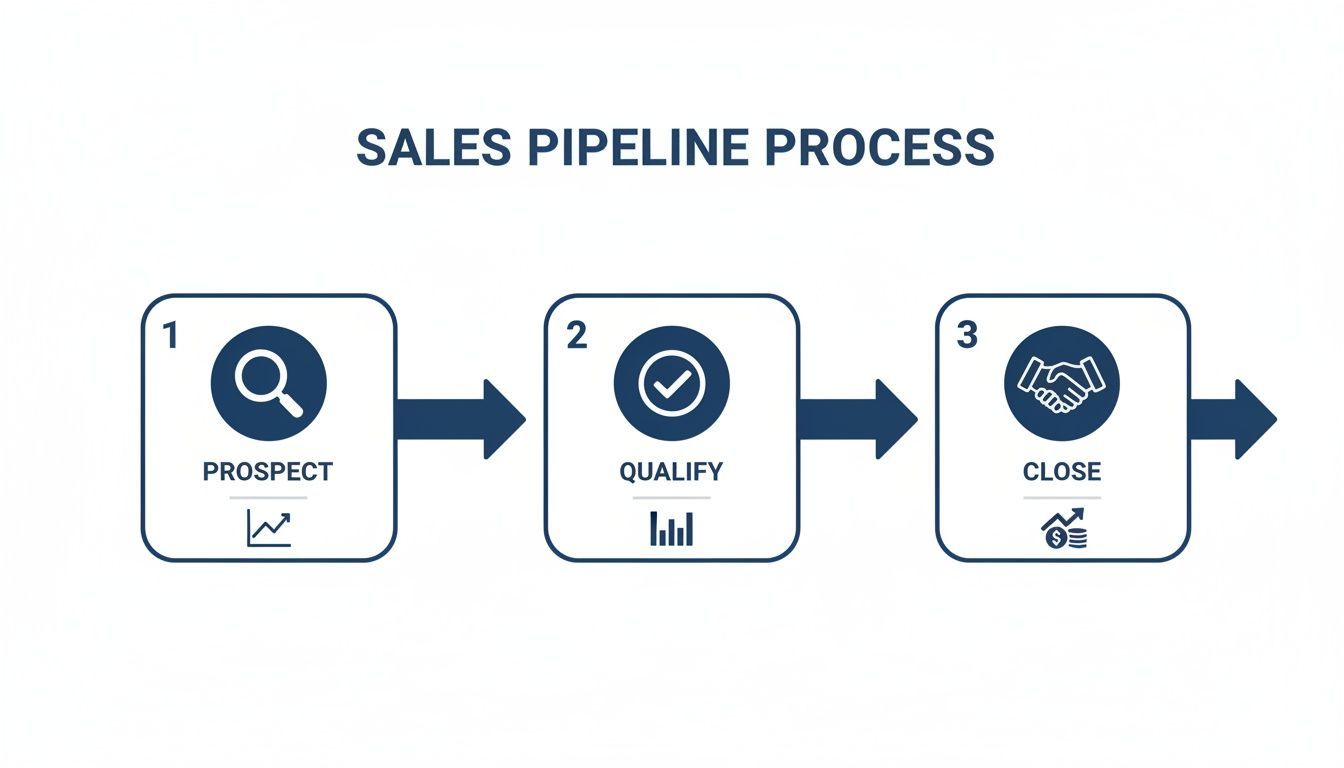
Each of these phases contains its own distinct stages, and each stage demands clear rules to keep deals flowing smoothly from one to the next.
From Vague Labels to Concrete Actions
Think of your pipeline stages as checkpoints in the buyer's journey. A prospect can only pass a checkpoint once they've met specific, non-negotiable requirements. This removes all the subjectivity and guesswork, ensuring every deal in a particular stage has reached the same level of commitment.
For example, ditch a generic "Contacted" stage. Instead, define it as "Discovery Call Booked." The exit criterion is simple and binary: a meeting is either on the calendar, or it isn't. This one change instantly clarifies the status of every prospect at the top of your pipeline.
A well-defined pipeline is a shared language for your entire revenue team. When a sales rep says a deal is in the 'Proposal' stage, everyone from the CEO to the marketing lead should know exactly what that means—a formal quote has been sent, and the prospect has acknowledged receipt.
Building Your Qualification Framework
A qualification framework gives your team the specific rules for advancing deals. One of the most trusted and straightforward frameworks is BANT, which stands for Budget, Authority, Need, and Timeline. It prompts your reps to ask the right questions to figure out if a prospect is a genuine fit.
- Budget: Does the prospect have money allocated for this? It’s not about getting an exact number right away, but you need to confirm they have an approved budget for this type of project.
- Authority: Are you talking to the final decision-maker? Or at least someone who can sway the decision? If not, your next move is to map out the entire buying committee.
- Need: Have they clearly spelled out a pain point or business challenge that your product directly solves? A "nice-to-have" isn't a qualified need. It's a dead end.
- Timeline: Do they have a specific timeframe for making this happen? A project vaguely slated for "sometime next year" isn't an active opportunity and shouldn't be clogging up your current pipeline.
By writing these rules down, you empower reps to disqualify poor-fit leads early and often. This keeps the pipeline healthy and focused only on deals with a real chance of closing. For a deeper dive, check out our complete guide on the ideal sales pipeline format.
Setting Realistic Benchmarks
Defining your stages is only half the battle. You also need to understand what "good" actually looks like.
Today, a healthy B2B sales pipeline isn't measured by raw lead volume but by its stage-by-stage conversion rates. Recent data shows that for a typical B2B pipeline, only 20–25% of all leads ever become Marketing Qualified Leads (MQLs).
From there, the numbers get even tighter: 12–18% of MQLs convert to Sales Qualified Leads (SQLs), and just 10–12% of SQLs turn into real opportunities. The final stretch, from opportunity to a closed-won deal, often sits at a slim 6–9%.
Fueling Your Pipeline with High-Quality Leads
You've meticulously mapped out your pipeline stages and qualification rules. Now comes the fun part: filling that pipeline with high-potential prospects.
A powerful sales engine isn’t built on sheer volume; it’s fueled by the quality of leads flowing into it. The goal is to consistently attract prospects who look just like your Ideal Customer Profile (ICP). This ensures your sales team spends their time on promising conversations, not chasing dead ends.
This means getting strategic about where you find your leads. A lead's origin is often a dead giveaway about its likelihood to close. Think about it: a warm referral from a happy customer is a completely different ballgame than a cold name on a list. One comes with built-in trust and an implied need, while the other is a total unknown.
Focusing on High-Conversion Channels
The data is crystal clear: where your leads come from matters just as much as how many you get.
Recent benchmarks show that referrals and inbound channels consistently convert at 2–3x the rate of cold outreach. One analysis of acquisition channels found that deals from referrals convert at 25.56%. Leads from email marketing and SEO weren't far behind, closing at 22.83% and 21.22%, respectively. Meanwhile, classic cold calling and untargeted outbound lagged at the bottom. You can see the full breakdown in this sales call conversion rate report.
This doesn't mean you should ditch outbound entirely. It just means you need a smarter, more balanced approach.
Inbound Channels: These are leads who come to you. They've read your blog, downloaded a guide, or found you in a search. They already have some level of awareness and interest.
- Search Engine Optimization (SEO): Creating helpful content that answers your ICP's biggest questions.
- Content Marketing: Building authority with compelling case studies, whitepapers, and webinars.
- Referrals: Actively encouraging and incentivizing your best customers to spread the word.
Outbound Channels: This is where you proactively reach out to prospects. Success here isn't about spray-and-pray; it's about hyper-targeting and genuine personalization.
- Targeted Social Prospecting: Pinpointing and engaging with decision-makers on professional networks.
- Personalized Email Campaigns: Crafting messages that speak directly to a prospect's specific pains and role.
- Strategic Cold Calling: Focusing on a small, well-researched list of high-value accounts.
The best pipelines blend inbound and outbound. Inbound keeps the top of the funnel warm with educated leads, while targeted outbound lets you go after dream accounts that might not find you on their own.
Streamlining Lead Capture and Enrichment
Once you've zeroed in on your key channels, the next challenge is getting lead data into your CRM without friction. Manual data entry is the enemy of a high-velocity sales team. It’s slow, riddled with errors, and pulls reps away from what they do best: selling.
Picture this: your top SDR finds a perfect-fit prospect on a professional networking site. The old way? Painstakingly copying their name, title, and company, then switching tabs to paste it all into the CRM. That process, repeated dozens of times a day, is a massive productivity drain.
This is where modern tools are a game-changer. With a solution like Add to CRM, reps can capture contact details from social profiles or email signatures with a single click. The tool doesn't just add the info to your CRM; it automatically enriches it with key data like company size, industry, and location. Every new record is complete and accurate right from the start.
To dive deeper into improving this workflow, check out our comprehensive guide on outbound lead generation.
By automating capture and enrichment, you solve several problems at once:
- You increase speed: Leads hit the system instantly, enabling much faster follow-up.
- You improve data quality: Automation kills typos and keeps formatting consistent.
- You boost sales productivity: Reps spend their valuable time engaging prospects, not doing admin work.
Ultimately, fueling your pipeline comes down to smart choices. It's about prioritizing the lead sources that deliver the highest ROI and then using technology to make sure those valuable leads get into your system cleanly and efficiently.

Find verified contact data on LinkedIn®
Add to CRM finds verified emails, phone numbers, and job titles on LinkedIn® — then adds them to your CRM in one click.
Start Free Trial


 Trusted by 2,500+ users4.7
Bringing Your Pipeline to Life with CRM and Automation
A sales pipeline strategy is only as good as its execution. The real magic happens when you translate your carefully defined stages and qualification rules into a living, breathing system inside your Customer Relationship Management (CRM) platform.
This is where your blueprint becomes an operational reality, empowering reps to sell smarter, not just harder. The goal isn't just to track deals; it's to build a low-friction environment that kills administrative busywork and surfaces critical insights when they matter most. When you configure your CRM to mirror your sales process, you turn it from a simple database into the central nervous system of your revenue engine.
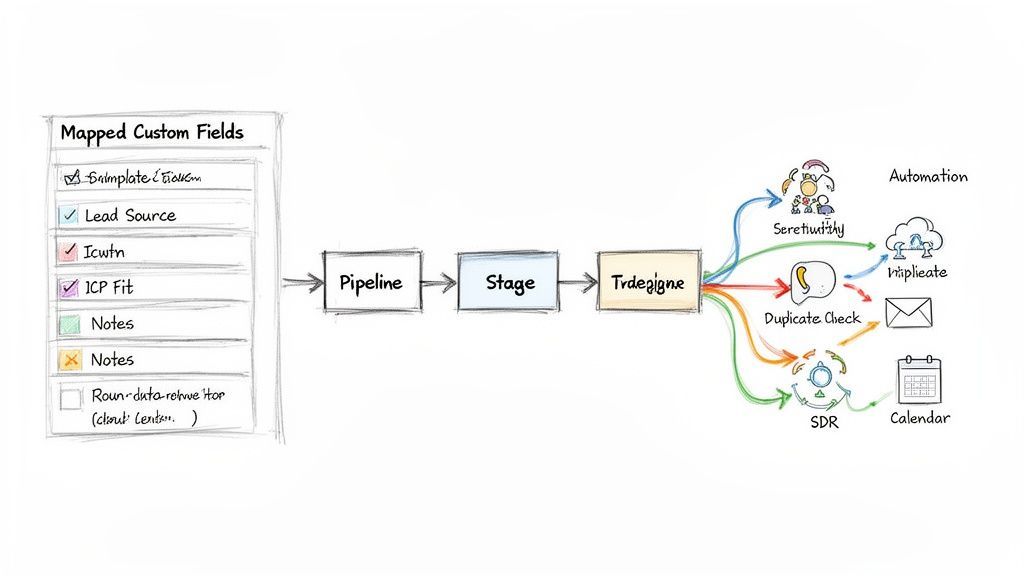
This setup ensures every piece of data serves a purpose, guiding your team’s actions and keeping everyone on the same page.
Mapping Your CRM to Your Sales Process
First things first: your CRM stages need to perfectly match the ones you’ve already defined. If you decided on "Discovery Call Booked" as a stage, that exact name should appear in your CRM's deal view. This one-to-one mapping kills ambiguity and makes sure the whole team is speaking the same language.
Next up are custom fields. These are the specific data points you need to capture to qualify leads and route them to the right people. Don't go overboard here—start with the essentials that actually inform an action.
- Lead Source: Where did this prospect come from? (e.g., SEO, Referral, Outbound). This is non-negotiable for measuring channel ROI.
- ICP Fit: Does this account match your Ideal Customer Profile? A simple "High," "Medium," or "Low" dropdown can guide prioritization at a glance.
- Qualification Notes: A dedicated space for BANT criteria or other framework notes keeps critical information front and center. No more digging through call logs.
- Key Pain Point: What's the number one business challenge the prospect is trying to solve? This helps tailor every single conversation that follows.
Properly mapping these fields ensures that from the moment a lead hits your system, you have the context needed to handle it correctly. For more practical advice, check out our tips on how to use CRMs to their full potential.
Automating Lead Capture and Data Hygiene
Manual data entry is the silent killer of sales productivity. It’s slow, riddled with errors, and pulls reps away from what they should be doing: selling. Modern tools are designed to solve this exact problem, making sure your CRM data is clean, complete, and captured with zero friction.
Imagine a rep finds a high-value prospect on a social network. Instead of that tedious copy-paste routine, tools like Add to CRM let them capture the contact and company info in a single click. The system can even check for duplicates automatically, preventing a messy database down the line.
Data hygiene isn't a one-time cleanup project; it's an ongoing discipline. Automating duplicate checks and data enrichment at the point of entry is the most effective way to maintain a trustworthy CRM. A clean pipeline leads to accurate forecasts.
By automating this first step, you create a ripple effect of efficiency. Reps get hours back each week, data quality skyrockets, and leads land in the pipeline ready for immediate, informed follow-up.
Triggering Actions with Simple Automations
Once your data is clean and structured, you can start building simple automations that have a massive impact. Today, pipeline performance is all about speed and coordination.
In fact, research shows that engaging a new lead within 60 seconds of an inquiry can boost conversion rates by nearly 400%. When sales and marketing are tightly aligned, companies see an average 65% increase in conversions from target accounts. This highlights just how critical operational speed is at the top of the funnel.
Here are a few high-impact automations you can set up right away:
- Instant Lead Routing: As soon as a lead enters the CRM and is enriched with data like territory or company size, an automation rule can instantly assign it to the correct rep. This completely eliminates manual triage and slashes response times.
- Automated Task Creation: When a deal moves to a new stage, like "Proposal Sent," the CRM can automatically create a follow-up task for the deal owner, scheduled for three days later. This ensures no opportunity ever gets forgotten.
- Stalled Deal Alerts: Create a workflow that pings a sales manager if a deal has been sitting in one stage for longer than your average. This helps you spot and fix bottlenecks before they cost you the deal.
These automations act as a safety net, ensuring consistency and follow-through. They transform your pipeline from a passive tracking tool into an active system that guides your team toward the next best action.
Measuring and Optimizing Pipeline Performance
A sales pipeline isn't a "set it and forget it" tool. Think of it as a living, breathing health report on your entire revenue engine. To keep that engine running smoothly, you have to constantly measure performance, diagnose the bottlenecks, and make smart, data-driven adjustments.
This is where you stop guessing and start engineering predictable growth.
https://www.youtube.com/embed/LKEy2owShw
The real key here is to focus on metrics that spark action, not just vanity numbers. Knowing you have 500 leads is mildly interesting, but knowing your conversion rate from demo to proposal is a dismal 5% is actionable. That number tells you exactly where your process is breaking down and where to focus your energy.
Building Your Pipeline Dashboard
Your CRM should be the single source of truth for pipeline health. Most modern CRMs like Salesforce or HubSpot offer customizable dashboards that let you visualize the metrics that truly matter to your business. A good dashboard isn't cluttered; it tells a clear story about your pipeline's efficiency at a glance.
Start by tracking a handful of high-impact Key Performance Indicators (KPIs).
- Number of Qualified Opportunities: How many new, sales-ready deals are actually entering your pipeline each week or month? This is the ultimate measure of your prospecting and qualification efforts.
- Average Deal Size: What’s the typical value of a deal in your pipeline? Tracking this helps with revenue forecasting and lets you spot trends in customer spending before they become problems.
- Sales Cycle Length: On average, how long does it take to move a deal from that first touchpoint to a closed-won status? A shortening sales cycle is a massive indicator of an efficient sales process.
- Stage-to-Stage Conversion Rates: What percentage of deals successfully move from one stage to the next? Honestly, this is probably the most critical metric for pinpointing specific bottlenecks.
Together, these KPIs give you a balanced view of your pipeline's volume, value, velocity, and efficiency. They are the vital signs of your sales operation.
Interpreting the Data to Find Bottlenecks
Once you have your dashboard up and running, the real work begins. You have to learn how to read the data and ask the right questions. For instance, if you see your win rate is declining while everything else looks steady, it could signal anything from poor qualification to new competitive pressure.
Your pipeline data isn't just a report card; it's a treasure map. Every metric points toward an opportunity for improvement. A low conversion rate at a specific stage isn't a failure—it's a clear signal telling you exactly where to focus your coaching and process refinement efforts.
Let’s play out a real-world scenario. Say your team is crushing its target for new demos, but the conversion rate from the "Demo" stage to the "Proposal" stage is tanking. The problem clearly isn't at the top of the funnel. So instead of just telling your team to "make more calls," you can dig in with targeted questions:
- Are we demoing the right features to solve the prospect's actual pain points?
- Are we failing to build a clear business case and ROI during the demo itself?
- Is our qualification process too loose, letting unqualified leads slip through to the demo stage?
This data-driven approach transforms your pipeline reviews from boring status updates into strategic, problem-solving sessions that actually move the needle.
Essential Sales Pipeline KPIs and Their Meaning
To help you get started, this table breaks down the essential metrics, what they tell you, and what "good" generally looks like. While benchmarks can definitely vary by industry, these figures provide a solid starting point for most B2B sales teams.
| KPI | What It Measures | Why It Matters | Industry Benchmark |
|---|---|---|---|
| Lead-to-Opportunity Rate | The percentage of raw leads that become qualified sales opportunities. | Measures the quality of your leads and the effectiveness of your initial qualification process. | 10-15% |
| Win Rate (Opportunity-to-Close) | The percentage of qualified opportunities that result in a closed-won deal. | This is the ultimate measure of your sales team's effectiveness in closing deals. | 20-30% |
| Sales Cycle Length | The average time it takes for an opportunity to move through the entire pipeline. | A shorter cycle means faster revenue recognition and a more efficient sales motion. | Varies widely (e.g., ~84 days for B2B) |
| Pipeline Coverage Ratio | The ratio of your total pipeline value to your revenue quota for a given period. | Indicates if you have enough opportunities in the pipeline to realistically hit your target. | 3x to 4x |
By keeping a close, consistent eye on these metrics, you can spot negative trends long before they have a chance to derail your quarter. From there, you can run targeted plays—like specific sales coaching, content updates, or process tweaks—to fix the leaks and keep your revenue engine humming.
Works with 29+ CRMs
Add to CRM finds verified emails, phone numbers, and job titles on LinkedIn® — then adds them to your CRM in one click.
Start Free TrialTrusted by 2,500+ users4.7Troubleshooting Common Sales Pipeline Problems
Even the most buttoned-up sales pipeline springs a leak now and then. Deals stall out, prospects ghost you, and your forecast starts to feel more like wishful thinking than a reliable projection.
When this happens, don't panic. It's time to put on your mechanic's hat, diagnose the issue, and get your revenue engine humming again.
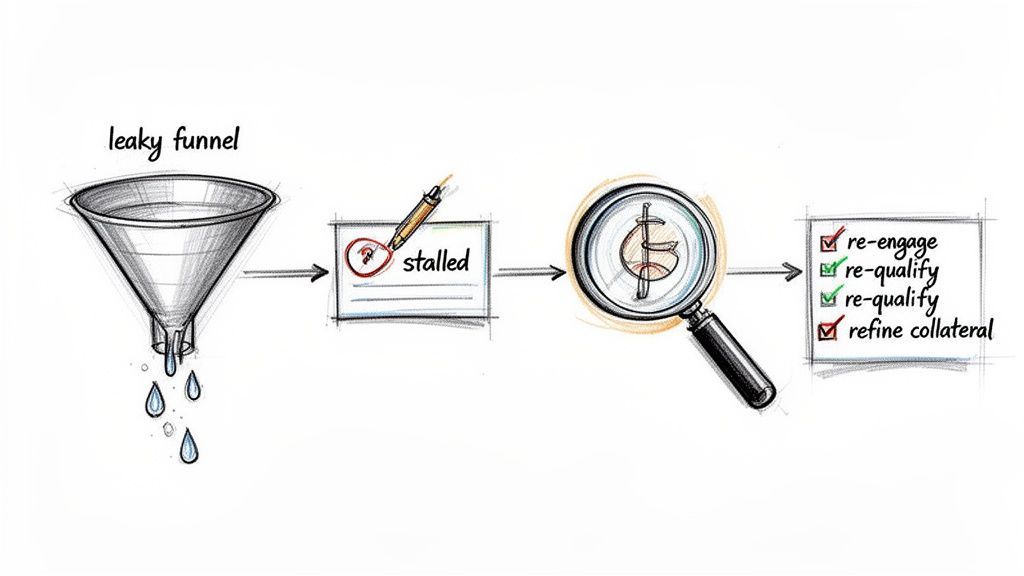
If you treat your pipeline like a system—with clear inputs and outputs—you can usually trace the trouble back to its source. A few classic symptoms pop up over and over, and each one points to a specific breakdown in your process. Spotting these signs early is the whole game.
Diagnosing a Stalled Pipeline
This is probably the most common headache: a pipeline full of deals that just… sit there. Opportunities that looked red-hot a month ago are now collecting dust in the same stage, bloating your forecast and killing team morale.
It feels wrong to let a lead go, but stalled deals are dead weight. Plain and simple. The problem usually comes from a failure to disqualify prospects early on, with reps clinging to "hopeful" deals instead of moving on to better-fit opportunities.
Pro Tip: Roll out a pipeline hygiene rule. If a deal shows zero meaningful engagement—no email reply, no meeting accepted—within a set timeframe (say, 14-21 days), it gets automatically flagged for review. This forces a decision: either try a new re-engagement play or cut it loose.
To get things moving again, run a pipeline audit focused on these aging deals. Give your team a simple checklist to run through:
- Re-qualify: Has their budget, timeline, or decision-maker changed?
- Find the Blocker: What's the real reason for the hold-up? Is a stakeholder on vacation, or did their priorities get shuffled?
- Set a Hard Next Step: Propose a clear action with a deadline. If they won't commit, it's time to move that deal out of your active forecast.
Fixing a Leaky Funnel
Another classic issue is the "leaky funnel," where you see a huge drop-off at one specific stage. Maybe you're booking demos left and right, but almost none of them ever advance to the proposal stage. That’s a massive red flag.
This kind of leak signals a major disconnect between what you're showing them and what they actually need.
The culprit is often a messaging mismatch or a failure to connect the dots on value. Your sales deck might be too generic, or maybe your reps aren’t doing a great job of linking your product's features to that prospect's specific, nagging pain points.
To plug the leaks, start by looking at the conversion rate between each stage in your CRM. Find the biggest drop-off point and zoom in. Listen to call recordings from that stage, review the demo scripts, and pull your top performers aside to ask what they do differently. Often, a few tweaks to your talk tracks or sales collateral for that one stage can make all the difference.
Sales Pipeline FAQs
Building out a sales pipeline always surfaces a few practical questions. Here are the straight-up answers to the most common ones I hear from sales leaders.
What Is the Ideal Number of Pipeline Stages?
There’s no magic number, but most B2B sales cycles land comfortably in the five to eight stage range. Anything less than five, and you risk losing crucial detail on where a deal actually is. Go over eight, and you’re probably over-engineering it, making the whole thing a nightmare to manage.
The real key is to make each stage a meaningful, verifiable step forward. A stage should only exist if it demands a specific set of actions from your team and signals a real change in the prospect's commitment level.
How Often Should I Review My Sales Pipeline?
Consistency is everything. A formal pipeline review meeting with the whole sales team should be on the calendar at least once a week. This is non-negotiable for keeping forecasts accurate, spotting stalled deals early, and creating a regular rhythm for coaching.
Beyond the team huddle, every single rep should be glancing at their personal pipeline daily. A quick 15-minute scan each morning is all it takes to set priorities and make sure a killer opportunity doesn't get buried.
A pipeline isn't a static report; it's a living, breathing management tool. Regular reviews turn it from a look-back exercise into a forward-looking guide that helps your team actually win more deals.
Can a Sales Pipeline Be Too Full?
One hundred percent, yes. A pipeline bloated with unqualified leads or deals that haven't moved in weeks is a massive red flag. It creates a false sense of security, makes forecasting a joke, and pulls your reps' focus away from the deals that have a real shot at closing.
This is exactly why disciplined qualification and ruthless pipeline hygiene are so critical. I'd much rather see a pipeline with fewer, higher-quality opportunities than a long list of dead-end deals. A healthy pipeline has momentum, not just volume.
Stop wasting hours on manual data entry and start building your pipeline faster. Add to CRM lets you capture leads from any professional network or email with a single click, instantly enriching them with verified contact data and syncing them to your CRM. See how it works at Add to CRM.
Start saving time and closing more deals.
Find verified contact info for your prospects on LinkedIn®, Gmail and Outlook — and add them to your CRM with 1-click.

 Loading...Trusted by 2,500+ founders, SDRs & more