How to Find Business Phone Numbers and Connect Faster
Tired of dead ends? Learn how to find business phone numbers with proven, real-world strategies that connect you with decision-makers, not just gatekeepers.
To find a business phone number, your first stop should almost always be the free, public tools right at your fingertips. Think Google Maps, a few clever search tricks, and the company's own website.
You'd be surprised how often direct-dial numbers are hiding in plain sight. Mastering these free methods lets you bypass the main switchboard and connect with the right person without spending a dime. It's the bedrock of smart, cost-effective prospecting.
Free vs Paid Phone Number Discovery Methods
Before we dive into the "how," let's quickly compare the two main paths you can take. Free methods are powerful but require manual effort, while paid tools offer speed and automation at a cost. Understanding the trade-offs helps you build the right tech stack for your needs.
Here’s a quick breakdown:
| Method Type | Pros | Cons | Best For |
|---|---|---|---|
| Free Manual Search | $0 cost, great for targeted research, often uncovers highly accurate data | Time-consuming, doesn't scale well for large lists, requires persistence | Sales reps with a smaller, high-value target list or teams on a tight budget. |
| Paid Data Provider | Fast and scalable, enriches entire lists in minutes, integrates with CRMs | Can be expensive, data accuracy varies by provider, may provide outdated or generic numbers | High-volume sales teams, SDRs who need to process hundreds of leads, and data enrichment workflows. |
Ultimately, the best approach is often a hybrid one. Start with the free techniques to find what you can, then use a paid tool to fill in the gaps or enrich leads at scale.
Start With the Free Tools in Your Prospecting Kit
Before you even think about pulling out a credit card for a data provider, you need to get good with the free resources everyone has access to. Too many sales reps give up after a quick glance at the "Contact Us" page, grabbing the first generic number they see.
That’s a rookie mistake. It completely overlooks the goldmine of direct lines hidden just beneath the surface.
The real goal here is to think like a detective. You're not just looking for a number; you're looking for the right number. By mastering a few simple search techniques, you can build a solid pipeline of accurate contacts without ever touching your budget.
Go Beyond the Obvious Search
A basic Google search is just the warm-up. The real wins come from using its advanced features and other free platforms that most people ignore. This is how you find the direct numbers that get you straight to decision-makers.
Here are a few of the most powerful free resources to start with:
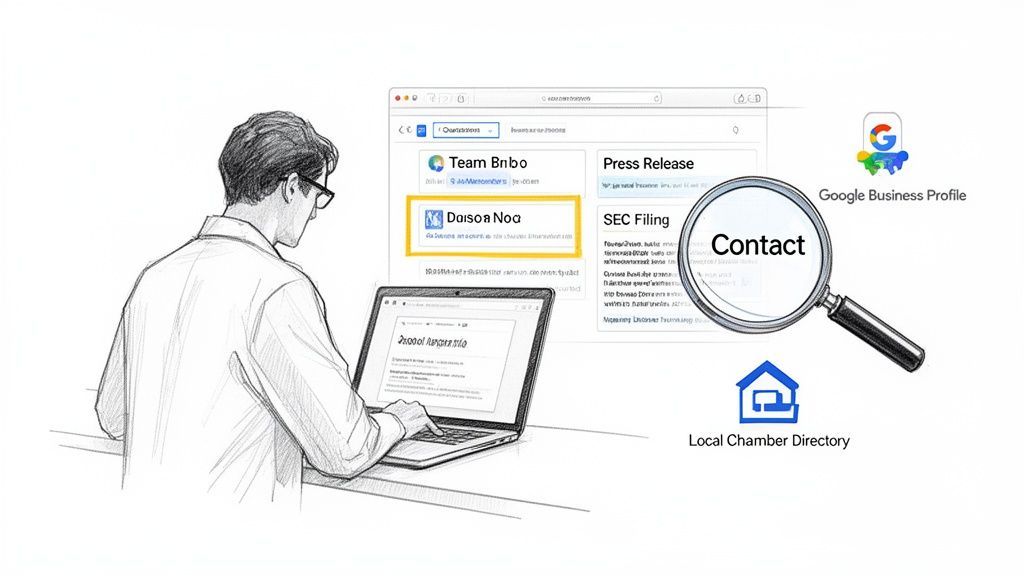
- Company Websites: Don't just stop at the contact page. Dig into the "About Us" or "Team" sections for individual bios. Check press releases, as they often list a direct media contact. For public companies, SEC filings are a goldmine for executive contact details.
- Google Business Profile: For any local business, this is usually the most up-to-date source for their main phone number. Businesses are highly motivated to keep this info accurate for their customers, so you can trust it.
- Online Directories: Think local. Your local Chamber of Commerce or industry-specific associations often have member directories. These lists frequently contain direct phone numbers you won't find advertised anywhere else.
These free strategies are a fundamental part of a comprehensive approach to sales prospecting.
The key takeaway here is that a little persistence goes a long way. The first number you find is rarely the best one. Spending an extra two minutes digging around a company’s digital footprint can be the difference between hitting a gatekeeper and getting a direct line to your target.
Digging Deeper: Finding Phone Numbers in Digital Footprints
Okay, so the basic Google searches came up empty. Don't worry, this is where the real detective work begins. We need to go beyond the surface and look at a prospect's digital presence—the places they actively hang out and leave clues.
Things like professional networks and even old email threads are goldmines for accurate contact info. They often hold the direct dials that bypass gatekeepers entirely. Mastering these next few methods is what separates amateurs from pros.
This deeper dive is so important because getting the right number is everything. The phone is still king in B2B sales—a staggering 51% of leads still originate from calls, and over 80% of sales directors say it's essential to their process.
And don't believe the myth that executives don't answer. Globally, 57% of C-level executives actually prefer calls from salespeople. You just need their real number. If you're curious, you can find more cold calling statistics that prove its staying power.
Sift Through Professional Networks
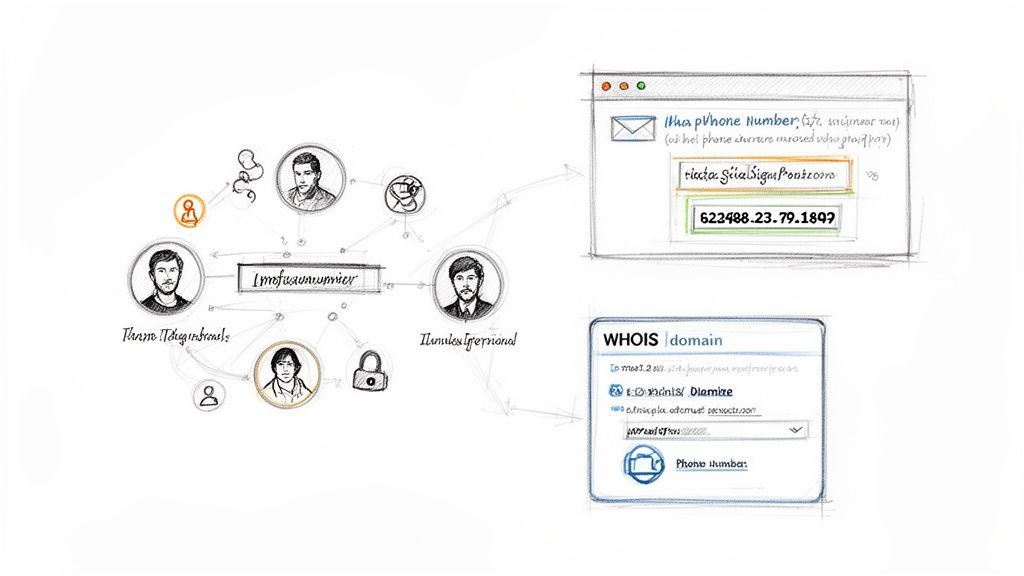
Professional social networks are so much more than a place to check a job title. Think of them as living, breathing directories. While you'll rarely find a phone number listed directly on a profile, the activity around the profile is what you're after.
Look for patterns. Does a sales manager post about an event and tag a colleague? Check the comments. Did they share a screenshot where an email signature is partially visible? It takes a bit more finesse, but this is how you uncover contact details that aren't meant to be public.
Don't just scan a profile; observe their behavior. People leave a trail of digital breadcrumbs in their comments, posts, and group discussions. Following that trail often leads right to a direct line.
Mine Email Signatures and Old Threads
Your own inbox is an incredibly underrated tool. Think about it: every email you've ever received from a prospect is a potential source. That little signature at the bottom is often a treasure map.
Do a quick search in your email client for a person’s name or company. You might instantly find a direct line you completely forgot you had from a conversation months ago.
This is hands-down one of the most reliable ways to find a number. Why? The information comes straight from the source. A number in an email signature is almost always a direct dial or a personal mobile number—your ticket to skipping the switchboard.
Use Technical and Public Record Searches
This approach gets a bit more technical, but it’s powerful for certain types of businesses.
For smaller companies or solo entrepreneurs, a WHOIS lookup on their domain name can be surprisingly revealing. When someone registers a website, they have to provide contact info. Unless they pay for privacy protection (many don't), that information becomes part of a public record. It's often the founder's direct cell.
For bigger, publicly traded companies, you can look up their public filings with government bodies like the SEC. These documents are public records and often list the names—and sometimes contact information—of key executives and board members. It's a less common tactic, but for finding verified, high-level contact info, it's incredibly effective.
Using Data Enrichment Tools for Speed and Scale
Manual searches are effective, but they don't scale. Let’s be real—when you have a list of a hundred prospects, digging for each number one by one becomes a massive time sink. Those are hours you should be spending on calls and demos, not playing detective.
This is exactly where data enrichment tools come in.
These platforms aren't just simple search tools; they’re high-powered engines built to deliver accurate contact data in a single click. Instead of you hunting through databases, they bring the data directly to you, turning a painful manual process into an afterthought.
From Manual Scavenger Hunt to Automated Enrichment
The real magic of these tools isn't just finding one number faster. It’s about building a repeatable, scalable system for your entire prospecting workflow. They plug directly into your browser or CRM, so you're not just getting a phone number—you're getting a complete, ready-to-use lead profile.
Shifting from manual to automated means you can:
- Kill tedious data entry: No more copy-pasting names, job titles, and numbers into CRM fields.
- Sidestep human error: Automation prevents the typos and misplaced data that inevitably creep in during manual entry.
- Keep your database clean: Good tools automatically check for duplicates, stopping you from creating confusing, cluttered records before they happen.
For top-performing sales teams, this kind of automation easily saves 4+ hours per week. That’s time you get back to focus on building relationships and actually selling.
When Manual Phone Discovery Stops Scaling
For high-volume B2B teams, manual phone discovery quickly becomes a bottleneck. ZoomInfo provides 135M+ verified phone numbers, including 120M direct dials, refreshed against 1.5B+ data points processed daily and supported by human research. This gives reps broad coverage without cross-referencing WHOIS records, email signatures, and other sources manually. ZoomInfo’s GTM Context Graph adds timing and account context by combining buyer intent, funding events, hiring patterns, and firmographic data with each contact record. Through GTM Workspace, that context can sync with the CRM, helping reps prioritise accounts worth calling this week, reduce dead-end dials, and start more relevant conversations.
To compare it with other providers, see our guide to the best data enrichment tools.
How Data Enrichment Looks in Practice
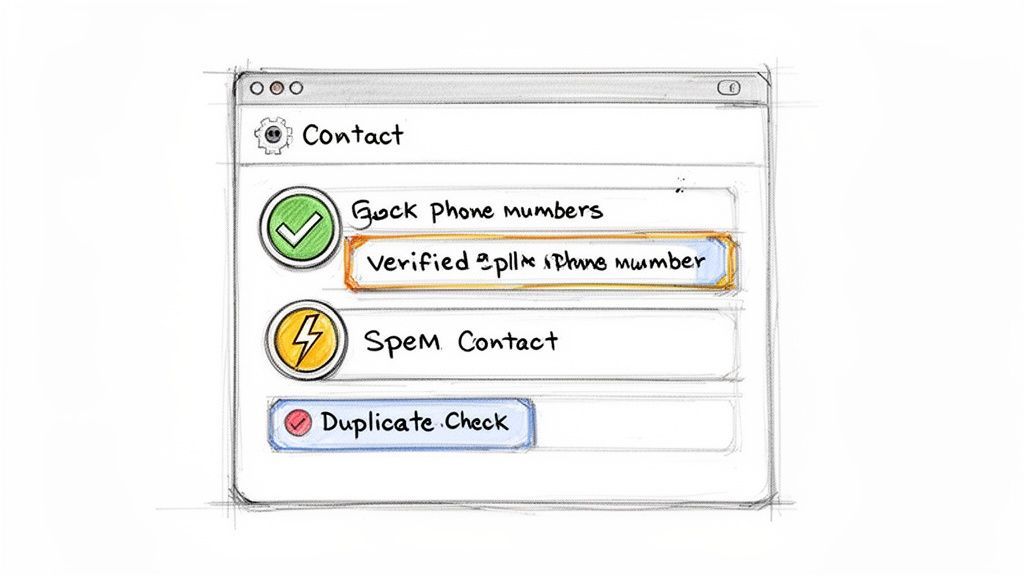
So, you've found the perfect decision-maker on a professional network. Instead of opening ten new tabs to track down their direct dial, a tool like Add to CRM embeds right where you're working. One click, and it pulls their verified phone number, email, and over 30 other data points like company size or industry.
Here’s a glimpse of what that looks like. You can see the contact's info, verify it on the spot, and push the fully enriched profile straight to your CRM without ever leaving the page.
This speed is more critical than ever. The VoIP market is set to explode to $326.27 billion by 2032, a shift driven by the 87% of professionals who use their mobile phones for work every week. Getting instant access to verified mobile numbers gives you a serious competitive edge. You can see more on the growth of VoIP solutions from Nextiva.
The point is to stop just finding data and start using it instantly. A great enrichment tool doesn’t just hand you a phone number; it delivers a complete, actionable lead profile that’s already synced into your workflow.
Of course, not all data providers are created equal, and data quality varies wildly. To help you navigate the options, we put together a guide on the best data enrichment tools that breaks down the features, performance, and pricing for modern sales teams.

Find verified contact data on LinkedIn®
Add to CRM finds verified emails, phone numbers, and job titles on LinkedIn® — then adds them to your CRM in one click.
Start Free Trial


 Trusted by 2,500+ users4.7
Keeping Your Outreach Accurate and Compliant
Finding a number is a great start, but it's totally useless if it’s disconnected or rings the wrong person. Bad data doesn't just waste time; it hurts your sender reputation and can even land you in legal hot water.
Before you start dialing, you need a quick, reliable process for verification and compliance. This isn’t just about ticking boxes—it’s about protecting your brand and making sure every call has the best possible chance of connecting. A clean, compliant list is the foundation of any successful outreach campaign.
Verifying Your Phone Numbers
Once you have a list of potential numbers, the next step is to confirm they're actually active and belong to the right person. A little effort upfront here will dramatically boost your connection rates and stop you from wasting time on dead ends.
There are a few simple yet effective ways to do this:
- Use an online validation tool: Several services can ping a number to check if it's active without actually making a call. This is a fast, low-cost way to scrub large lists.
- Make a low-stakes test call: Sometimes, the most direct approach is the best one. A quick, friendly call to verify you have the right contact for "John Doe at XYZ Corp" is a perfectly acceptable B2B practice.
- Cross-reference with another source: If you found a number on a company website, see if it matches the one on their Google Business Profile or in a directory. A match across multiple sources is a strong signal of accuracy.
Staying Compliant with Regulations
Verification handles accuracy. Compliance handles the legal and ethical side of your outreach. Ignoring regulations like "Do Not Call" (DNC) lists isn't just bad form—it can lead to serious fines and damage your company's reputation.
The Federal Trade Commission (FTC) manages the National Do Not Call Registry, a database of consumers who have opted out of telemarketing calls. While B2B calls often fall under different rules, it's absolutely critical to respect any opt-out requests immediately.
Here is the official portal for the National Do Not Call Registry where consumers can register their numbers.
Understanding this system is essential for any sales team. It sets the standard for consumer consent and privacy.
Respecting an individual's request to be removed from your call list is non-negotiable. It protects your business and shows you value their time and privacy—which is crucial for your long-term brand health.
For global outreach, the rules get even more complex. Regulations like the General Data Protection Regulation (GDPR) in Europe impose strict requirements on how you can collect, store, and use personal data, including phone numbers.
Always make sure your data sourcing and outreach practices align with the specific laws of the countries you're targeting. That diligence keeps your campaigns effective and, most importantly, above board.
Build an Automated Prospecting-to-CRM Workflow
All the methods we've covered so far will help you find business phone numbers. But the real magic happens when you stitch them together into a seamless workflow.
Manually hunting for a contact, then painstakingly copy-pasting their info into your CRM? That’s a massive productivity killer—a relic from a slower era of sales.
The modern sales engine runs on speed, accuracy, and automation. Imagine a rep prospecting a list of target accounts. With the right tools, they can find a prospect, pull their verified phone number, check for duplicates in the CRM, and create a fully enriched contact record. All in a single click, without ever leaving the page.
Connect Your Tools for Maximum Efficiency
An integrated approach is about making your tools work for you, not the other way around. When you connect a prospecting tool directly to your CRM, you eliminate the friction between finding information and acting on it.
No more toggling between a dozen tabs or trying to manage messy spreadsheets. A tool like Add to CRM acts as the bridge, letting data flow instantly from a professional network or inbox straight into Salesforce, HubSpot, or whatever system you use. This keeps your data clean and frees up your team's mental energy for what really matters: selling.
This simple, three-step process for compliant and efficient data handling is key.
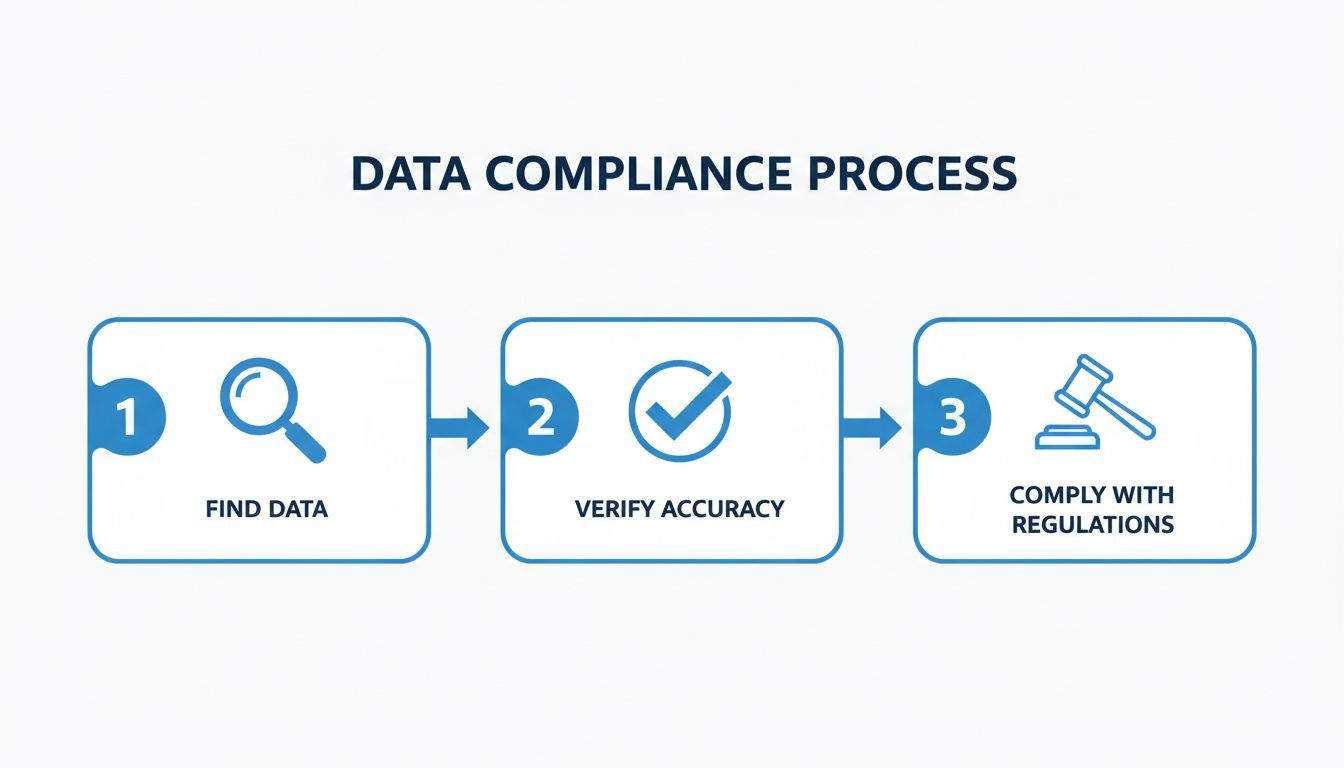
The flow is straightforward: find, verify, and comply. This sequence should be the foundation of every prospecting activity you undertake. It’s a constant reminder that speed must be balanced with accuracy and ethical responsibility.
And this workflow has a direct, measurable impact. Finding reliable business phone numbers is still a cornerstone of effective sales. In fact, phone calls drive a whopping 69% of all business inquiries globally. For comparison, email sits at just 16%. That's a huge gap, and it underscores why sales teams can't afford to neglect their phone strategy. You can see more on these stats from AMBS Call Center's research.
A Real-World Scenario
Let's walk through a practical example. Say an SDR is building a list of VPs of Marketing at SaaS companies. Here’s how the automated workflow plays out:
- Find the Prospect: They spot a promising contact on a professional networking site.
- Enrich in One Click: Instead of starting a manual Google search, they click the Add to CRM extension. It instantly finds the prospect's verified direct dial, email, and other key company data.
- Sync to CRM: At the same time, the extension checks if this contact already exists in their HubSpot CRM. It's a new lead, so the SDR just clicks "Add." A complete, accurate contact record is created on the spot.
This entire process takes less than ten seconds. Top sales teams using this kind of workflow save over four hours a week, per person. That's time they can pour directly into selling.
The goal is to shrink the time between discovery and outreach to almost zero. An automated workflow doesn't just make you faster; it makes you more consistent and keeps your data pristine.
For a deeper dive into streamlining these processes, check out our guide on how to automate data entry and start reclaiming that valuable selling time.
Works with 29+ CRMs
Add to CRM finds verified emails, phone numbers, and job titles on LinkedIn® — then adds them to your CRM in one click.
Start Free TrialTrusted by 2,500+ users4.7Questions That Come Up All The Time
Even with the best strategies, trying to track down a business phone number can feel like a bit of detective work. It's a mix of smart searching, the right tools, and a little persistence. Here are a few questions that sales pros run into all the time.
Is It Legal to Cold Call a Business Number I Found Online?
For the most part, yes. It's generally legal to cold call a business number. Regulations like the National Do Not Call Registry are really designed to protect consumers from getting unsolicited calls on their personal lines. B2B communication plays by a different set of rules.
That said, it’s not a complete free-for-all. If someone asks you to stop calling, you absolutely have to honor that request immediately. The best practice is to maintain your own internal "Do Not Call" list. It protects your reputation and shows you respect people's wishes, which is just good business.
Why Can’t I Find a Direct Number for an Executive?
If you’re having a tough time finding a direct line for a C-suite executive, that's by design. Companies intentionally put up a shield around their top leaders to protect their time and keep them focused. You're just not going to find their direct dial on the company's "About Us" page.
Getting those numbers requires you to dig a little deeper than a standard Google search. This is where you might:
- Turn to a paid data provider that specializes in executive-level contacts.
- Comb through press releases or media kits. Sometimes a media contact is a C-level executive's assistant, and that's your foot in the door.
- Tap into your professional network. A mutual connection can often point you in the right direction or even make an introduction.
How Accurate Are Paid Data Providers?
The accuracy of paid data providers is all over the map. The good ones use a mix of technology—like web crawlers and public record searches—and actual human verification to keep their database fresh. But you have to remember that data gets old fast. People change jobs, companies reorganize, and phone numbers get disconnected all the time.
A top-tier provider should offer real-time verification and be able to back up a high accuracy rate, often above 95% for both emails and phone numbers. Always ask a vendor how they verify their data and look for recent reviews or case studies.
Many of these platforms offer a handful of free credits. Take them! It's the perfect way to test-drive their data quality on a few of your target accounts before you pull out the company credit card. The goal is a partner that gets you connected, not one that sells you a list of dead ends.
Ready to stop the manual scavenger hunt and start connecting with prospects in seconds? Add to CRM is the one-click solution that finds verified phone numbers and enriches your contacts directly inside your CRM.
Start saving time and closing more deals.
Find verified contact info for your prospects on LinkedIn®, Gmail and Outlook — and add them to your CRM with 1-click.

 Loading...Trusted by 2,500+ founders, SDRs & more