Your Playbook for Email Marketing to Generate Leads
Tired of cold outreach that falls flat? Learn how to use email marketing to generate leads with proven strategies for list building, automation, and CRM sync.
Using email marketing to generate leads is one of the most dependable and cost-effective moves you can make for B2B growth. Think of it as a direct line to your potential customers, letting you nurture them from a flicker of interest all the way to being sales-ready with content that actually speaks to them. When done right, a smart email strategy isn't just a tactic—it becomes your most reliable pipeline-building machine.
Why Email Is Still Your #1 B2B Lead Generation Engine
In a world buzzing with countless marketing channels—from flashy paid ads to the endless scroll of social media—email just keeps delivering the goods. Its real power is its directness and incredible efficiency. Unlike a social media post, where mysterious algorithms decide who sees your content, an email lands right in a decision-maker's inbox. It’s an open door to a one-on-one conversation.
That direct access is precisely why email marketing to generate leads remains a top priority for sharp sales and marketing teams. You get to cut through the noise and put your message exactly where it needs to be.
Unpacking The ROI Of Email Marketing
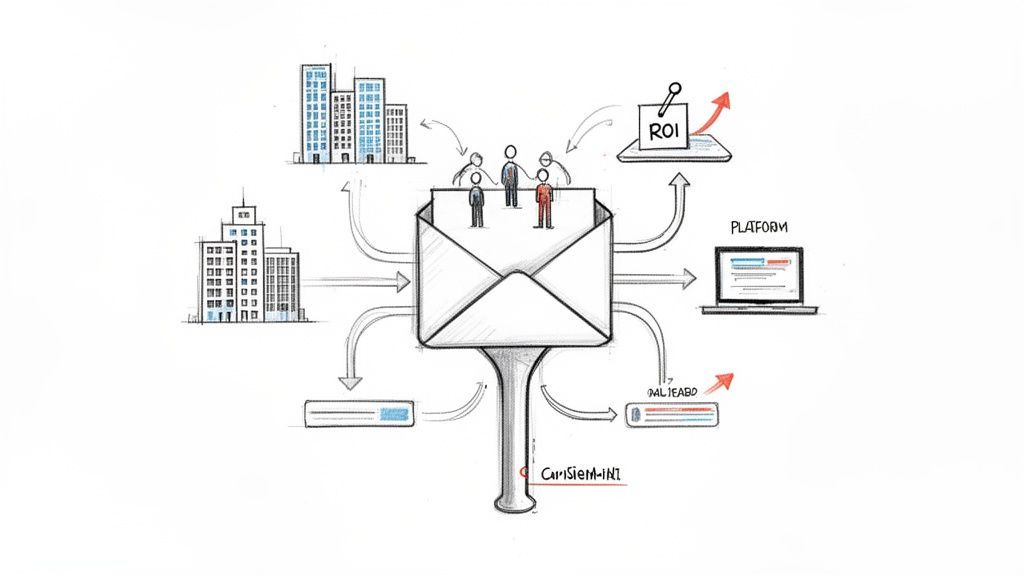
The return on investment for email is just plain hard for other channels to compete with. For every single dollar you put in, email marketing brings back an average of $36 to $42 in return. That kind of efficiency is why it's not just a strategy, but often the core strategy for building sustainable growth.
The data consistently tells the same story. Email marketing is the clear winner for generating leads, with 48% of marketers calling it their number one method. It edges out other heavy hitters like website landing pages (44%) and content marketing (43%), proving it’s still the champ. You can dig into more data on lead generation tactics to see the full picture.
The real magic of email isn't just about sending messages; it's about building a scalable system for engagement. A smart email strategy automates your outreach, builds relationships over time, and predictably delivers qualified leads right to your sales team.
Comparing B2B Lead Generation Channels
Here's a quick comparison of popular B2B channels, highlighting why email consistently outperforms others in key areas like ROI and direct access.
| Channel | Average ROI (per $1 spent) | Primary Strength |
|---|---|---|
| Email Marketing | $36 - $42 | Direct inbox access & high personalization |
| SEO | Variable | Long-term organic traffic |
| Content Marketing | Variable | Builds authority & attracts inbound interest |
| Paid Social Media | $2 - $5 | Precise audience targeting |
While a mix of channels is always smart, email's unparalleled ROI and direct line of communication make it an essential pillar of any serious B2B growth strategy.
Bridging The Gap From Prospecting To Outreach
The best part? Modern tools have completely closed the loop between finding great prospects and actually reaching out to them. The whole process isn't fragmented anymore. You can now identify professionals who fit your Ideal Customer Profile (ICP), grab their verified contact info, and drop them into a targeted email sequence almost instantly.
This seamless workflow is the key to scaling your efforts. Instead of burning hours on manual data entry and list building, you can pour that time into what really moves the needle:
- Crafting compelling messages that hit on your audience's biggest pain points.
- Segmenting your lists so every email feels personal and relevant.
- Analyzing campaign performance to constantly tweak and improve your approach.
By connecting your prospecting tools directly to your outreach platforms, you’re not just sending emails—you’re building an efficient, powerful lead generation machine. The next sections of this guide will walk you through the exact, actionable steps to build this system for your own business.
Building a High-Quality Prospect List That Converts
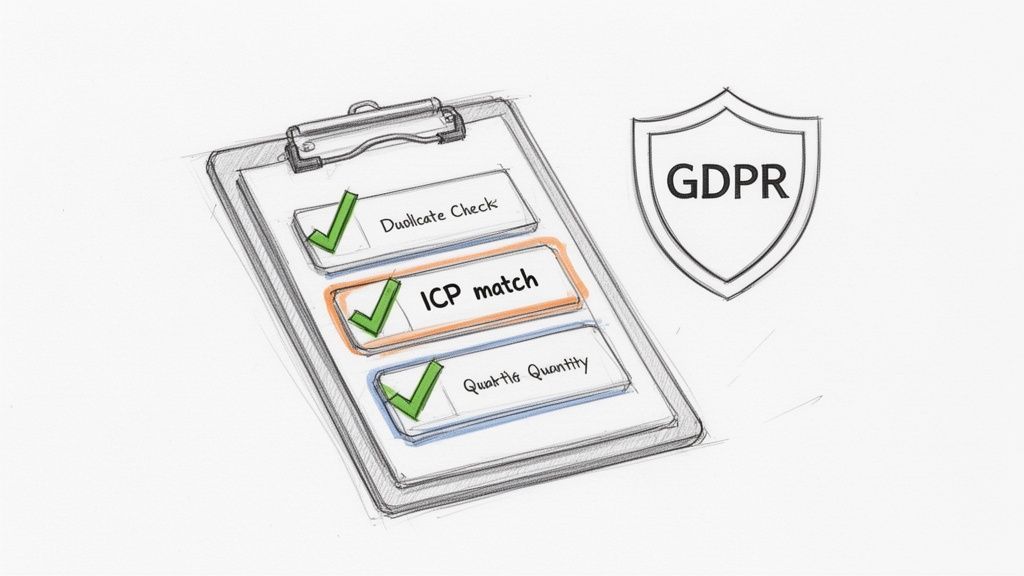
A killer email campaign isn’t built on sheer volume—it’s built on a foundation of high-quality contacts. If you want to use email marketing to generate leads that actually close, you have to nail the prep work long before you write a single subject line. It all starts with building a prospect list that's clean, targeted, and ready to engage.
Forget the old "spray and pray" approach. The real goal here is to speak directly to the right people at the right companies. That means your list can’t just be big; it has to be incredibly relevant.
Defining Your Ideal Customer Profile
Before you can find your ideal prospects, you have to know exactly who you're looking for. This is where a detailed Ideal Customer Profile (ICP) comes in. Think of an ICP as a crystal-clear description of the perfect company that gets the most value from your product or service.
It's not just about basic demographics. A good ICP dives deep into firmographics—the specific traits of a company that signal a perfect fit. This profile becomes the blueprint for your entire prospecting effort.
To build a solid ICP, zero in on these data points:
- Industry or Vertical: Which specific sectors does your solution crush it in? Get as narrow as you can.
- Company Size: How many employees does your sweet-spot customer have? Are you talking startups, mid-market, or enterprise giants?
- Annual Revenue: What revenue bracket suggests a company can both afford and benefit from what you're selling?
- Geographic Location: Are there specific countries, regions, or even cities where you see the most traction?
- Technology Stack: What other software or tools do your best customers use? This can be a huge tell for a good fit.
Having a precise ICP is your first line of defense against wasting time on leads that will never, ever convert. It's the filter that keeps your team focused on high-potential accounts.
Finding And Verifying Prospect Data
Once your ICP is locked in, the next move is to find the people who match it. Business networking platforms are an absolute goldmine for this, letting you search and filter for professionals by job title, company, industry, and seniority.
But finding the right person is only half the battle. The real challenge is getting accurate contact info. This is where data quality becomes everything. A list riddled with outdated or just plain wrong email addresses will tank your campaign's performance before it even gets off the ground.
The accuracy of your contact data directly impacts your sender reputation. High bounce rates are a major red flag for email providers, signaling you're a low-quality sender and making it more likely your messages land in spam.
This is why email verification is completely non-negotiable. Tools that offer real-time verification can check if an email address is valid on the spot, ensuring your messages actually hit the inbox. Proper validation keeps your bounce rate low and your deliverability high. To get into the weeds on this, check out our guide on how to verify email addresses for some practical tips.
Growing Your List With Lead Magnets
Outbound prospecting is a must, but you also need a solid strategy to pull inbound leads into your orbit. This is where lead magnets shine. A lead magnet is simply a valuable resource you offer to prospects in exchange for their contact information.
This approach is brilliant because it ensures that the people joining your list are genuinely interested in what you have to say. It’s a fantastic way to grow your list organically with highly qualified contacts who are already raising their hands.
Some of the most effective B2B lead magnets include:
- In-depth Whitepapers or eBooks: Offer deep insights into a specific industry problem.
- Exclusive Webinars or Workshops: Live events provide direct value and position you as an authority.
- Practical Checklists or Templates: Give prospects actionable tools they can use to solve a problem right now.
- Original Research Reports: Nothing builds credibility like unique, data-driven insights.
The key is to offer something so valuable that your ideal prospect is happy to trade their email address for it. This simple exchange is one of the most reliable ways to build a high-quality, engaged email list for your campaigns.
Crafting Emails That Actually Get Responses
Getting your email opened is a solid first step, but it's only half the battle. The real win is getting a reply—the kind that kicks off an actual conversation. This is where the craft of writing a high-converting email comes in, turning a name on a list into a warm, engaged lead.
It's all about moving beyond generic templates to write something that feels personal and genuinely useful. A well-written email cuts through the noise and shows the person on the other end you've done your homework and actually understand what they're up against.
Writing Subject Lines That Demand an Open
Your subject line is the gatekeeper. It doesn't matter how great your email is if nobody clicks on it. The best ones spark curiosity without feeling like cheap clickbait.
Think of it as the headline for your message. It needs to be sharp and to the point, especially since over 40% of emails are opened on a phone where screen space is tight.
Here are a few battle-tested approaches:
- Be Hyper-Specific: Instead of "Marketing Idea," try "Idea for [Company Name]'s blog strategy." It proves you've done a bit of digging.
- Ask a Question: A subject like "Quick question about your Q3 hiring goals" is direct, relevant, and makes them open the email to find out what you're asking.
- Reference a Mutual Connection or Event: If you met somewhere or know someone in common, drop it in. "Following up from [Event Name]" creates instant familiarity.
The goal is to stand out by being relevant, not just loud.
The First Line Is Your Secret Weapon
Once they've opened the email, the first sentence determines if they keep reading. This is where you build immediate rapport and prove you aren't just another mass emailer. Drop the tired "Hope you're having a great week."
Instead, use the data you've collected to make a real connection. This is where enriched profiles are worth their weight in gold, giving you the ammo you need for a killer opener.
A personalized opening line shows you see the prospect as an individual, not just another entry in your CRM. It signals that you’ve invested time to understand their world, which immediately sets you apart from 90% of other cold emails.
For example, you could mention:
- A recent company achievement: "Congrats on the new product launch—the feature set looks incredible."
- A piece of content they shared: "Loved the article you posted about AI in logistics. Your point on automation really resonated."
- A recent job change: "Saw you recently moved into the VP of Sales role at [Company Name]. Exciting step!"
That little bit of effort makes your outreach feel like a one-on-one chat right from the start.
Crafting Body Copy That Converts
Alright, now it's time to get to the point. The body of your email should be clear, concise, and focused entirely on the prospect's world—their pain points, their goals, their challenges. Resist the urge to launch into a long pitch about your company.
The most effective emails I've seen follow a simple framework:
- Identify a Problem: Show you get a specific challenge they likely face. Something like, "Many RevOps leaders are struggling to maintain data hygiene across multiple platforms."
- Hint at a Solution: Briefly connect that problem to the value you offer, but don't get bogged down in jargon. "We help teams automate data enrichment to solve exactly that."
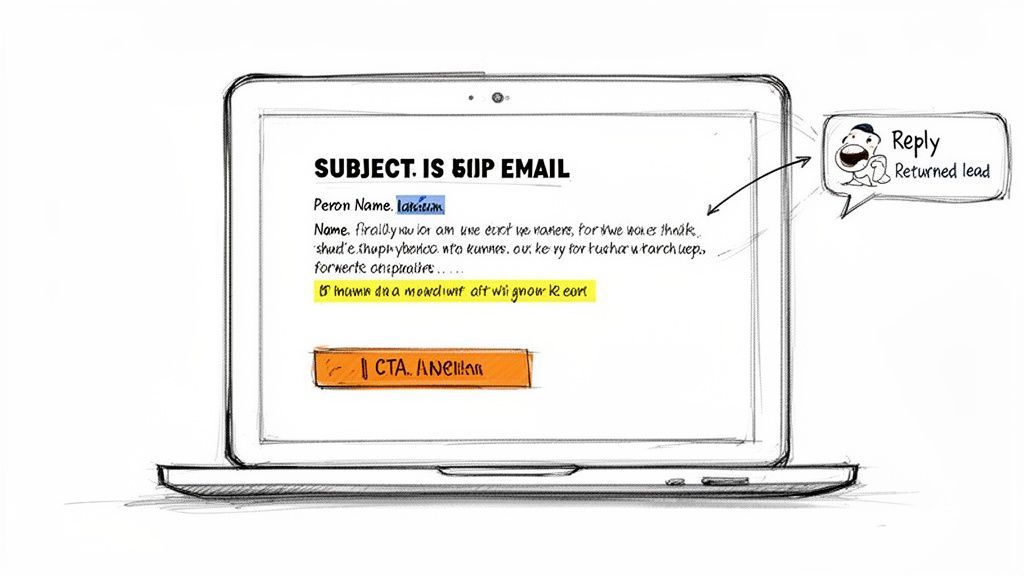
- End with a Clear Call-to-Action (CTA): Make it incredibly easy for them to say yes. Instead of a vague "Let me know your thoughts," try a specific, low-friction ask like, "Are you open to a 15-minute call next week to dig into this?"
This structure keeps the focus on them, showing you're a helpful resource, not just another vendor. It's this targeted approach that explains why email marketing can deliver a staggering ROI, averaging $36 to $50 for every $1 spent. It works because it’s personal and direct. For a closer look, you can dig into more email marketing stats and their implications.
Finally, keep your formatting clean. Short paragraphs, bullet points, and bold text are your friends. Nobody has time for a wall of text, so make your email easy to scan in 30 seconds. Respecting their time is often the final touch that earns you a reply.

Find verified contact data on LinkedIn®
Add to CRM finds verified emails, phone numbers, and job titles on LinkedIn® — then adds them to your CRM in one click.
Start Free Trial


 Trusted by 2,500+ users4.7
Automating Outreach Without Sounding Like a Robot
To really scale your email marketing for lead generation, you have to move beyond one-off emails and build a system that works for you. This is where automation becomes your secret weapon.
It allows you to engage prospects at just the right moment without losing that personal touch that actually gets replies. The goal isn't to just blast everyone with the same generic message. It's about creating intelligent, responsive campaigns that feel one-to-one.
Smart outreach like this is all about turning a prospect's actions into conversation starters. When someone downloads a whitepaper or lingers on your pricing page, that’s a clear signal. Automation lets you act on that signal instantly with a perfectly timed, relevant follow-up—moving the relationship forward while you focus on closing deals.
Designing Intelligent Drip Campaigns
A drip campaign is just a pre-built sequence of emails sent out automatically. But a great drip campaign doesn't just fire off messages on a rigid schedule. It actually reacts to what your prospects do. This behavioral approach is what separates effective automation from robotic spam.
Think of it like a choose-your-own-adventure story for your leads. The path they take depends entirely on their actions.
Did they click a link in your first email? Great. The next email can lean into their interest in that specific topic. Did they ignore it? No problem, the system can send a different follow-up designed to re-engage them with a new angle.
This level of responsiveness is a game-changer. Seriously. Smart email marketing automation can skyrocket qualified leads by a staggering 451%. According to a report on email marketing statistics, this massive lift comes from tactics like drip campaigns (used by 67% of marketers) and smarter segmentation (used by 56%).
The Power of Segmentation and Workflows
You wouldn't give the exact same sales pitch to a startup founder and an enterprise CTO, right? So why would you send them the same email? This is where segmentation comes in. By dividing your audience into smaller, targeted groups, you can build workflows that deliver highly relevant content every single time.
You can segment your lists based on all kinds of useful data points:
- Firmographics: Grouping by company size, industry, or annual revenue.
- Behavioral Data: Segmenting based on website activity, email engagement, or recent content downloads.
- Lead Source: Customizing follow-ups for prospects from a webinar versus those from a cold outreach list.
Once you've defined your segments, you can build automated workflows for each. For instance, a "New Webinar Registrant" workflow might send a thank-you email, a reminder before the event, and a follow-up with the recording. This makes sure every touchpoint is contextual and actually adds value.
The core idea behind automation is efficiency without compromise. It’s about creating a system that delivers personalized, timely, and relevant communication at scale. This frees up your team from repetitive tasks so they can focus on high-value conversations.
Making Automation Feel Human
The biggest fear people have with automation is sounding like a robot. It's a valid concern, but easy to avoid. The key is to bake personalization into every step of your sequences from the start.
Use dynamic fields to insert names, company details, or other relevant info you've gathered. This is table stakes.
More importantly, write your automated emails with a human voice. Keep them concise, helpful, and focused on the prospect's needs. The technology handles the when, but you still control the what and the why. A well-crafted automated email should feel no different than a message you typed out yourself just a few moments ago.
Ultimately, automation amplifies your ability to build relationships. It eliminates the manual drudgery of follow-ups and data management, which is a massive time sink. For more on that, check out our guide on how to automate data entry to see how you can win back hours.
By building smart, behavior-driven sequences, you create a powerful engine for generating and nurturing leads around the clock.
Syncing Your Leads and CRM for a Seamless Sales Handoff
An email campaign doesn't end with a reply. The whole point of using email marketing to generate leads is to feed your sales team clean, actionable data they can use to start conversations and close deals. This is where the crucial link between your outreach and your CRM comes into play.
A disconnected process—where leads are manually copied and pasted—is a recipe for disaster. It’s slow, tedious, and invites human error that can cost you valuable opportunities. A seamless sync creates a closed-loop system where everything is perfectly aligned, giving your sales managers total visibility into the pipeline from first touch to final close.
Eliminating Manual Data Entry
Manually shuffling lead info from your email or prospecting tool into your CRM is one of the biggest time-sucks for any sales team. In fact, some studies show reps can spend up to 40% of their time on tasks that don't generate revenue, and you can bet manual data entry is a huge part of that. Every minute spent copying a name, title, or company is a minute not spent selling.
Automating this sync instantly frees up countless hours. When a prospect replies or shows interest, their data should flow directly into the CRM, creating a new record or updating an existing one without anyone lifting a finger. This doesn't just boost productivity; it ensures leads are followed up on quickly, while they're still hot.
The speed of your lead handoff is everything. A lead contacted within five minutes is 21 times more likely to enter the sales cycle than one contacted after 30 minutes. Automation makes that kind of speed possible.
That efficiency is a massive competitive advantage. It lets your team focus on what they do best: building relationships and having meaningful conversations instead of getting bogged down in admin work.
Maintaining Data Consistency with Field Mapping
Just dumping data into your CRM isn't enough. It has to be the right data in the right places. This is where custom field mapping becomes your best friend. Field mapping is simply telling your integration which piece of data from your source (like a prospecting tool) goes into which specific field in your CRM.
For instance, you can map things like:
- "Seniority Level" from your tool to a "Job Level" custom field in your CRM.
- "Company Revenue" straight to your CRM's "Annual Revenue" field.
- "Lead Source" to automatically tag the prospect as coming from your "Q3 Cold Outreach" campaign.
Without proper mapping, you end up with messy, inconsistent data that’s almost useless for segmentation or reporting. A well-mapped system ensures every lead record is complete and standardized from the moment it’s created. This clean data structure is vital for accurate forecasting and building targeted follow-up campaigns later on.
Preventing Duplicates to Keep Your Database Clean
A cluttered CRM filled with duplicate contacts is a salesperson's worst nightmare. It causes confusion, leads to multiple reps calling the same person, and completely skews your analytics. A clean database is the foundation of any successful sales operation.
Modern integration tools solve this by automatically checking for duplicates. Before creating a new contact, the system scans your CRM to see if a record with the same email address or name already exists. If it finds a match, it can enrich the existing record with any new information instead of creating a messy duplicate.
This proactive approach keeps your database pristine and ensures a single source of truth for every prospect and account—critical for collaboration and providing a smooth customer experience. For teams that need a more hands-on approach, you can learn more about how to import contacts lists safely to avoid creating duplicates from the start.
A clean CRM isn't just a "nice-to-have." It’s a strategic asset that powers your entire revenue engine.
Works with 29+ CRMs
Add to CRM finds verified emails, phone numbers, and job titles on LinkedIn® — then adds them to your CRM in one click.
Start Free TrialTrusted by 2,500+ users4.7Putting It All Together: Your B2B Lead Generation Playbook
The secret to generating B2B leads with email marketing isn't about finding one "magic" template. It’s about building a repeatable, data-driven system that works for you.
When you've dialed in your Ideal Customer Profile and written emails that genuinely connect, the final piece of the puzzle is creating a smooth handoff to your sales team. This is where automation becomes your best friend, turning manual clean-up into a seamless flow.
This is what that final, critical stage looks like—bridging your outreach directly to your sales pipeline.
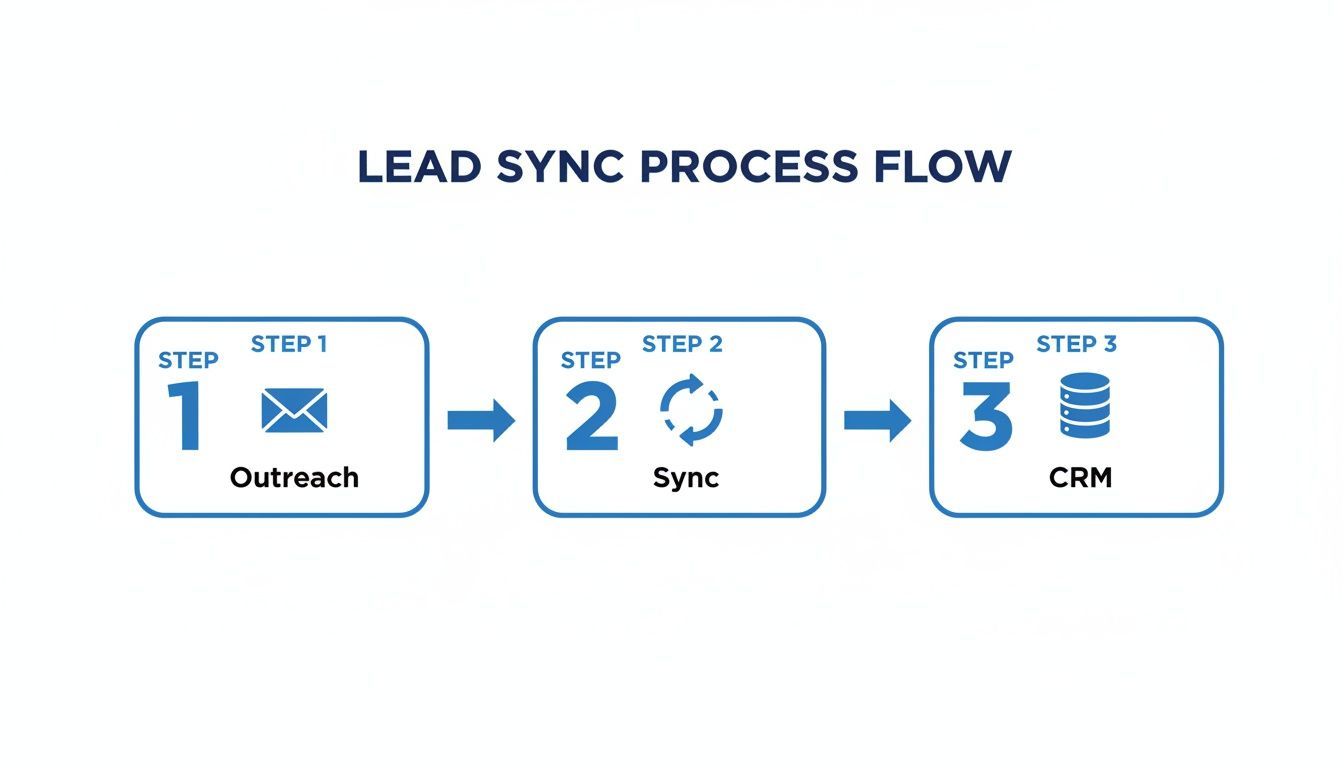
The journey from a prospect's positive reply to a clean, enriched record in your CRM has to be frictionless. Any delay or manual step is a chance for a warm lead to go cold.
Think of your strategy as a living document. You should constantly be testing subject lines, tracking reply rates, and tweaking your approach based on what the numbers are telling you. What worked last quarter might not work today.
Consistent lead generation comes from building an efficient, automated system that you can measure, optimize, and scale over time. This is how you free yourself from tedious tasks and focus on high-level strategy.
By treating your email outreach as a predictable engine—not a series of one-off campaigns—you'll build a reliable source of growth for your business.
Got Questions About Email Lead Generation? We've Got Answers.
As you start putting your email lead gen strategy into action, you're bound to run into a few practical questions. Nailing these details often separates a campaign that truly connects from one that just falls flat. Let's tackle some of the most common ones I hear about frequency, metrics, and compliance.
How Often Should I Email My List for Lead Generation?
Ah, the million-dollar question. Finding the right email cadence is a balancing act, and honestly, there's no single magic number. The perfect frequency really depends on your audience, your industry, and how much value you're packing into each send.
A good starting point for most B2B audiences is once a week or maybe bi-weekly.
But the real secret? Let your engagement data be your guide. If you’re seeing consistently high open and click-through rates, your audience might actually welcome hearing from you more often. On the flip side, if you notice a spike in unsubscribes, that’s a crystal-clear signal to ease off the gas.
The goal is to be a welcome guest in their inbox, not a persistent pest. Always, always prioritize quality over quantity. One hyper-relevant email is infinitely more powerful than five generic blasts.
What Are the Most Important Metrics to Track?
You can track dozens of email metrics, but most of them are just noise. To get a clear picture of your campaign's health without getting lost in the weeds, focus on the handful of KPIs that actually move the needle for lead generation.
These are the ones that truly matter:
- Open Rate: This is your first hurdle. It tells you if your subject lines are compelling enough to even get noticed in a slammed inbox.
- Click-Through Rate (CTR): This is where engagement really starts. It measures how many people found your content interesting enough to click a link.
- Reply Rate: For any kind of outreach campaign, this is often the holy grail. A high reply rate means your message truly resonated and started a real conversation.
- Conversion Rate: This tracks how many people took the final step you wanted them to, like filling out a form or booking that demo. It's the ultimate measure of whether your campaign actually worked.
How Can I Ensure My Emails Comply With GDPR and CAN-SPAM?
Staying on the right side of regulations like GDPR and the CAN-SPAM Act isn't just about avoiding fines—it's just good business. These laws are built on the simple principles of transparency and respecting people's inboxes.
To keep your campaigns compliant, just stick to these core rules:
- Get Clear Consent: Make sure you have a legitimate reason to be contacting people. For your inbound lists, this means using straightforward opt-in forms. No tricks.
- Provide a Clear Unsubscribe Option: Every single email must have an easy, obvious way for recipients to opt out. Don't hide it in tiny font at the bottom.
- Be Transparent: Clearly identify who you are and include your physical mailing address in every email. Never use misleading subject lines or header info.
Follow these guidelines, and you won't just stay compliant—you'll build trust with your audience. And in email marketing, trust is everything.
Ready to build a clean, accurate prospect list and sync leads directly to your CRM in one click? Add to CRM eliminates the manual work of data entry, helping you save hours and focus on closing deals. Get started for free on addtocrm.com.
Start saving time and closing more deals.
Find verified contact info for your prospects on LinkedIn®, Gmail and Outlook — and add them to your CRM with 1-click.

 Loading...Trusted by 2,500+ founders, SDRs & more