12 Best CRMs for Solopreneurs in 2026 (Free & Paid Options Compared)
We compared popular CRMs for one-person businesses. See pricing, features, and pros/cons side by side to find the best CRM for solopreneurs in 2026.
As a solopreneur, you wear every hat in the business: CEO, sales team, marketer, and customer support. Juggling leads, client projects, and follow-ups across spreadsheets, email threads, and sticky notes isn't just chaotic; it’s a direct path to missed opportunities and stalled growth. The right Customer Relationship Management (CRM) system acts as your operational command center, creating a single source of truth that organizes your sales pipeline and automates the tedious administrative tasks that drain your energy.
The challenge isn't deciding if you need a CRM, but which one. With hundreds of platforms all promising to streamline your workflow, the search can be overwhelming. Many are bloated with enterprise-level features you’ll never use but still pay for, while others are too simplistic to scale with your ambitions. This guide is designed to cut through that noise and deliver clear, actionable insights.
We compared popular platforms to find the best CRM for solopreneurs, focusing on affordability, ease of use, and features that directly impact a one-person operation. Inside, you'll find a detailed breakdown of 12 top-tier options, from simple Gmail-integrated tools to comprehensive client management platforms. We'll explore:
- Practical use cases for each CRM.
- Honest pros, cons, and hidden costs.
- Direct links and screenshots to see the software in action.
Our goal is to provide a definitive resource that helps you move beyond messy spreadsheets and confidently select the perfect system to organize, automate, and scale your business. Every CRM price in this guide was checked on the vendor's own website in September 2026.
1. HubSpot CRM
HubSpot CRM is a dominant player in the customer relationship management space, earning its top spot for solopreneurs due to its powerful, free-forever core CRM and unparalleled scalability. It’s an ideal choice for a solo business owner planning for future growth who wants a system that can evolve without the need for a complicated data migration later. The platform centers around a unified contact database, allowing you to manage leads, track deals, and monitor your sales pipeline from a single, intuitive dashboard.
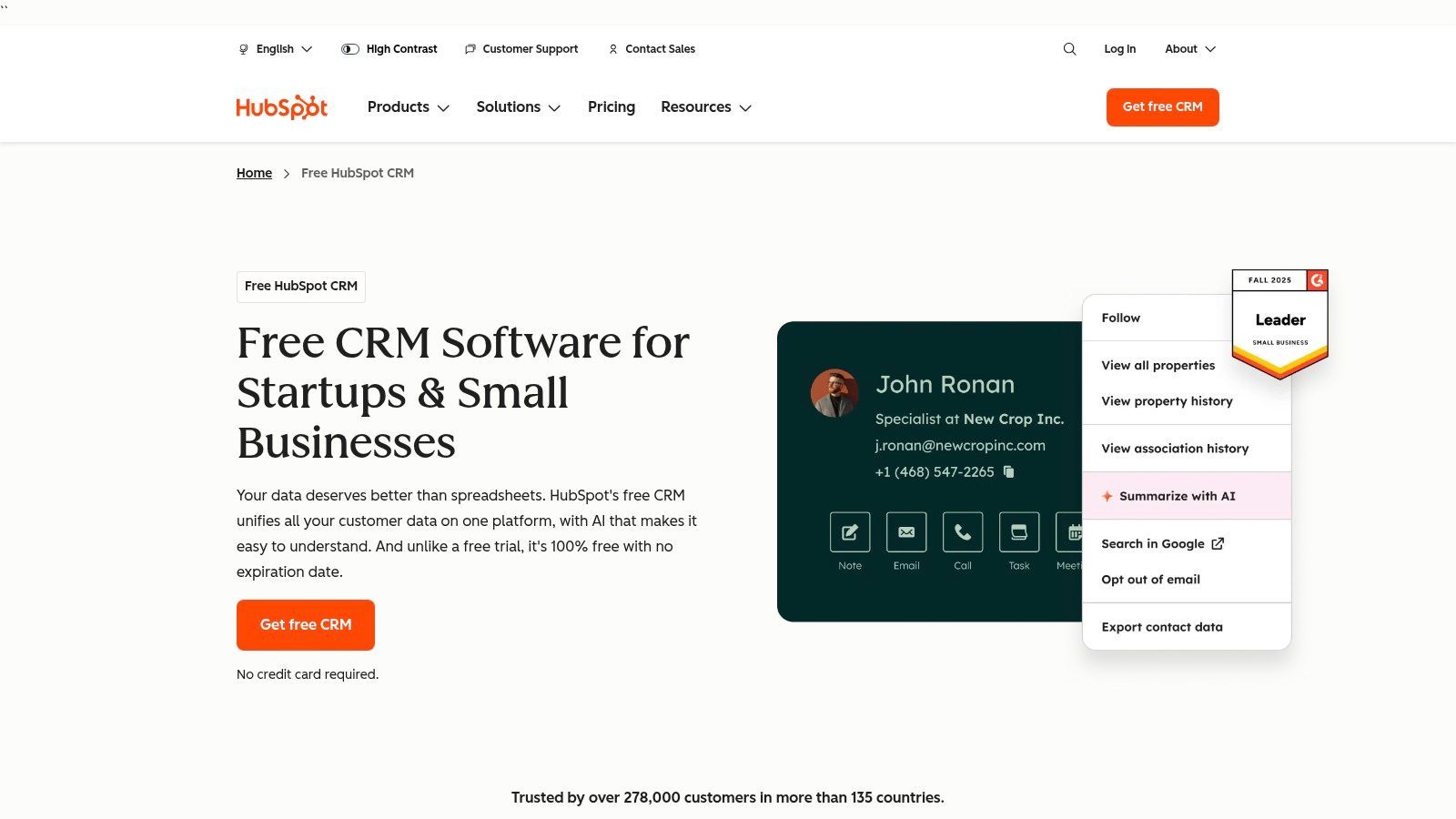
What truly makes HubSpot the best CRM for solopreneurs who anticipate scaling is its modular "hub" system. You can start with the free tools, which include contact management, deal pipelines, email tracking, and a meeting scheduler, and later add paid features from their Marketing, Sales, Service, or Content Hubs as your needs dictate. This à la carte approach prevents you from paying for advanced features you don't need right away. For those getting started, their comprehensive documentation and onboarding resources make the initial setup manageable. For a deeper dive into maximizing its features, explore how to effectively use a CRM like HubSpot.
Key Information & Features:
- Best For: Solopreneurs who want a robust, all-in-one platform that can grow with their business.
- Pricing: Offers a Free plan for up to two users and 1,000 contacts. Paid "Starter" plans, which bundle features across different hubs, list at $20/month per seat whether billed monthly or annually (HubSpot currently discounts them for new customers).
- Pros:
- Scalable: Starts free and grows with you, adding only the features you need.
- Extensive Ecosystem: Integrates with thousands of apps via its marketplace.
- Mature Platform: Excellent documentation, support, and a vast user community.
- Cons:
- Potential for Complexity: Can feel overwhelming compared to simpler, single-purpose CRMs.
- Rising Costs: Adding multiple hubs or upgrading tiers can become expensive quickly.
2. Pipedrive
Pipedrive has built its reputation as a sales-first CRM, making it a fantastic choice for solopreneurs who live and breathe their sales pipeline. Its core strength lies in its visual, Kanban-style interface that makes tracking deals from lead to close incredibly intuitive. This activity-based selling approach prompts you to define the next action for every deal, ensuring no opportunity falls through the cracks, a critical feature when you are managing every aspect of the business yourself.
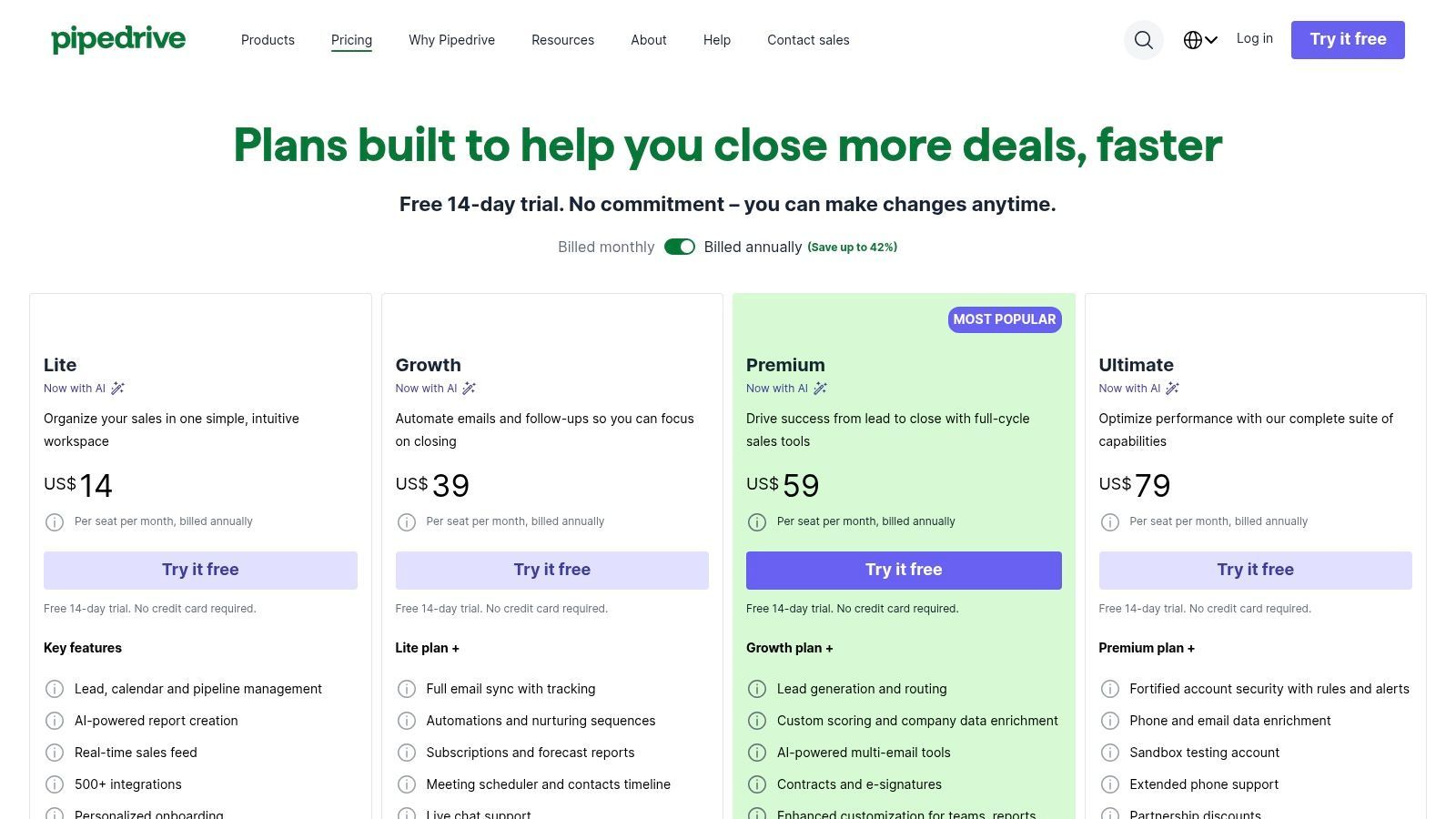
Unlike all-in-one platforms that can be complex, Pipedrive focuses on doing one thing exceptionally well: managing your sales process. You can set it up in minutes, customize your pipeline stages, and immediately start tracking conversations and scheduling activities. While core functionality is centered on sales, its marketplace of over 500 integrations and optional add-ons like LeadBooster and Campaigns allows you to bolt on marketing and project management tools as needed. This makes it a powerful yet uncluttered option, allowing you to calculate the potential ROI of a focused CRM for your specific sales activities.
Key Information & Features:
- Best For: Solopreneurs who need a simple, visual, and action-oriented tool to manage their sales pipeline effectively.
- Pricing: Starts with the "Lite" plan at $14/user per month billed annually ($24 billed monthly). A 14-day free trial is available.
- Pros:
- Intuitive UI: Extremely easy to learn and use, with a clean visual pipeline.
- Activity-Focused: Prompts for next steps help maintain sales momentum.
- Quick Setup: Can be configured and ready to use in under an hour.
- Cons:
- Add-on Costs: Key marketing and lead-gen features often require paid add-ons.
- Limited Lower Tiers: Advanced reporting and automation are reserved for higher-priced plans.
3. Close
Close is a sales-focused CRM designed for high-velocity engagement, making it a powerful choice for solopreneurs who spend their day calling, emailing, and texting leads. It distinguishes itself by tightly integrating communication tools directly into the CRM interface, eliminating the need to constantly switch between your inbox, phone, and contact database. This all-in-one approach streamlines outreach and ensures every interaction is automatically logged against the correct contact, providing a clear, chronological view of your entire relationship history.
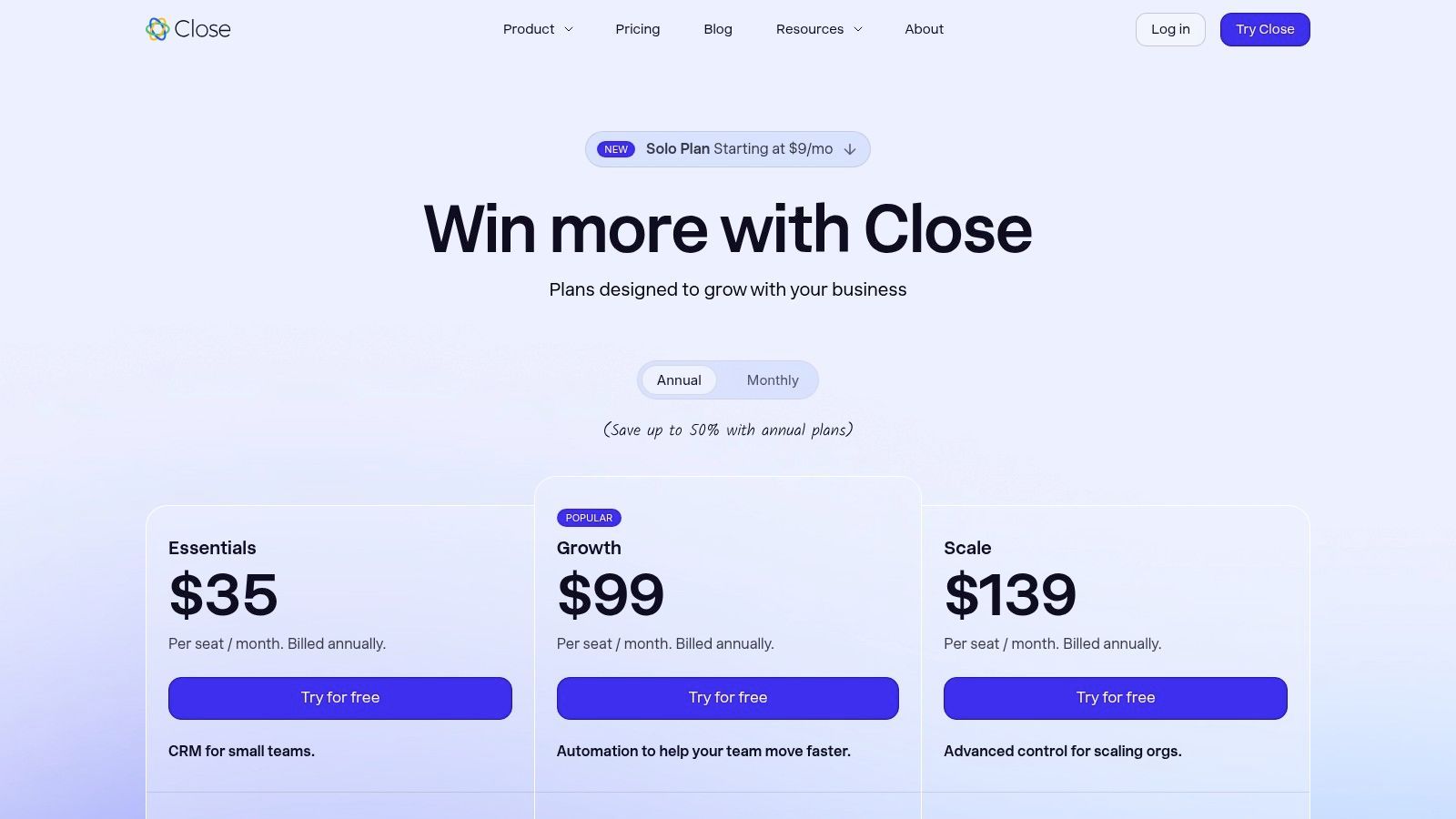
The platform is built for action. Even its Solo plan, made for one-person businesses, includes two-way email sync, built-in calling, and SMS for up to 10,000 leads, while automated workflows and the Power Dialer start on the Growth plan. Its intuitive design and excellent documentation make it quick to set up, allowing you to focus on selling rather than on complex configurations. For a solopreneur who needs a CRM that acts as a true sales communication hub, Close is one of the best CRM for solopreneurs available.
Already using Close? Add to CRM's Close integration adds contacts from Gmail, Outlook, and company websites to Close in one click and finds verified email addresses for them.
Key Information & Features:
- Best For: Solo sales professionals who need built-in calling, SMS, and email in a single platform.
- Pricing: The "Solo" plan costs $9/month billed annually, or $19 billed monthly, for one user and up to 10,000 leads; calling and SMS are billed on usage. Team plans start with "Essentials" at $35/user/month billed annually, and a 14-day free trial needs no credit card. Visit the Close pricing page for details.
- Pros:
- Excellent Communication Hub: Built-in telephony, SMS, and email sync are seamlessly integrated.
- Fast Implementation: Easy to set up and use, with strong documentation to guide you.
- Sales-Focused Workflow: The interface is designed to maximize sales activity and efficiency.
- Cons:
- Advanced Features Gated: Automated workflows and the Power Dialer start on the Growth plan ($99/user/month billed annually).
- Potential for Extra Costs: Usage-based fees for calling and SMS can increase the monthly bill.
4. Bigin by Zoho CRM
Bigin is Zoho's answer for small businesses and solopreneurs who find full-scale CRMs like Zoho CRM too complex. It strips down customer relationship management to its essentials, focusing squarely on pipeline management. This makes it a fantastic choice for a solo operator whose primary need is to visualize and manage their sales process from lead to close without getting bogged down in extraneous features. The platform is built around clear, stage-based pipelines that are easy to set up and manage.
What makes Bigin one of the best CRM for solopreneurs is its potent combination of simplicity and affordability. It offers built-in telephony, email integration, and workflow automations that are typically found in more expensive platforms. Its seamless integration with the broader Zoho ecosystem (like Zoho Campaigns or Books) provides a clear and accessible upgrade path as your business needs evolve. The mobile apps are also highly functional, allowing you to manage deals and contacts on the go, a critical feature for any solo business owner.
Key Information & Features:
- Best For: Solopreneurs and micro-businesses needing a simple, pipeline-focused CRM with a low learning curve.
- Pricing: Offers a Free plan for a single user. Paid plans start at a very accessible $7/month per user, billed annually.
- Pros:
- Very Affordable: One of the most budget-friendly, yet capable, CRMs on the market.
- Simple and Intuitive: The pipeline-centric interface is easy to understand and use immediately.
- Strong Mobile App: Excellent functionality for managing your business from anywhere.
- Cons:
- Limited Customization: Less flexible than more advanced enterprise-level CRMs.
- Relies on Zoho Ecosystem: Accessing deeper marketing or analytics features often requires adding other Zoho apps.
5. Streak CRM for Gmail
Streak is a unique CRM designed for solopreneurs who live and breathe inside their Gmail inbox. Instead of operating as a separate application, Streak integrates directly into the Gmail interface, transforming your email client into a flexible, powerful sales and project management tool. This native integration eliminates the need for constant context switching, allowing you to manage pipelines, track communications, and update deal stages without ever leaving your inbox. It’s the ultimate choice for those who find traditional CRMs too cumbersome and want to centralize their workflow where their conversations happen.
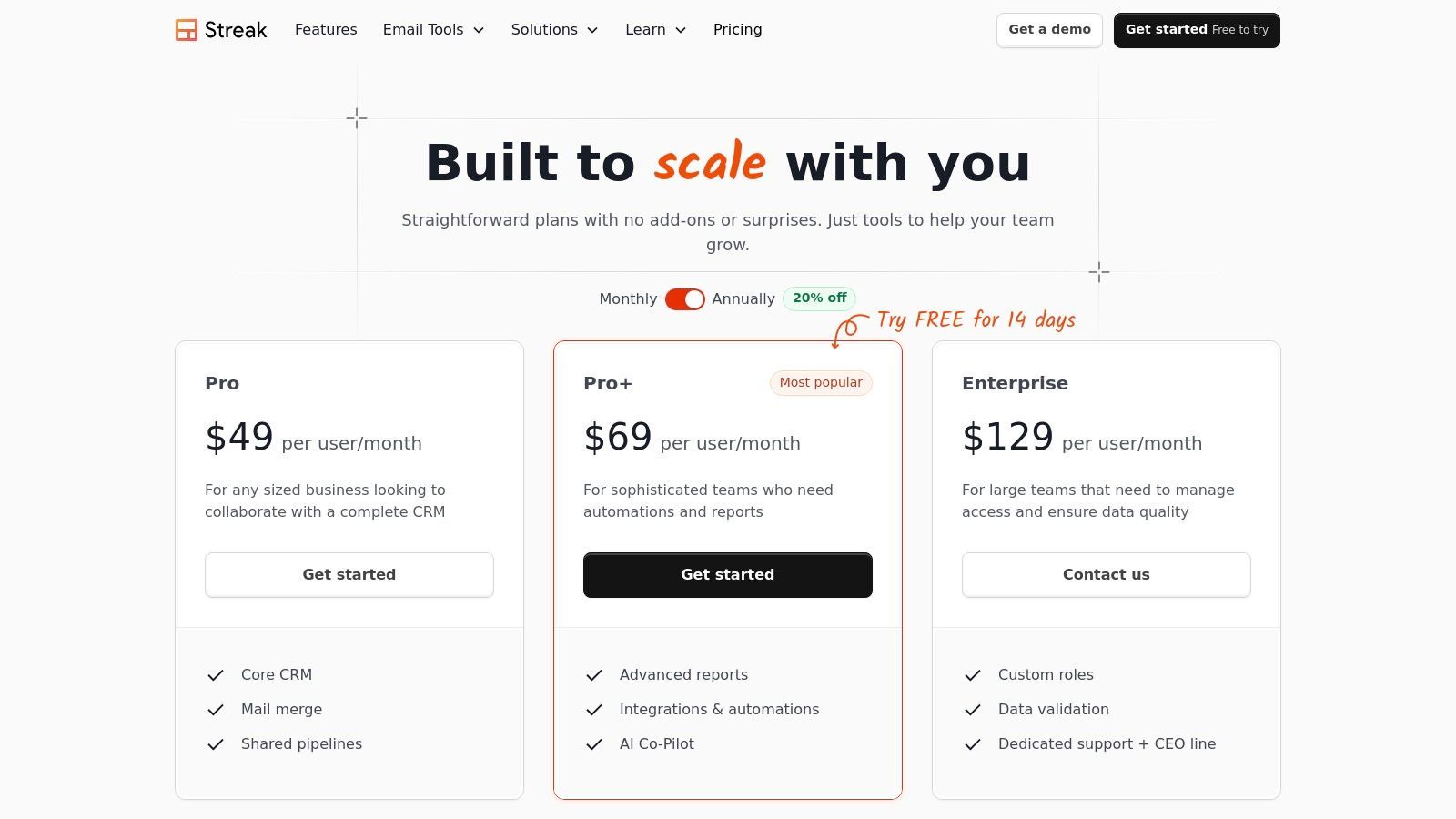
The platform’s strength lies in its simplicity and email-centric features. You can create visual pipelines for any process, from sales to hiring, and associate emails with specific deals or contacts automatically. Features like mail merge, email tracking, and snippets are built-in, streamlining outreach efforts significantly. For solopreneurs heavily reliant on Google Workspace, this setup is incredibly efficient. To better understand how this type of embedded tool works, you can explore the benefits of CRM integration with Gmail. While it lacks the all-in-one scope of larger platforms, Streak's focused approach makes it one of the best CRM for solopreneurs who prioritize inbox productivity above all else.
Key Information & Features:
- Best For: Solopreneurs and freelancers who manage their entire business workflow from their Gmail inbox.
- Pricing: A Free plan covers Streak's Gmail email tools (email and link tracking, snippets, and mail merge up to 50 sends a day) but does not include CRM pipelines. CRM plans start at $49/user per month billed annually ($59 billed monthly) for Pro, and Pro+ ($69/user per month billed annually, $89 monthly) comes with a 14-day free trial.
- Pros:
- Native Gmail Experience: Works seamlessly inside your inbox with minimal setup.
- Strong Email Tooling: Excellent for solo outreach with built-in mail merge and tracking.
- Flexible Pipelines: Easily customizable for sales, project management, support, and more.
- Cons:
- Gmail-Dependent: Only a viable option if you exclusively use Gmail and Google Workspace.
- Limited Reporting: Advanced reporting and automation are locked behind higher-priced tiers.
6. Freshsales by Freshworks
Freshsales, part of the Freshworks ecosystem, is a sales-focused CRM that excels at providing built-in communication tools right out of the box. It’s an excellent choice for solopreneurs who engage with clients across multiple channels and want to consolidate their phone, email, and live chat conversations into one platform without relying on numerous third-party integrations. This unified approach simplifies daily workflows, allowing you to see a complete history of every interaction with a contact in a single, chronological timeline.
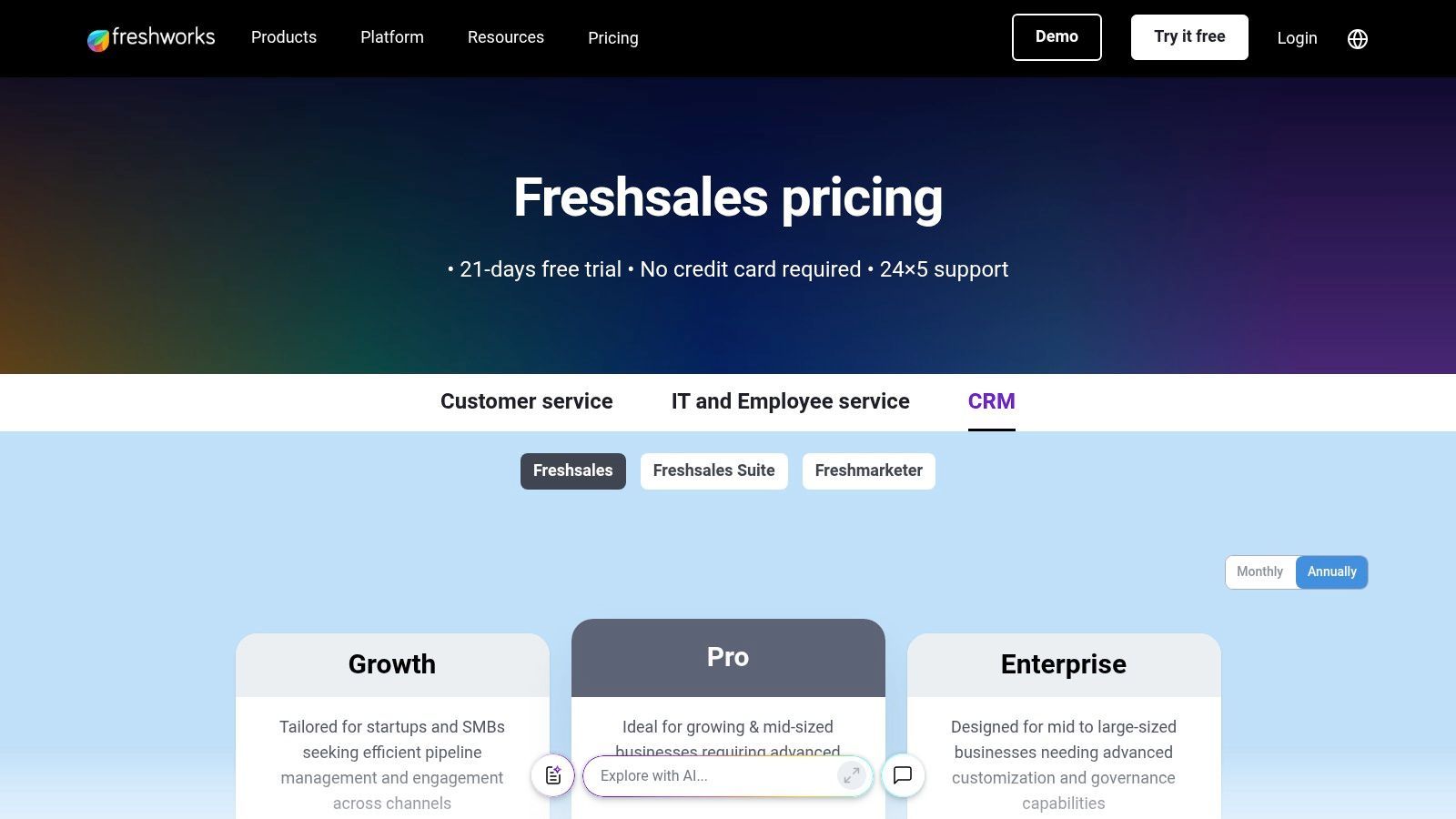
What makes Freshsales a contender for the best CRM for solopreneurs is its blend of powerful features and competitive pricing. The platform includes an AI assistant, Freddy, which helps with lead scoring, deal insights, and even suggesting next best actions, automating some of the analytical work that can bog down a solo operator. While its user interface is comprehensive and may have a slightly steeper learning curve than simpler tools, the 21-day free trial of its highest-tier plan lets you fully explore its capabilities before committing.
Key Information & Features:
- Best For: Solopreneurs who need built-in, multi-channel communication tools (phone, chat, email) at a competitive price point.
- Pricing: Paid plans start at $9/user/month billed annually ($11 billed monthly). A 21-day full-feature trial is offered.
- Pros:
- All-in-One Communication: Integrated phone, email, and chat significantly reduce the need for external tools.
- AI-Powered Insights: Freddy AI provides valuable lead scoring and sales forecasting.
- Competitive Entry Price: The paid plans offer a strong feature set for the cost.
- Cons:
- Potential for Overwhelm: The feature depth might be more than a new solopreneur initially needs.
- Advanced Customization is Gated: Key features like custom modules are reserved for higher-priced Enterprise plans.

One Chrome extension for all your CRM enrichment
Find verified emails, phone numbers, and job titles on LinkedIn®. Add contacts to any of 29+ supported CRMs in one click.
Start Free Trial


 Trusted by 2,500+ users4.7
7. Capsule CRM
Capsule CRM offers a refreshingly simple and intelligent approach to customer relationship management, making it an excellent choice for solopreneurs who prioritize ease of use and clarity. It strips away the complexity often found in larger platforms, focusing instead on providing a clean, intuitive interface for managing contacts, tracking sales opportunities, and visualizing your pipeline. This focus on simplicity ensures a very short learning curve, allowing solo operators to get up and running quickly without getting bogged down in complicated setup processes.
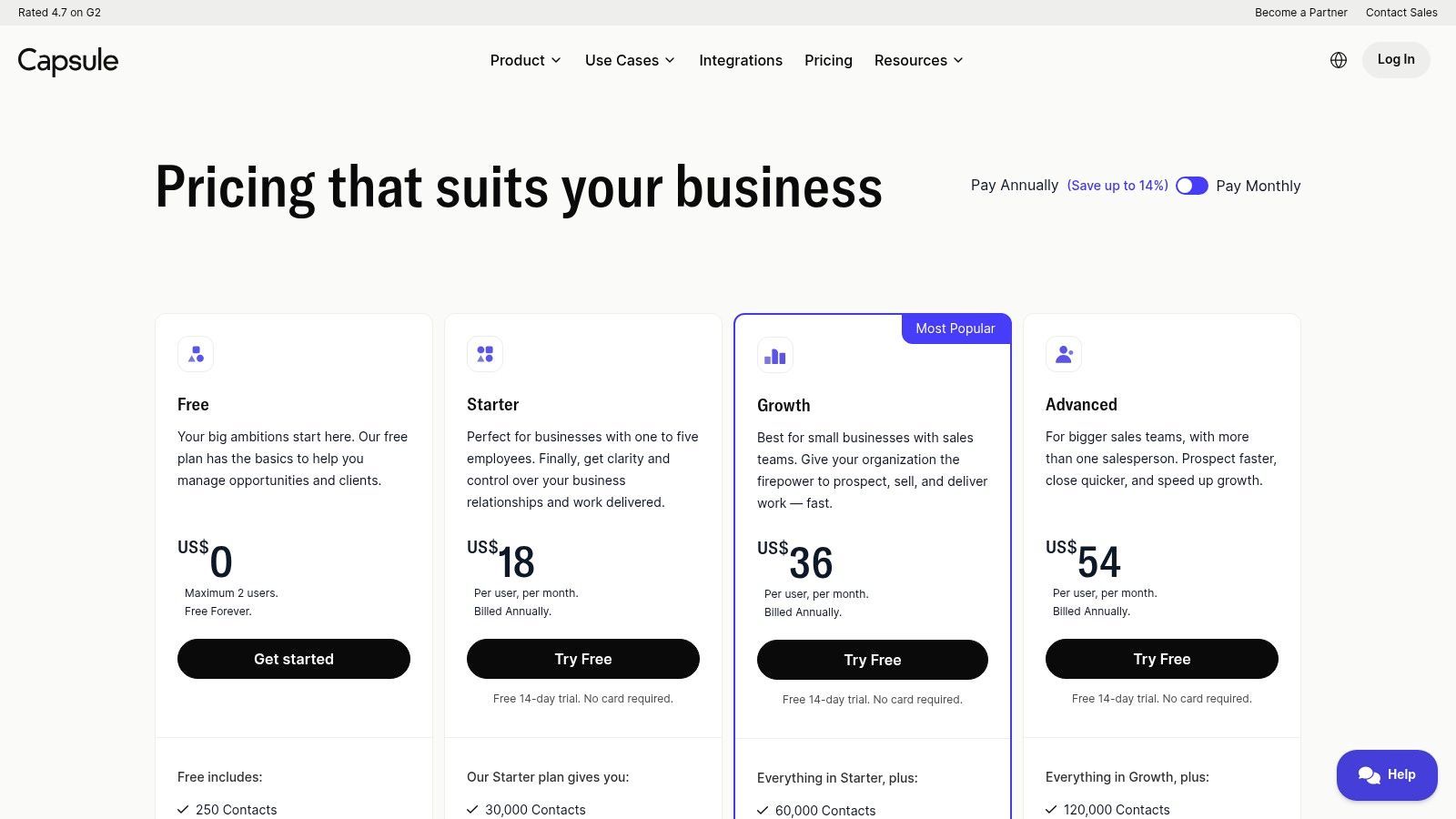
What makes Capsule a standout option is its blend of core CRM functionality with optional project management features. Every plan includes a project board (multiple boards start on Growth), so you can manage post-sale work and projects directly within the same system you use for sales, creating a seamless transition from lead to client delivery. This is particularly valuable for service-based solopreneurs who need to track both their sales pipeline and project tasks without juggling multiple applications. Its tight integrations with tools like Google Workspace, Microsoft 365, and Xero further streamline daily operations, positioning it as a strong contender for the best CRM for solopreneurs seeking an uncomplicated yet capable hub for their business.
Key Information & Features:
- Best For: Solopreneurs and small teams who need a straightforward, easy-to-learn CRM with optional project management capabilities.
- Pricing: Offers a Free plan for up to two users and 250 contacts. Paid plans start at $18/user per month billed annually ($21 billed monthly) for Starter; workflow automations begin on Growth at $36/user per month billed annually ($38 monthly).
- Pros:
- User-Friendly: Incredibly easy to learn and navigate, with excellent mobile apps.
- Transparent Pricing: Simple, clear pricing tiers without hidden costs.
- Integrated Projects: Combines sales and project management in one platform, with a project board on every plan.
- Cons:
- Basic Automation: Lacks the advanced marketing automation and reporting of larger suites.
- Tiered Features: Workflow automations and multiple project boards start on the Growth plan; Free and Starter include a single project board.
8. HoneyBook
HoneyBook is a client relationship platform designed specifically for creative entrepreneurs and service-based solopreneurs. It goes beyond a traditional CRM by integrating proposals, contracts, invoicing, and payments into a single, cohesive system. This all-in-one approach is its biggest strength, allowing freelancers like photographers, designers, and consultants to manage the entire client lifecycle, from initial inquiry to final payment, without juggling multiple software subscriptions. The platform excels at creating a seamless, professional experience for both the business owner and their clients.
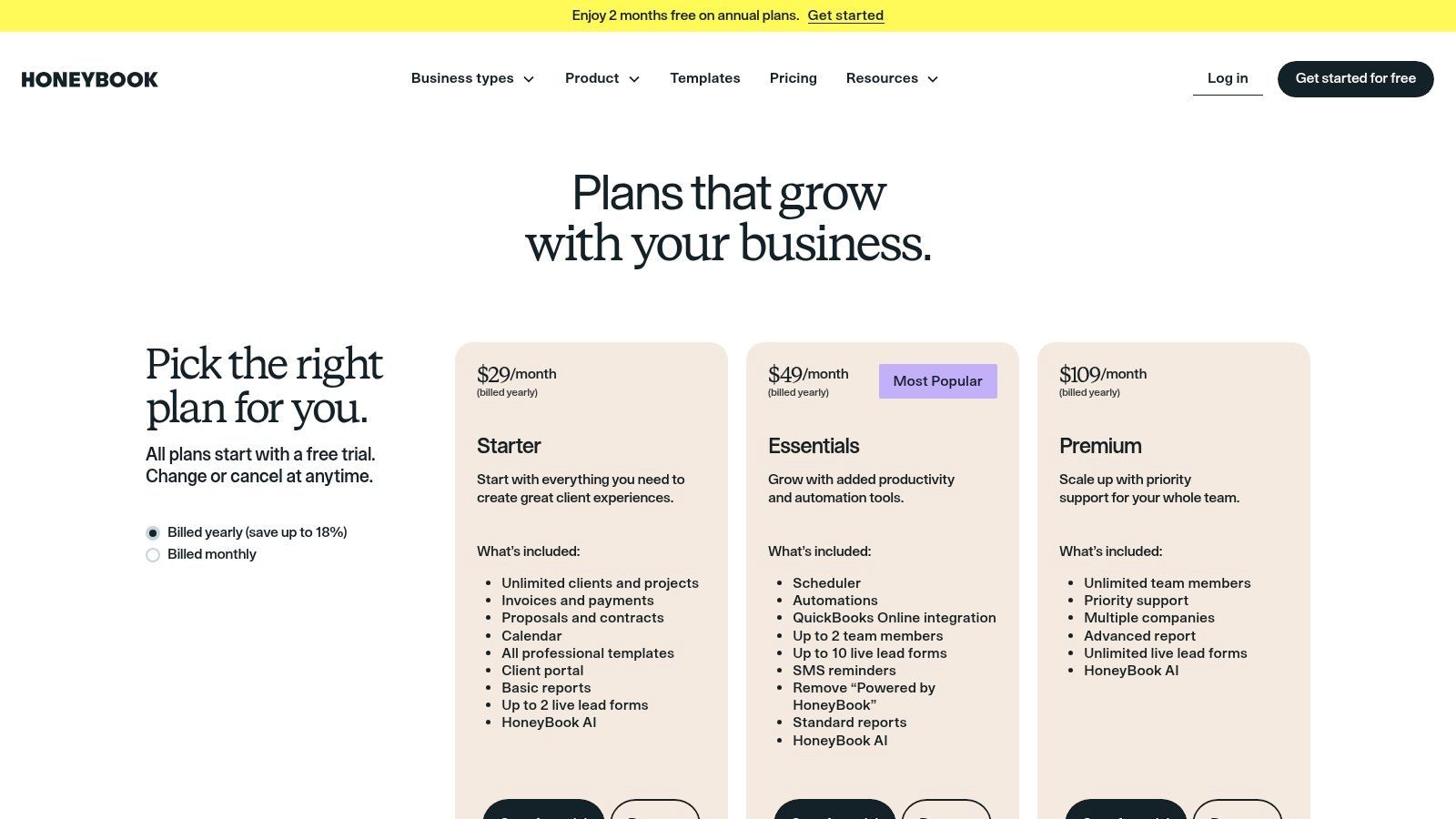
What makes HoneyBook a top CRM choice for solopreneurs in creative fields is its focus on client-facing documents and workflow automation. You can use templates to quickly generate beautiful proposals that clients can review, sign, and pay in one step. The system automates reminders for payments and follow-ups, saving significant administrative time. By consolidating these critical business functions, HoneyBook reduces software clutter and streamlines operations, letting solo professionals focus more on their creative work and less on back-office tasks. For more details on their plans, visit the HoneyBook pricing page.
Key Information & Features:
- Best For: Creative solopreneurs and service providers who need a combined CRM, invoicing, contract, and scheduling tool.
- Pricing: Starts at $29/month (billed annually; $36 billed monthly) for the "Starter" plan. "Essentials" adds the scheduler and automations for $49/month (billed annually; $59 monthly), and "Premium" is $109/month (billed annually; $129 monthly). A 30-day free trial needs no credit card.
- Pros:
- All-in-One Platform: Reduces tool sprawl by combining CRM with billing, contracts, and scheduling.
- Professional Client Experience: Streamlines proposals, contracts, and payments for clients.
- Strong Support: Offers a 60-day money-back guarantee and US-based customer support.
- Cons:
- Niche Focus: Less suited for complex B2B sales cycles or product-based businesses.
- Price Structure: The best value is on annual plans, and automations require the Essentials plan ($49/month billed annually) or higher.
9. Bonsai
Bonsai is less of a standalone CRM and more of an all-in-one business management suite tailored specifically for freelancers, consultants, and creative professionals. It earns its spot on this list for solopreneurs who want to manage their entire client workflow, from lead capture to final payment, within a single, cohesive system. Bonsai integrates client management with proposals, contracts, project management, time tracking, and invoicing, eliminating the need to stitch together multiple disparate tools.
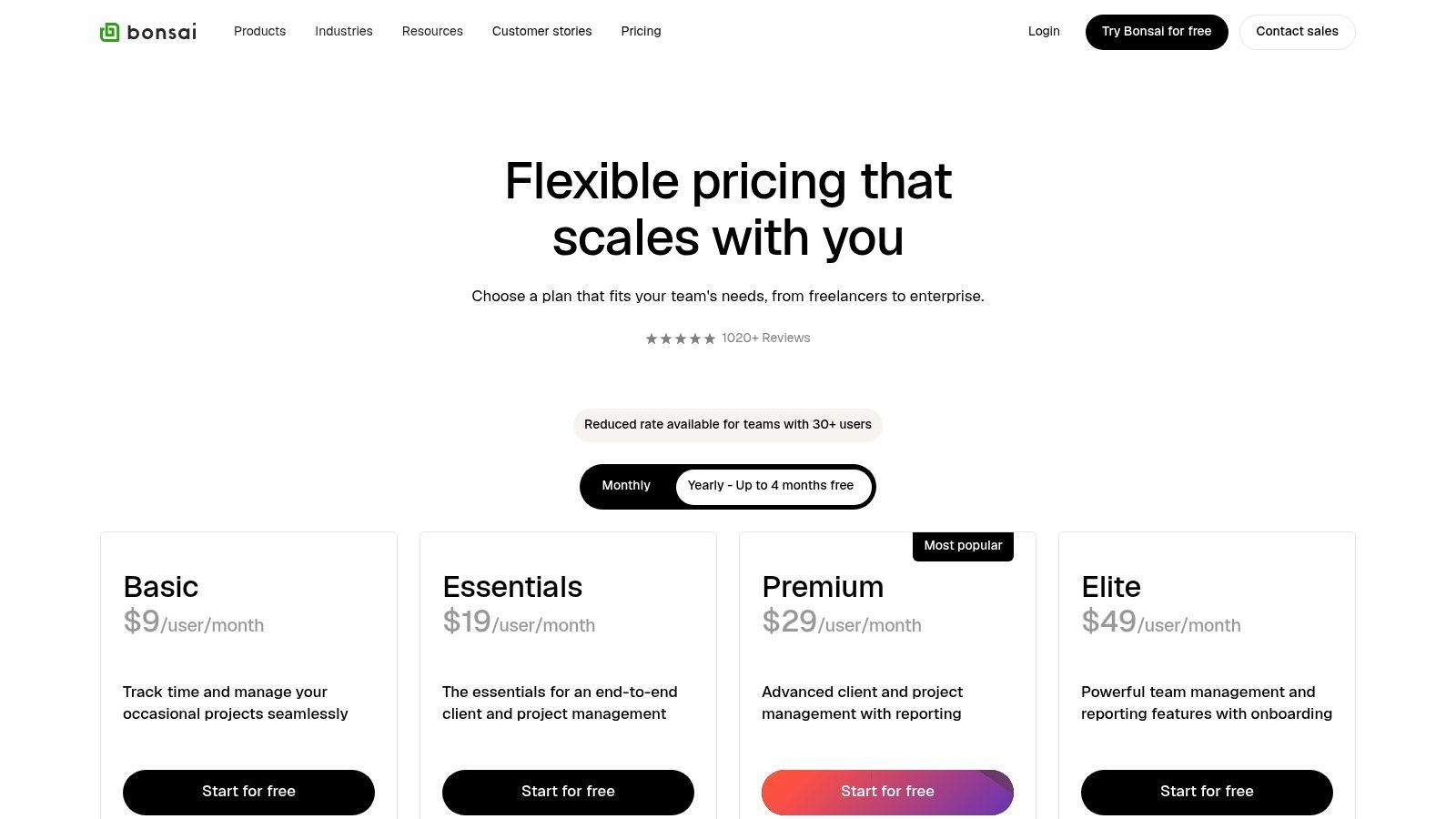
The platform's strength lies in its seamless, project-based workflow. You can convert a proposal into a contract and then into an invoice with just a few clicks, with all documents and communications tied to a specific client record. This makes it an excellent choice for service-based solopreneurs who need to manage project deliverables alongside client relationships. While its core CRM features are simpler than dedicated platforms, its holistic approach provides a level of operational efficiency that is hard to match, making it a powerful contender as a CRM for solopreneurs who value integration above all else.
Key Information & Features:
- Best For: Freelancers and consultants seeking an end-to-end system for managing clients, projects, and finances.
- Pricing: Priced per user. Basic costs $9/user per month billed annually ($15 billed monthly) and includes the CRM; invoices, proposals, and contracts start on Essentials at $19 billed annually ($25 monthly), and Premium at $29 billed annually ($39 monthly) unlocks the deals pipeline, custom fields, and integrations. A 7-day free trial is available.
- Pros:
- All-in-One Workflow: Seamlessly connects proposals, contracts, projects, and invoicing.
- Client-Centric Design: Built from the ground up for managing service-based client engagements.
- Simple Pricing: Straightforward tiers with clear feature inclusions.
- Cons:
- Limited CRM Functionality: Lacks the advanced sales automation and reporting of dedicated CRMs.
- Paywalled Features: The deals pipeline requires the Premium plan ($29/user per month billed annually) or higher.
10. G2 — CRM for Small Business
While not a CRM itself, G2 is an indispensable resource for finding the best CRM for solopreneurs by leveraging user-generated reviews and data. It’s a B2B software marketplace that provides detailed rankings, comparisons, and authentic feedback specifically filtered for small business needs. For a solopreneur, this means you can cut through the enterprise-level noise and see how platforms actually perform for businesses of a similar size and complexity to your own. G2's platform allows you to compare shortlisted CRMs side-by-side on features, usability, and customer satisfaction scores.
The real value lies in the depth of its reviews. Users often detail their specific use cases, implementation experiences, and the pros and cons they’ve encountered firsthand. This peer-driven insight is crucial for a solo operator who lacks an IT department to vet options. By using G2's Small Business grid for CRM, you can quickly identify trending tools, filter by pricing models, and validate claims made on a vendor's website. It acts as a critical final checkpoint before you commit to a platform, ensuring the tool you choose truly aligns with your solo operations.
Key Information & Features:
- Best For: Solopreneurs conducting due diligence and comparing CRM options based on real user feedback.
- Pricing: Free to access all reviews and comparison tools.
- Pros:
- Authentic Reviews: A massive, current database of user reviews provides honest insights.
- Powerful Filtering: Easy to shortlist tools by business size, budget, and required features.
- Side-by-Side Comparisons: Directly compare your top choices on key metrics and satisfaction ratings.
- Cons:
- Sponsored Listings: Vendor promotions can appear, so it's wise to verify details directly on vendor sites.
- Broad Use Cases: Not every review will perfectly match a solo-use case, requiring some interpretation.
11. Capterra — CRM directory
While not a CRM itself, Capterra is an indispensable resource for any solopreneur navigating the complex market of CRM software. It functions as a massive, searchable directory of business software, allowing you to compare dozens of CRMs side-by-side. For a solopreneur, this is a crucial first step to validate options, understand the feature landscape, and avoid choosing a tool that's either too simple or too overpowered for your immediate needs. The platform's real value lies in its structured data and user-generated reviews.
Capterra allows you to create a shortlist and filter potential CRMs by specific features (like email marketing or project management), pricing models, and business size. This targeted approach helps you quickly narrow down the vast market to a manageable list of contenders that are genuinely a good fit. By leveraging their comparison tools and buyer guides, you can make a more informed decision, ensuring the platform you choose is the best CRM for solopreneurs based on your unique business requirements. You can visit their CRM section directly at https://www.capterra.com/customer-relationship-management-software/.
Key Information & Features:
- Best For: Solopreneurs in the research phase who need to compare features, pricing, and user reviews across a wide range of CRM options.
- Pricing: Free to use for research and comparison.
- Pros:
- Extensive Coverage: Includes both major players and niche CRM vendors, offering a comprehensive market view.
- Powerful Filtering: Easily narrow down options based on specific features, deployment type, or budget.
- User Reviews: Provides social proof and real-world insights from other business users.
- Cons:
- Sponsored Listings: Be aware that some vendor placements are sponsored, which can influence visibility.
- Data Lag: Information on pricing or features can sometimes be outdated; always verify on the vendor's official website.
Start your 7-day free trial of Standard
Find verified emails, phone numbers, and job titles on LinkedIn®. Add contacts to any of 29+ supported CRMs in one click.
Start Free TrialTrusted by 2,500+ users4.712. AppSumo
AppSumo isn't a CRM itself but a marketplace that earns its spot on this list as a strategic resource for finding the best CRM for solopreneurs on a budget. The platform offers lifetime and heavily discounted annual deals on emerging software, which sometimes include CRM systems. For a solo business owner watching every dollar, securing a capable CRM for a one-time fee instead of a recurring monthly subscription can be a game-changer for cash flow. This approach allows you to access premium features that might otherwise be out of reach.
The key to using AppSumo successfully is due diligence. Since deals are for newer or less-established tools, it's crucial to read user reviews, check the vendor's roadmap, and understand the terms of the lifetime deal. Most lifetime deals come with a 60-day refund window (some offer only 30 days, so check each deal's terms), giving you ample time to test a tool and ensure it fits your workflow before committing. For solopreneurs willing to explore up-and-coming software, AppSumo presents an unparalleled opportunity to acquire a high-value CRM at a fraction of its long-term cost.
Key Information & Features:
- Best For: Budget-conscious solopreneurs looking for high-value lifetime deals on emerging CRM platforms.
- Pricing: Varies by deal; offers significant discounts and one-time lifetime purchases. An AppSumo Plus membership (around $99/year) provides an extra 10% off.
- Pros:
- Incredible Value: Potential to get a capable CRM for a one-time payment, within the deal's tier limits.
- Risk-Free Testing: Most lifetime deals carry a 60-day refund window (check each deal's terms), allowing for thorough evaluation.
- Discover New Tools: A great way to find innovative software not yet on the mainstream radar.
- Cons:
- Inconsistent Availability: The best deals are time-sensitive and may not return.
- Varying Quality: The longevity and support of featured software can be uncertain.
Top 12 CRMs for Solopreneurs — Comparison
| Product | Core focus / Key features | Best for | Unique selling point | Pricing / Value |
|---|---|---|---|---|
| HubSpot CRM | Contact/deal/activity tracking, automations, large app ecosystem | Solopreneurs who want a scalable all-in-one platform | Generous free core CRM with modular paid hubs | Free tier; paid hubs can add up |
| Pipedrive | Kanban-style pipelines, activity reminders, email sync, 500+ integrations | Founders wanting a visual, activity-driven sales process | Intuitive UI and fast setup | Paid plans with add-ons for marketing features |
| Close | Two-way email sync, built-in calling & SMS, dialers | Solo sellers needing integrated telephony + inbox | Strong telephony and SMS capabilities in one CRM | Solo plan $9/mo billed annually; calling/SMS billed on usage |
| Bigin (Zoho) | Pipeline-centric workflows, mobile apps, Zoho integrations | Small businesses and solo users on a budget | Very affordable, lightweight alternative to Zoho CRM | Low-cost entry; fewer advanced features |
| Streak (Gmail) | Pipelines, mail merge, link tracking inside Gmail | Gmail/Workspace users who sell from their inbox | Native Gmail experience, minimal context switching | Free email tools (no CRM); CRM from $49/user/mo billed annually |
| Freshsales (Freshworks) | Built-in email, chat, phone, AI (Freddy), multichannel tools | Solopreneurs wanting bundled multichannel engagement | Competitive pricing with AI-powered insights | Paid plans from $9/user/mo billed annually; 21-day trial available |
| Capsule CRM | Contact & opportunity tracking, simple pipelines, project boards | Operators who want a clean, no‑bloat CRM | Easy learning curve and transparent tiering | Free plan for 2 users; modest paid tiers |
| HoneyBook | Lead capture, client portal, proposals, contracts, invoices | Freelancers/creatives needing CRM + billing & scheduling | Combines CRM with payments/contracts in one tool | Paid plans; best value on annual billing |
| Bonsai | Contracts, proposals, invoices, time tracking, deals pipeline | Solo consultants wanting end-to-end freelancer workflow | All-in-one freelancer suite with unlimited clients/projects | Subscription tiers; advanced features on higher plans |
| G2 — CRM for Small Business | Filtered reviews, side-by-side comparisons, trending tools | Buyers shortlisting CRMs using user reviews | Large, current review base for small-business needs | Free to use; verify vendor pages for details |
| Capterra — CRM directory | Shortlists, filters, buyer guides, feature explainers | Buyers validating options and pricing ballparks | Broad vendor coverage and buyer guidance | Free; data may lag vendor changes |
| AppSumo | Time-limited discounts, lifetime/annual deals, refund windows | Budget-conscious solopreneurs hunting deals | Potential for strong value via limited-time offers | Deal-based pricing; availability and quality vary |
Making Your Final Decision: Actionable Next Steps
Choosing the best CRM for solopreneurs isn't about finding a universally perfect platform. It's about discovering the tool that perfectly aligns with your unique business model, workflow, and growth aspirations. Throughout this guide, we've explored a diverse range of options, from powerhouse platforms like HubSpot and Pipedrive to niche-specific solutions like HoneyBook and Bonsai, and even resource hubs like G2 and Capterra to continue your research. The right choice will feel less like software you have to manage and more like a dedicated partner helping you scale.
Your ideal CRM is one that simplifies complexity, not adds to it. If you live in your inbox, a tool like Streak might be the most seamless fit. If your focus is on a highly visual and intuitive sales pipeline, Pipedrive is a strong contender. If you sell by phone, Close puts calling, SMS, and email in a single low-cost Solo plan. For those just starting out and needing a robust free option, HubSpot's free CRM or Bigin by Zoho offer incredible value without the initial investment. The key takeaway is that features are only valuable if you actually use them. Don't be swayed by an exhaustive feature list if your core need is simply to track leads and manage follow-ups.
From Analysis to Action: Your Implementation Checklist
Now it's time to move from reading and researching to hands-on testing. A CRM can look perfect on paper, but its true value is only revealed when you integrate it into your daily operations. A clunky interface or a confusing workflow can quickly turn a promising tool into a source of frustration.
Here is a practical, step-by-step plan to confidently make your final selection:
Revisit Your Core Needs: Before you start any trials, take one last look at your initial "must-have" list. Is your primary goal lead management, project management, client invoicing, or a combination? Rank your priorities. This clarity will be your compass during the testing phase.
Create a Shortlist of 2-3 Contenders: Based on the breakdowns above, select the top two or three CRMs that seem to be the best fit. Trying to test five or more will lead to decision fatigue. Focus your energy on the most promising candidates.
Commit to the Free Trial: This is the most critical step. Don't just sign up and poke around. Dedicate a few hours to a real-world test drive. Almost every tool we've mentioned, from Close to Freshsales, offers a free trial or a permanently free plan.
Execute a "Core Workflow Test": Simulate your most common daily tasks within each platform.
- Prospect Capture: Can you easily add a new contact from a professional network or an email? How many clicks does it take?
- Deal Creation: Create a sample deal or project. Move it through your defined pipeline stages. Is the process intuitive?
- Task Management: Schedule a follow-up email, a phone call, and a meeting. Do you get reminders? Is it easy to see what's on your plate for the day?
- Data Retrieval: Search for a contact or a deal. How quickly can you find the information you need?
By running this simple test, you'll get a tangible feel for which platform complements your natural way of working. The best CRM for solopreneurs is ultimately the one you will consistently use. An investment of a few hours now will save you countless hours of frustration and potential migration costs later. You are building the central nervous system for your business, so choose a foundation that is not just powerful, but also a pleasure to work with.
No matter which CRM you choose, ensuring high-quality, accurate contact data is your top priority. Add to CRM streamlines this process by letting you instantly save contacts from professional networks and websites directly to your CRM with a single click, eliminating manual data entry and keeping your pipeline clean. Start your free trial of Add to CRM and see how effortless prospect capture can be.
Start saving time and closing more deals.
Find verified contact info for your prospects on LinkedIn®, Gmail and Outlook — and add them to your CRM with 1-click.

 Loading...Trusted by 2,500+ founders, SDRs & more