What Is the Sales Cycle: what is sales cycle and how to master it
Discover what is sales cycle and how it unfolds from lead to close, with key stages, metrics, and tactics to accelerate deals.
Published on February 1, 2026
The sales cycle is the journey a potential customer takes from the moment they first hear about you to the day they sign on the dotted line. Think of it as your sales team's playbook—a repeatable, step-by-step process that turns curious strangers into happy customers.
Without a defined cycle, you’re just winging it. With one, you have a clear roadmap that ensures no opportunity gets lost along the way. Nailing this process is the secret to predictable revenue and scalable growth.
The Foundation of Predictable Revenue
At its core, a well-understood sales cycle turns selling from a chaotic art into a repeatable science. It gives your team a structured framework for every interaction, which builds consistency and efficiency. When everyone follows the same map, you can actually see where you're going and, more importantly, figure out how to get there faster.
Imagine trying to fix a leaky pipe without knowing where the leak is. That's what sales without a defined cycle feels like. Once you map out the stages, you can pinpoint exactly where deals are slowing down or falling through.
For instance, are a lot of prospects ghosting you after the demo? That’s a signal to either improve your presentation or do a better job of qualifying leads beforehand. That kind of insight is pure gold, but it's impossible to find without a structured process to measure against.
Why a Defined Sales Cycle Is So Important
Mapping out each stage of your sales journey brings a ton of clarity and purpose to your entire operation. It’s not just busywork; it has a real impact on everything from individual rep performance to your company's high-level financial planning.
Here’s why it matters:
- Better Forecasting: When you know the average time a deal spends in each stage, you can predict future revenue with surprising accuracy. No more wild guesses.
- A More Efficient Team: A clear process gets rid of the guesswork. It lets your reps focus their energy on high-impact activities that actually move deals forward.
- Growth That Scales: New hires can get up to speed in days, not months. You hand them a proven playbook, and they can start contributing right away.
- An Awesome Customer Experience: Consistency is key. A structured process ensures every single prospect gets a thoughtful, professional experience, building trust from the very first call.
A well-defined sales cycle brings clarity, consistency, and predictability to your sales process. It helps you spot where deals slow down, track performance, and apply the right strategies at the right time. Ultimately, it allows you to close more deals faster.
The 7 Key Stages of a Modern Sales Cycle at a Glance
Before we dive deep, let's get a high-level view. Every business is a bit different, but most successful sales cycles follow a similar seven-stage framework. This table breaks it down into a simple, easy-to-digest summary.
| Stage | Primary Goal |
|---|---|
| 1. Lead Generation | Identify potential customers through marketing and outreach. |
| 2. Prospecting | Contact leads to gauge initial interest. |
| 3. Qualification | Determine if the prospect has the need, budget, and authority. |
| 4. Discovery & Demo | Deeply understand the prospect's pain points and present the solution. |
| 5. Proposal | Outline the solution, pricing, and terms in a formal offer. |
| 6. Negotiation | Address objections and finalize the terms of the deal. |
| 7. Closing | Get the final sign-off and officially win the business. |
Think of these stages as the essential building blocks. Once you understand the goal of each one, you can start tailoring them to fit your specific product, industry, and customers.
Navigating Today's Longer Sales Cycles
It’s no secret that the B2B buying journey has gotten more complicated. In fact, 43% of B2B sales leaders say their sales cycles got longer in the last year, with some studies showing an average jump of 38%.
What's going on? For one, there are more cooks in the kitchen. Mid-market deals that used to take a few months now often stretch to nine, simply because more decision-makers need to sign off on every purchase. This new reality makes having a structured, efficient sales cycle more critical than ever.
You can dig into more of these evolving B2B sales trends at MarketingProfs.com.
Navigating the 7 Stages of the B2B Sales Cycle
Every B2B sale tells a story. It’s the journey you guide a potential customer on, from the first "hello" to the final signed contract. While every industry has its quirks, this journey almost always follows a predictable, seven-stage path.
For any sales pro looking to build a process that just works, mastering these steps is everything.
This simple diagram shows the high-level flow, turning a total stranger into a paying client.
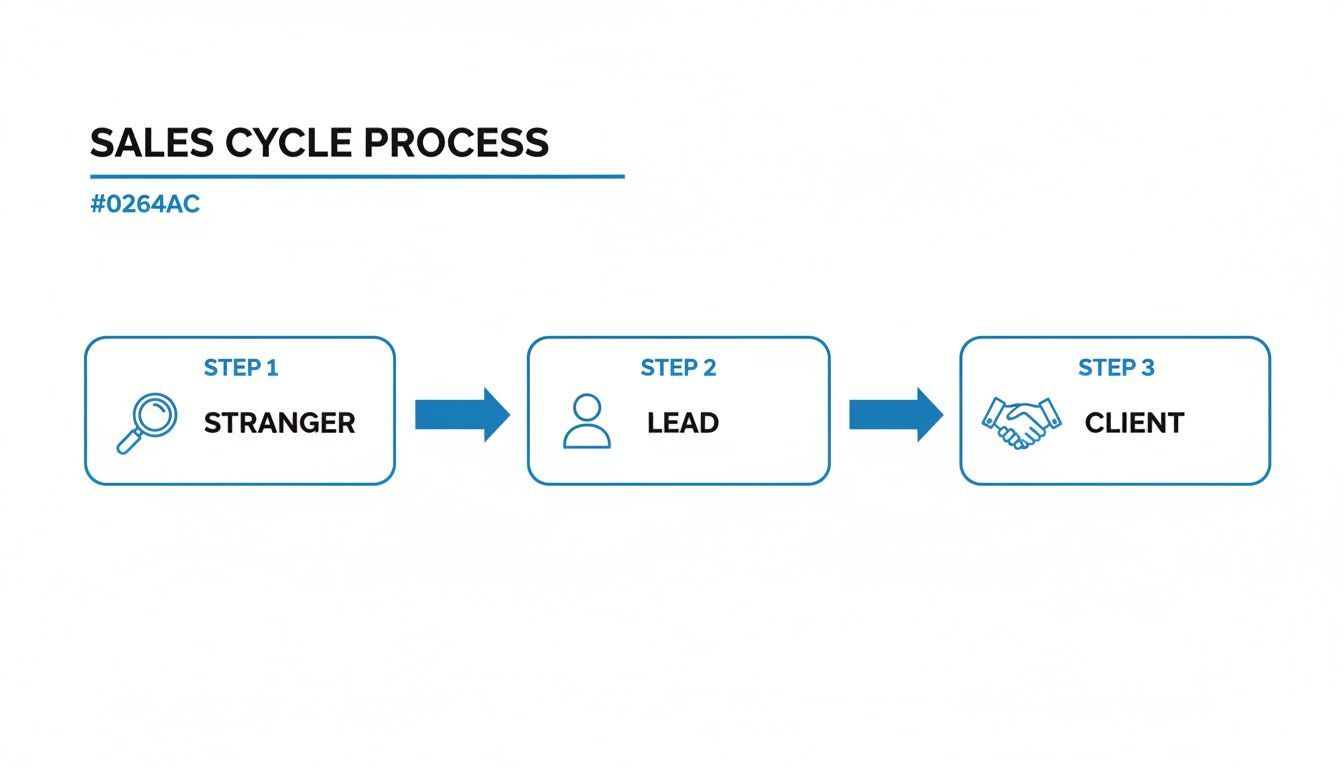
Think of it as a roadmap. Each stage requires different skills and strategies to keep the conversation moving forward and transform that initial spark of interest into real business.
Stage 1: Prospecting
This is where it all begins. Prospecting is the hunt for potential customers who fit your ideal customer profile (ICP). It’s all about building a solid list of companies and people who could genuinely get value from what you're selling.
Your methods can be anything from cold outreach and social selling on platforms like LinkedIn to networking at industry events. The goal isn’t just to find any lead, but the right lead. Get this right, and you’ll save a ton of time and energy down the line.
Stage 2: Contact Initiation
Okay, you've got your list. Now it's time to make first contact. This isn't the moment for a hard pitch; it's about opening a dialogue. Your only goal here is to introduce yourself and your company, see if there's a glimmer of interest, and start building a connection.
Whether you use a personalized email, a cold call, or a direct message, the key is to provide value right away. Share a useful resource or a sharp insight to prove you've done your homework. Show them you’re focused on their world, not just your quota.
Stage 3: Lead Qualification
This is arguably the most important stage in the entire cycle. Here’s where you figure out if a lead is a genuine prospect worth your time. Chasing unqualified leads is one of the biggest resource drains in sales, so you have to be disciplined.
Smart sales teams lean on proven frameworks to qualify leads without wasting time.
- BANT (Budget, Authority, Need, Timeline): The classic. Does the lead have the budget? Are you talking to the decision-maker? Is there a real business need? And is there a timeline for a purchase?
- MEDDIC (Metrics, Economic Buyer, Decision Criteria, Decision Process, Identify Pain, Champion): This one’s more in-depth and perfect for complex enterprise deals where you need to vet an opportunity from every angle.
If a lead doesn't check the right boxes, don't be afraid to disqualify them. It frees you up to focus on the deals that actually have a shot at closing.
Stage 4: Nurturing
Here’s a hard truth: not every qualified lead is ready to buy right now. The nurturing stage is where you play the long game. It's about building trust and staying top-of-mind by consistently offering value over time.
This means sharing relevant content, checking in at the right moments, and positioning yourself as a helpful advisor, not just another salesperson.
Nurturing is the bridge between initial interest and active consideration. It ensures that when the prospect is finally ready to make a decision, your solution is the one they think of first.
Stage 5: Presenting the Solution
Once you have a rock-solid understanding of the prospect's problems, it's showtime. This is your moment to deliver a product demo or sales presentation that connects the dots. A great presentation isn't about rattling off features; it's about showcasing benefits.
You need to tie every single part of your solution back to the specific needs and pain points the prospect shared with you. To get a better sense of how to lay these stages out visually, check out our guide on how to build a sales pipeline.
Stage 6: Handling Objections
Objections are not a bad sign. In fact, they’re a great one. They show your prospect is engaged and thinking seriously. They’ll almost always have questions about pricing, implementation, or specific features.
The trick is to see objections not as roadblocks, but as opportunities. They’re a chance to clarify your value and calm any underlying fears. Listen carefully, validate their concern, and then deliver a thoughtful, confident response.
Stage 7: Closing the Deal
This is the final push—getting that signature on the dotted line. This stage involves sending the official proposal, negotiating the final terms, and guiding the prospect through their procurement process.
A smooth closing process reinforces all the trust you’ve built so far. It turns a transaction into a partnership and sets the stage for a successful, long-term relationship.
Measuring Your Sales Cycle with Key Metrics
Defining your sales cycle stages is like drawing a map. Now, you need a dashboard with gauges to see how fast you’re going, how much fuel you're using, and if you’re even heading in the right direction. This is where key performance indicators (KPIs) come in.
Without metrics, you're flying blind. You might feel like your team is busy, but you won't know if all that activity is actually translating into closed deals. Tracking the right data helps you spot bottlenecks, forecast revenue with confidence, and make smart decisions based on numbers, not just gut feelings.
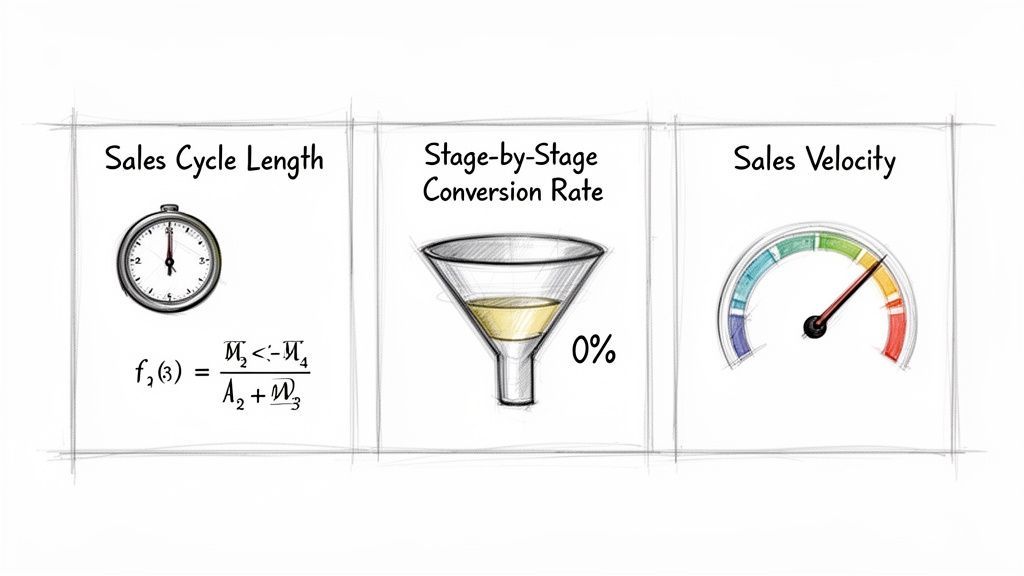
By focusing on a few core metrics, you can get a clear picture of your entire sales operation's health and find exactly where you can improve.
To make it easy, here's a quick reference table with the essential metrics and how to calculate them.
Essential Sales Cycle Metrics and Formulas
| Metric | What It Measures | Formula |
|---|---|---|
| Sales Cycle Length | The average time it takes for a deal to go from initial contact to closed-won. | Total Days to Close All Deals / Total Number of Closed Deals |
| Stage Conversion Rate | The percentage of deals that successfully move from one stage of your pipeline to the next. | (Number of Deals in Stage 2 / Number of Deals in Stage 1) * 100 |
| Sales Velocity | How quickly deals move through your pipeline and generate revenue, measured in revenue per day. | (# of Opportunities x Average Deal Size x Win Rate %) / Sales Cycle Length in Days |
These three metrics work together to give you a complete diagnostic of your sales process. Let's dig into each one.
Calculating Your Sales Cycle Length
The most fundamental metric is your Sales Cycle Length. This KPI measures the average amount of time it takes to close a deal, from the very first contact right up to the final signature. Think of it as the ultimate benchmark for your sales efficiency.
Calculating it is straightforward:
Formula: Total number of days to close all deals ÷ Total number of deals closed = Average Sales Cycle Length
A long cycle can signal problems like unqualified leads clogging up your pipeline or reps struggling to create a sense of urgency. Keeping an eye on this number helps you set realistic quotas and forecast when that revenue will actually hit the books. For a deeper look, you can learn more about the nuances of the average sales cycle in our glossary.
Analyzing Stage-by-Stage Conversion Rates
While the overall cycle length gives you the big picture, the Stage-by-Stage Conversion Rate tells you where your deals are getting stuck. This metric shows the percentage of deals that successfully advance from one stage to the next.
For example, what percentage of qualified leads actually get a proposal? And how many of those proposals turn into closed deals? A low conversion rate between two specific stages is a huge red flag, pointing directly to a bottleneck in your process.
- Low Demo-to-Proposal Rate? Your presentations might not be hitting the mark or communicating real value.
- Low Proposal-to-Close Rate? You could be running into issues with pricing, negotiation skills, or getting key stakeholders on board.
Tracking these micro-conversions lets you make surgical improvements to your sales process instead of just guessing what needs to be fixed.
Understanding Sales Velocity
Finally, there's Sales Velocity. This metric combines several others to measure how quickly deals are moving through your pipeline and generating revenue. Think of it as the speedometer for your sales engine. It literally tells you how much revenue you can expect to close per day.
The formula brings together four key variables:
- Number of opportunities in your pipeline
- Average deal size
- Overall win rate percentage
- Average sales cycle length in days
A higher velocity means you're closing more deals, faster. By tracking this metric, you can see the direct impact of your efforts. Improve your win rate or shorten your cycle length, and you'll immediately see your sales velocity increase—proof that the strategic changes you're making are paying off.
Proven Strategies to Shorten Your Sales Cycle
Knowing your sales cycle metrics is the first step. Actually using them to close deals faster? That’s the real game-changer.
A long, drawn-out sales cycle kills momentum. It inflates your customer acquisition costs and gives prospects way too much time to get cold feet or, even worse, check out your competition. Shortening your cycle isn't about being pushy—it's about removing friction and building a smarter, more efficient path from that first handshake to a signed contract.
The goal here is to focus your team's energy where it actually counts and eliminate the dead air that causes promising deals to stall out.
Refine Your Ideal Customer Profile
One of the biggest drags on any sales cycle is time wasted on leads that were never going to close. When reps are chasing prospects who are a poor fit for your product, they inevitably hit a wall—but only after sinking hours of effort into a lost cause.
The antidote is a rock-solid Ideal Customer Profile (ICP). This isn't just a vague persona; it's a crystal-clear definition of your perfect customer, backed by data. It goes beyond basic demographics to include firmographics like company size and revenue, along with the specific pain points and buying behaviors that signal a great fit. A sharp ICP acts as a filter, making sure you only pursue leads with a high probability of closing.
- Analyze Your Best Customers: Take a hard look at your happiest, most successful clients. What do they all have in common? Find those shared traits to build a profile grounded in reality, not guesswork.
- Prioritize Ruthlessly: Use that ICP to score new leads the moment they come in. This lets your team immediately focus their attention on the opportunities that matter most.
Align Your Sales and Marketing Teams
When sales and marketing operate in different universes, your entire sales cycle grinds to a halt. Marketing throws leads over the fence without knowing what makes them "sales-ready," and sales complains that the leads are junk. That disconnect creates a massive bottleneck right at the top of your funnel.
Aligning sales and marketing isn't just some fluffy "best practice." It's a powerful growth engine. It creates a seamless handoff from initial brand awareness to active sales engagement, keeping deals moving with consistent messaging and clear, shared goals.
The results speak for themselves. Tightly aligned teams see up to 38% higher win rates and 36% better customer retention. This synergy also drives 24% faster revenue growth because teams are 67% more effective at closing deals when they work together. On the flip side, misalignment can cost businesses an average of 10% of their annual revenue. If you need more proof, you can explore more data on why this alignment is crucial on LXA Hub.
Implement Smart Automation
Admin work is the silent killer of sales productivity. Manually logging calls, sending follow-up emails, and updating CRM records—it all has to be done, but it's a massive time suck that pulls reps away from what they actually do best: selling.
Putting smart automation in place is one of the fastest ways to shave time off your sales cycle. By letting the machines handle the repetitive stuff, you free up your team to focus on building relationships and moving deals across the finish line.
Consider these easy automation wins:
- Automated Email Sequences: Set up nurturing campaigns for prospects who aren't quite ready to buy. This keeps them engaged without any manual effort from your team.
- CRM Data Entry Tools: Use solutions that automatically capture and sync prospect data right into your CRM, killing the soul-crushing copy-paste routine for good.
- Scheduled Follow-Up Reminders: Make sure no opportunity falls through the cracks by automating reminders for key touchpoints.
By strategically using these tactics, you can systematically root out delays, boost your sales velocity, and build a much more predictable revenue machine.
How a CRM Powers Your Sales Cycle
A well-defined sales cycle is your blueprint for predictable revenue, but that blueprint needs a command center to actually bring it to life. That's where a modern Customer Relationship Management (CRM) platform comes in. Think of it as the central nervous system for your entire sales operation.
A good CRM gives you the visibility, automation, and clean data you need to manage the entire process from start to finish. It tracks every lead's journey, automates the tedious-but-critical follow-ups, and gives managers a real-time pulse on the pipeline’s health.
Without one, you're stuck trying to manage complex relationships with spreadsheets and sticky notes—a surefire recipe for missed opportunities and stalled deals.
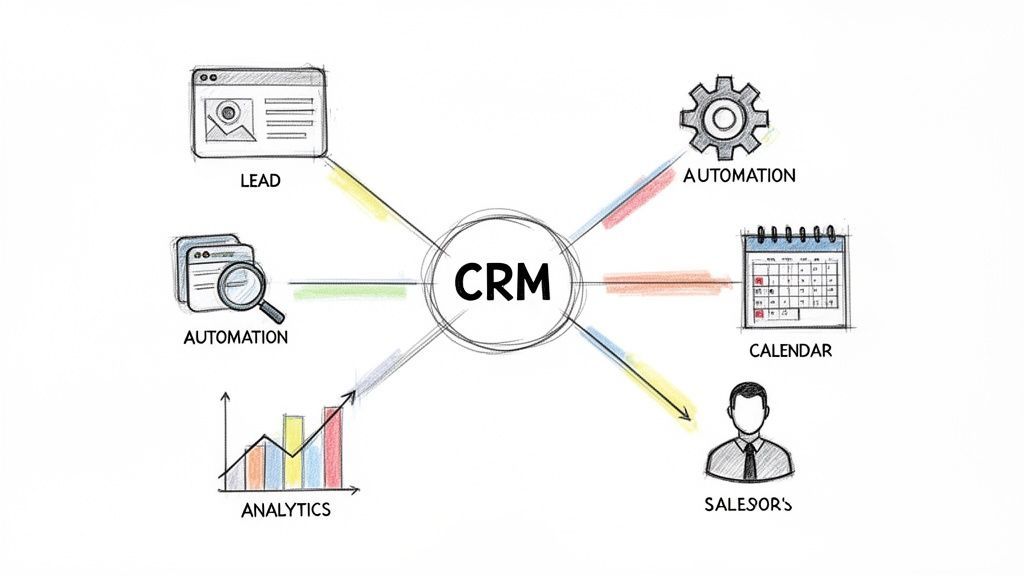
This centralized hub ensures everyone on your team is on the same page, creating a single source of truth for every prospect and customer interaction.
Centralized Data and Visibility
The real magic of a CRM is its ability to pull every piece of customer data into one place. Every email, call, meeting note, and interaction gets logged, building a complete history for each and every contact.
This 360-degree view empowers your reps to have smarter, more relevant conversations. Instead of starting from scratch on every call, they can instantly see where a prospect is in their buying journey, what’s already been discussed, and what the next logical step should be.
For managers, this visibility offers an accurate, top-down view of the entire pipeline, making forecasting far more reliable.
A CRM transforms your sales cycle from a series of disconnected events into a cohesive, manageable workflow. It ensures that no lead falls through the cracks and every opportunity is moved forward with purpose.
Automation That Accelerates Deals
One of the biggest drags on any sales cycle is administrative busywork. Reps waste countless hours on manual data entry, logging activities, and scheduling follow-ups instead of actually selling. A CRM tackles this problem head-on with powerful automation.
By automating those repetitive tasks, you give your sales team back their most valuable asset: time.
- Automated Follow-ups: Set up email sequences to nurture leads, ensuring consistent communication without any manual effort.
- Task Reminders: Automatically create tasks for reps to follow up after a demo or send a proposal, keeping deals on track.
- Data Enrichment: Instantly update contact records with fresh information, keeping your database accurate and ready for action.
This isn't just about convenience. AI-adopting sales teams have been shown to slash their cycle times by up to 20%. That's a huge deal, especially when many SaaS companies are seeing deal timelines get longer. Tools that automate CRM data entry are essential here, as they save teams valuable hours and eliminate manual bottlenecks.
Overcoming the Data Entry Bottleneck
While a CRM is the command center, its effectiveness depends entirely on the quality of the data inside it. This is where so many teams stumble.
Manually transferring prospect information from professional networking sites or an email signature into a CRM is tedious, slow, and full of human error. This initial data entry step often becomes a major bottleneck right at the start of the sales cycle.
Luckily, purpose-built tools can eliminate this friction entirely. Solutions that automate CRM enrichment and data entry are crucial for saving reps hours of admin work, letting them focus on what they do best: selling. To get a better handle on these systems, you can check out our detailed guide on how to use CRMs effectively.
Common Questions About the Sales Cycle
Even with a solid plan, a few questions always pop up when teams start dialing in their sales process. Let's tackle the most common ones to make sure all the core concepts are locked in.
Think of this as the final check-in before you hit the road.
What’s the Difference Between a Sales Cycle and a Sales Pipeline?
This is easily the most common point of confusion, but the distinction is simple.
Your sales cycle is the how—it's your strategic map, the repeatable, step-by-step process your team follows to turn a stranger into a customer.
Your sales pipeline is the what—it's a real-time, visual snapshot of all your current deals and where each one is on that map. It tells you where all your cars are at any given moment.
How Long Should a B2B Sales Cycle Be?
Sorry, there’s no magic number here. The "right" length for a B2B sales cycle really depends on your industry, how complex your product is, and the size of the deal.
A simple software sale to a small business might wrap up in a few weeks. On the flip side, a complex enterprise solution with a dozen stakeholders could easily stretch out for nine months to a year.
The goal isn’t to hit some universal benchmark. It's to measure your own average cycle length and find ways to make it consistently more efficient.
What’s the Most Important Stage of the Sales Cycle?
Every stage matters, but if you ask a room full of sales leaders, most will point to one: Lead Qualification. Why? Because it has the biggest ripple effect on everything that follows.
Strong qualification is the ultimate gatekeeper. It ensures your team pours its time and energy into prospects who have a real need, the authority to buy, and the budget to do it. It’s the single best way to keep your pipeline clean and prevent reps from wasting months on deals that were never going to close.
Get this stage right, and every other step in your process becomes infinitely more likely to succeed.
Ready to stop the data entry that’s dragging your sales cycle down? Add to CRM turns any online profile into a clean CRM record in a single click, saving your team hours every week. Start prospecting faster and smarter today at https://addtocrm.com.
Start saving time and closing more deals.
Find contact info for your prospects on the #1 business social network and add them to your CRM with 1-click.

 Loading...



Trusted by 1000s of founders, SDRs & more
