How to Build High-Impact Email Lists by Industry
Stop using generic lists. Learn how to build targeted email lists by industry that drive real engagement and ROI. Get actionable strategies now.
Building targeted email lists by industry is the fastest way to improve your B2B outreach. Why? Because it forces a shift in mindset from sheer quantity to genuine quality. Instead of blasting generic messages to a massive, unfocused audience, you start creating highly relevant content that speaks directly to the unique challenges and language of a specific sector.
Why Generic Email Lists Dilute Your Marketing Efforts

Let's be honest: a massive, one-size-fits-all email list is more of a vanity metric than a strategic asset. True success in B2B marketing comes from precision, and that all starts with understanding industry-specific context. Generic outreach just doesn't connect.
When your message is too broad, it resonates with no one. Think about it. A software solution pitched to a financial services firm has completely different value propositions than the same solution pitched to a healthcare provider. The finance folks care about security and compliance, while the healthcare pros prioritize patient data privacy and HIPAA adherence. A generic email glosses over these critical nuances entirely.
The Downfall of One-Size-Fits-All Outreach
Sending the same message to everyone leads to predictable—and damaging—outcomes. You’ll see abysmal engagement rates, a spike in unsubscribes, and a tarnished sender reputation. Internet Service Providers (ISPs) absolutely notice when your emails are consistently ignored or marked as spam, which can tank your deliverability for all future campaigns.
A targeted campaign in a niche market with 100 engaged contacts will almost always outperform a generic campaign sent to 10,000 uninterested recipients. It’s about the right message for the right people, period.
On the flip side, tailoring your outreach to a specific industry’s pain points and vocabulary immediately builds credibility. It shows you’ve done your homework and actually understand their world. This simple adjustment transforms your email from an interruption into a valuable conversation.
This guide provides a clear roadmap for shifting from a list-size obsession to a list-quality focus. By concentrating on building powerful, industry-specific email lists, you create an asset that drives real, meaningful conversions. A key part of this shift is understanding the financial impact of each lead; you can explore our lead value calculator to see exactly how quality affects your bottom line.
Nailing Your Ideal Customer Profile for Industry Targeting
Before you even think about building a high-quality email list by industry, you have to know exactly who you're targeting. I'm not talking about basic, fluffy personas. This is about creating a detailed, data-driven Ideal Customer Profile (ICP) that’s customized for each industry you want to crack.
Think of your ICP as the blueprint for your entire list-building operation. It’s built on a foundation of firmographics—the hard facts about your target companies. These are the black-and-white criteria that instantly separate a perfect-fit customer from a time-waster.
Start with the Firmographic Foundation
First things first, outline the core attributes of the companies you serve best. These are your non-negotiables, the characteristics that define your sweet spot in the market.
- Company Size: Are you selling to scrappy startups with 10-50 employees or navigating the complex hierarchies of enterprises with over 1,000? The answer dramatically changes your sales cycle and who you need to talk to.
- Annual Revenue: Pinpointing a revenue range, like $5M-$50M, helps you focus on companies that actually have the budget and are on the right growth curve to need what you're selling.
- Geographic Location: Do you work with local businesses down the street, national players, or global giants? Nailing down the geography is mission-critical for any kind of personalized outreach.
- Technology Stack: This is a big one. Knowing what software they already use (like a specific CRM or marketing platform) can tell you a lot about their pain points and where you might fit in.
Layer on Industry-Specific Nuances
Got the firmographics down? Great. Now it’s time to add the industry-specific context that turns a generic profile into a laser-focused tool. You need to get inside the unique challenges, regulations, and priorities of each sector.
For example, an ICP for a SaaS company selling to healthcare will be completely different from one targeting retail. In healthcare, you’d be looking for prospects who mention HIPAA compliance. For retail, you’d prioritize companies struggling with e-commerce integrations or clunky inventory systems. This is the stuff that makes your messaging actually land.
When it comes to the retail and e-commerce world, email lists are an absolute powerhouse. The industry sees a wild ROI of up to $32-$45 for every dollar spent. It's no wonder 81% of SMBs swear by email for acquiring new customers. In fact, beauty brands saw their open rates climb to 23.8% last year alone. You can find more stats on ecommerce email performance at Omnisend.com.
The best place to start digging for these insights is your own backyard—your existing customer data. Look at your best, happiest clients. What industries are they in? What common problems did you solve for them?
Use that internal goldmine and back it up with market research. This is how you build sharp, actionable profiles that guide every single step you take from here on out. It’s this focused approach that ensures every contact you add isn't just another name on a list, but a potential high-value relationship waiting to happen.

Find verified contact data on LinkedIn®
Add to CRM finds verified emails, phone numbers, and job titles on LinkedIn® — then adds them to your CRM in one click.
Start Free Trial


 Trusted by 2,500+ users4.7
How to Source and Validate High-Quality Contacts
Okay, you've got your Ideal Customer Profile nailed down. Now for the real work: building your email lists by industry. This is where we shift from strategy to the nitty-gritty of finding contacts who actually fit your profile. And let's be clear—buying shady email lists is a complete non-starter. It's the fastest way to wreck your sender reputation before you even begin.
The best contacts are usually hiding in plain sight. Think professional networks, company directories, and those niche online communities where your ideal customers hang out. The trick is to be a sniper, not a machine gunner; your approach needs to be laser-focused on a specific industry.
This whole process boils down to a few key stages: identifying the basics of the business, diving deep into their specific challenges, and then backing it all up with solid research.
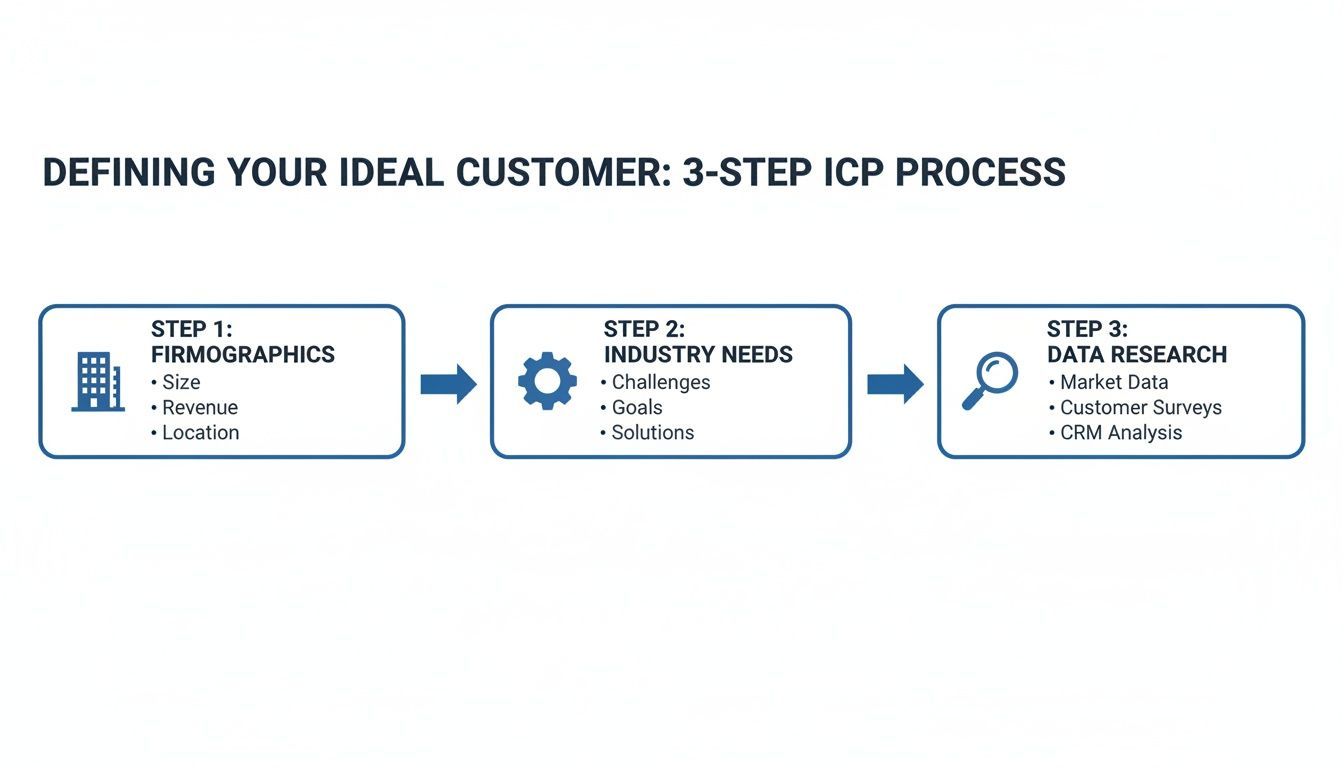
As you can see, a solid ICP is built in layers. You start with the company details (firmographics), add their industry-specific pain points, and then validate everything with data. This framework directly fuels your entire sourcing strategy.
Modern Sourcing Strategies That Actually Work
Your ICP is your treasure map—it should lead you straight to where your ideal contacts gather online. This isn't about guesswork; it's about strategically searching in the right digital watering holes.
Contact Sourcing Methods by Industry Focus
Picking the right sourcing method depends heavily on whether you're targeting businesses or consumers. A B2B tech salesperson will live on professional networks, while a B2C e-commerce brand might find gold in industry-specific trade show attendee lists. Here’s a quick breakdown of where to focus your energy.
| Sourcing Method | Best For (Industry Type) | Pros | Cons |
|---|---|---|---|
| Professional Social Networks | B2B | Unmatched filtering for roles, industries, company size. | Can be time-consuming; requires careful outreach. |
| Company Websites | B2B / B2C (Niche) | Direct access to key personnel and org structure. | Not always up-to-date; requires manual digging. |
| Industry Events & Webinars | B2B / B2C | Highly engaged contacts with demonstrated interest. | Lists can be expensive or require sponsorship. |
| Niche Online Communities | B2B / B2C | Great for understanding pain points and finding influencers. | Overt selling is often frowned upon. |
Ultimately, a mix of these strategies usually works best. Start with the low-hanging fruit on professional networks and company sites, then layer in more targeted approaches as you scale.
Here are the top three methods I always come back to:
Professional Social Networks: For B2B, certain platforms are indispensable. You can use advanced search filters to drill down by industry, company size, job title, and keywords to pinpoint the exact people you need to talk to. To really master this, check out our guide on using LinkedIn advanced search features.
Company Websites: Never underestimate the power of the "About Us" or "Team" page. These are often treasure troves that list key players and their roles, giving you a direct look at the company's org chart.
Niche Online Communities: Every industry has its own watering holes—be it dedicated forums, Slack channels, or private groups. Becoming an active participant lets you identify the most engaged professionals and get a firsthand look at the problems they're trying to solve right now.
The IT and Tech industry is a perfect example of where this pays off. Benchmarks show this sector hits a 22.7% average open rate and an incredible $36:1 ROI. That success isn't an accident; it's driven by the hyper-personalization that only a well-sourced contact list makes possible.
The Non-Negotiable Step: Validation and Enrichment
Finding contacts is only half the job. Firing off emails to a list of unverified addresses is a recipe for a sky-high bounce rate, which is a major red flag for email providers. They’ll start thinking you're a spammer, and your deliverability will tank.
This is why email verification isn't just a "nice-to-have"—it's a critical, non-negotiable step in the process.
Sending a campaign to an uncleaned list is like shouting into a disconnected phone. Your message goes nowhere, and you risk damaging the line for all future calls. Always verify before you send.
Email verification tools are your best friend here. They scan your list and confirm that every single address is active and can actually receive mail. It's a simple step that dramatically improves your deliverability and protects your all-important sender score.
Once you’ve cleaned your list, you can start enriching the data. This means adding more context—like company revenue, the tech they use, or their team size—to create even more powerful segments for your campaigns. This two-step dance—verify, then enrich—is what ensures every email you send has the best possible chance of not just landing in the inbox, but actually making an impact.
Organizing Your List With Smart Segmentation
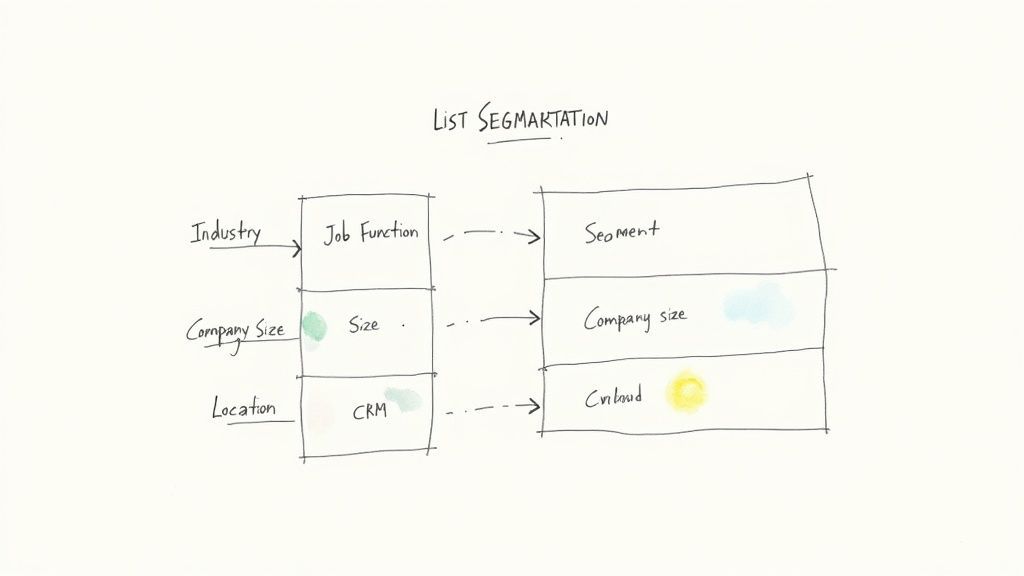
Sourcing high-quality contacts is a huge win, but let's be honest—an unsorted list is just a missed opportunity. The real magic of building email lists by industry happens when you structure that data for maximum impact. Think of smart segmentation as turning a blunt instrument into a surgical tool, letting you send hyper-relevant messages that actually get opened and clicked.
Just tagging contacts by industry is a good start, but it's only scratching the surface. The campaigns that truly move the needle use multi-layered segmentation. This is where you combine different data points to create micro-segments of your audience who share very specific traits.
Go Beyond Basic Industry Tags
Effective segmentation means looking at your contacts through multiple lenses. Your goal is to find common ground that goes deeper than just their industry vertical.
Here are the layers I always recommend starting with:
Job Function and Seniority: An email to a CEO should sound completely different from one sent to a marketing manager. Segmenting by job title lets you dial in your messaging to their specific pains and responsibilities.
Company Size or Revenue: A startup with 20 employees has a world of different needs (and buying processes) than a multinational corporation pulling in $500 million in revenue. This single data point should dictate your offer, pricing, and entire sales approach.
Geographic Location: This one’s crucial for any region-specific offers, event invitations, or messaging that needs to account for local market trends and regulations.
Buying Intent Signals: Are they just browsing your blog, or did they request a demo? Grouping contacts by engagement level helps you nurture leads the right way, moving them from "just looking" to "ready to buy."
This layered approach lets you get incredibly specific. For instance, you could target "VPs of Sales at SaaS companies in North America with 50-200 employees who have downloaded our latest case study." Now that's a segment you can have a real conversation with.
Practical CRM Integration and Data Mapping
Once you’ve got a segmentation strategy, the next job is getting that data organized in your CRM. A messy CRM will sabotage even the best campaigns, so getting this right is non-negotiable.
Start by mapping your data fields. This just means deciding exactly where each piece of info (like "Industry" or "Job Title") will live in your CRM. If your CRM doesn't have a default field you need, create a custom property. For example, you might create a custom field for "Primary Pain Point" or "Technology Stack."
Your CRM should be a single source of truth, not a digital junk drawer. Taking the time to map fields and set up custom properties prevents data chaos down the road and ensures every piece of information you collect has a purpose and a place.
Finally, make friends with your CRM's built-in duplicate prevention tools. Most modern CRMs can automatically flag or merge duplicate contacts based on their email address. Turning this feature on is one of the easiest wins for maintaining a clean database from day one. These simple, hands-on steps ensure your list is not only well-sourced but perfectly organized and ready for action.
Keeping Your Lists Healthy and Compliant
Building targeted email lists by industry is a huge win, but your work isn't done. Think of an email list like a garden—it needs constant attention to thrive. If you just set it and forget it, it won't be long before it's overgrown with weeds.
Without regular upkeep, even the most pristine list will degrade. People switch jobs, email addresses go dark, and engagement naturally fades. This decay torpedoes your sender reputation, tanks your deliverability, and wastes your marketing budget. The fix? Proactive list hygiene.
The Non-Negotiables of Email Compliance
Let's get one thing straight: navigating regulations like the CAN-SPAM Act in the U.S. and GDPR in Europe isn't just a good idea, it's the law. The penalties for ignoring them are severe—we're talking fines of up to $53,088 for a single email under CAN-SPAM.
Luckily, the core principles aren't complicated.
- Make Unsubscribing Easy: Every single marketing email you send must have a clear, simple way for people to opt out. This link has to work for at least 30 days after you hit send.
- Act on Opt-Outs Immediately: When someone unsubscribes, you have 10 business days to remove them. No excuses.
- Be Transparent: Your emails need to include your real physical postal address. Don't use deceptive "From" names or shady subject lines, either.
Following these rules isn't just about dodging fines; it's about building trust. When you respect someone's inbox, you're laying the groundwork for a solid customer relationship.
Proactive Strategies for List Hygiene
Beyond just staying legal, actively managing your list's health is what separates the pros from the amateurs. A clean, engaged list is your best defense against getting flagged as spam.
Get into the habit of scrubbing your list to remove inactive or invalid contacts. A high bounce rate is a massive red flag for email providers. A great tactic is to run a re-engagement campaign for anyone who hasn't opened an email in six months. If they still don't bite, it's probably time to let them go.
Healthcare is a perfect example of how a well-kept list pays off. Even with strict HIPAA considerations, healthcare email lists by industry see an average unique open rate of around 14.0% and deliver an incredible ROI of $35 for every dollar spent. With global email traffic expected to reach 392 billion per day by 2025, this laser focus on clean, compliant data is more important than ever. You can dig into more stats in this email marketing report on cloudhq.net.
Keep a close eye on your key metrics—bounce rates, unsubscribe rates, and spam complaints. These are the vital signs of your list's health. Tackling duplicates is another crucial piece of the puzzle; you can get the full rundown in our guide on how to merge duplicate contacts in your list. Consistent maintenance protects your sender score and makes sure your messages actually land in front of the people who matter.
Works with 29+ CRMs
Add to CRM finds verified emails, phone numbers, and job titles on LinkedIn® — then adds them to your CRM in one click.
Start Free TrialTrusted by 2,500+ users4.7Common Questions About Building Industry Email Lists
Even with a solid plan, you're bound to hit a few snags when building email lists by industry. Let's tackle the most common questions I hear with some straight, practical answers.
Is It Better to Buy a List or Build One?
I’ll keep this short: building your own list is almost always the right move. I know buying a list seems like a tempting shortcut, but it’s a fast track to getting your domain blacklisted.
Those lists are packed with outdated, unconsented, and just plain irrelevant contacts. The result? Sky-high bounce rates and a flood of spam complaints that will tank your sender reputation.
When you build your own list, every single contact is sourced with your Ideal Customer Profile (ICP) in mind. It absolutely takes more upfront work, but the quality, ROI, and peace of mind from staying compliant with rules like GDPR and CAN-SPAM are well worth it.
How Many Contacts Do I Really Need?
Forget quantity. The real metric is quality. A curated list of 100 perfect-fit contacts in a niche market will outperform a generic list of 10,000 uninterested people every time.
The "right" number depends entirely on your world. If you're in high-touch B2B sales with a long cycle, a few hundred hyper-qualified leads might be all you need to crush your revenue goals. On the other hand, a B2C ecommerce brand might need thousands to make the numbers work.
A great way to start is to set a small, achievable monthly goal. Aim for 50 new, qualified contacts and focus on genuine engagement before you even think about scaling up.
What Should I Do If My Emails Go to Spam?
If you're landing in the spam folder, it’s time for an immediate check-up on a few things. First, audit your list hygiene. A high bounce rate is a massive red flag for email providers. Run your list through a verification tool and get it clean—now.
Second, look at your email content with a critical eye. Are you using spammy trigger words ("free," "act now," "$$$"), all caps, or too many images? Tone it down.
Third—and this is a big one—make sure your domain is properly authenticated. You need to have your SPF and DKIM records set up. Think of them as a digital signature that proves to providers like Google and Microsoft that you're a legitimate sender.
Finally, if you’re sending from a new email account, you have to warm it up. Don't just blast out a thousand emails on day one. Start by sending small batches to your most engaged contacts first. This slowly builds a positive sender reputation.
How Often Should I Clean My Industry Email List?
List cleaning isn't a one-and-done task; it’s ongoing maintenance. As a rule of thumb, do a full-blown verification scrub every three to six months to clear out all the decayed or invalid contacts.
Beyond that, you need an automated process to remove any hard bounces the second they happen after a campaign. For subscribers who haven't opened or clicked anything in over six months, try a re-engagement campaign. If they still don't bite, it's time to let them go. A lean, healthy list keeps your deliverability high, your metrics honest, and your sender score protected.
Stop wasting hours on manual data entry. Add to CRM turns any social or email profile into a clean CRM record in one click, complete with verified contact data. Build better email lists by industry faster and keep your data pristine. Explore Add to CRM today.
Start saving time and closing more deals.
Find verified contact info for your prospects on LinkedIn®, Gmail and Outlook — and add them to your CRM with 1-click.

 Loading...Trusted by 2,500+ founders, SDRs & more