What Is Data Enrichment and How Does It Drive Growth
Learn what is data enrichment and how it transforms raw CRM data into actionable intelligence, fueling smarter sales and marketing for real business growth.
Published on December 31, 2025
- What Is Data Enrichment Explained
- The Four Pillars of a Solid Data Foundation
- How Enriched Data Translates to Real Business Wins
- A Practical Guide to Your Data Enrichment Strategy
- The Future Is Now: AI and Automation in Data Enrichment
- Putting Your Data Enrichment on Autopilot
- Common Questions About Data Enrichment
Data enrichment is the secret sauce that turns raw, incomplete data into a goldmine of actionable insights. It’s the process of taking the information you already have and making it better by adding missing details from other sources. The whole point is to give your sales, marketing, and RevOps teams the complete, accurate data they need to do their jobs well.
What Is Data Enrichment Explained
Think of a contact in your CRM as a simple pencil sketch. You have the basic outlines—maybe a name and an email address—but it's flat and lacks the detail you need to really connect with them.
Data enrichment is like a professional artist coming in to turn that sketch into a full-color, hyper-realistic portrait. It strategically layers external information onto your existing internal data, filling in the blanks and adding crucial context.
Suddenly, you have a complete, 360-degree view of your audience. For a Sales Development Representative (SDR), this process eliminates the headache of chasing leads with patchy profiles. For a Revenue Operations manager, it’s the best defense against data decay, ensuring the engine driving your revenue is running on clean, reliable fuel.

From Raw Data to Actionable Intelligence
At its heart, data enrichment is all about adding context. Instead of just knowing a lead's name, you can uncover the critical details that actually drive smarter business decisions.
Here’s what that looks like in the real world:
- Adding Firmographics: You can append company-level data like their industry, annual revenue, employee count, and where their offices are located.
- Including Demographics: Details like a contact’s job title, seniority, and professional skills help you understand their role and influence within the company.
- Uncovering Technographics: Finding out what tech stack a company uses (their CRM, marketing automation platform, or cloud provider) allows for incredibly relevant outreach.
This upgrade turns a basic contact list into a powerhouse of business intelligence. It’s the foundation for everything from hyper-personalized marketing campaigns and effective sales calls to accurate forecasting.
The goal isn't just to collect more data; it's to have the right data. Enrichment gives you the missing pieces of the puzzle, so your team can finally see the whole picture and act with confidence.
The Growing Importance of Enriched Data
The value of enrichment isn't just a "nice-to-have" concept anymore; it's a core part of modern business strategy. As companies lean more heavily on data to guide every move, the demand for high-quality, complete information has skyrocketed.
Data enrichment has exploded into a multi-billion-dollar industry, and for good reason. The global data enrichment tool market was valued at around USD 1.5 billion in 2023 and is projected to hit USD 5.8 billion by 2032. You can learn more about the data enrichment market's growth and find additional insights on DataIntelo. This massive growth shows just how essential enrichment has become for any company that wants a competitive edge.
The Four Pillars of a Solid Data Foundation
Data enrichment isn't some one-and-done magic trick. It's a structured process built on four essential components that work together. Think of your database like a building—for it to be strong and reliable, you need a solid foundation held up by sturdy pillars.
Each pillar represents a critical step in turning messy, incomplete data into a powerful business asset. By understanding these four concepts—appending, normalizing, verifying, and deduplicating—you can see exactly how a chaotic database becomes a clean, organized source of truth for your entire team.
Pillar 1: Appending Data
First up is the one most people think of: appending data. This is simply the act of adding new information to your existing records to fill in the blanks. If all you have for a contact is a name and an email, appending adds the missing pieces of the puzzle.
For example, you can append crucial details like:
- Firmographics: Company size, industry, and annual revenue.
- Demographics: A contact's job title, seniority level, and location.
- Technographics: The software and tools a company currently uses.
This process turns a basic contact record into a rich profile, giving your sales and marketing teams the context they need for a real conversation. It’s the difference between a shot-in-the-dark cold call and a strategic, well-informed outreach.
Pillar 2: Normalizing Data
Once you start adding new information, you'll quickly run into inconsistencies. That's where normalizing data comes in. Normalization is just the practice of getting all your data into a consistent, standard format across the entire database.
Without it, your data becomes a mess that’s nearly impossible to segment or report on. For instance, your reps might enter job titles in all sorts of ways: "VP of Sales," "Vice President, Sales," or "Sales VP." Normalization cleans this up, making sure every entry for that role is standardized to one format, like "VP of Sales."
This consistency is vital for accurate reporting, effective segmentation, and reliable automation. It ensures that when you filter for all your "VPs," you don't miss out on valuable contacts because of a simple formatting quirk.
Pillar 3: Verifying Data
Having a database full of standardized information is great, but it’s totally useless if that information is wrong. The third pillar, verifying data, is the process of confirming that the information in your records is accurate and up-to-date.
Data decays fast. People change jobs, companies get acquired, and email addresses go dark. Verification involves cross-referencing your data against reliable third-party sources to confirm it's still valid. This is especially important for contact details, as studies show that up to 22.5% of B2B contact data goes stale every single year.
Key Takeaway: Data verification is your best defense against data decay. It ensures your outreach is based on correct information, preventing bounced emails, wasted calls, and a damaged sender reputation.
A massive part of this is email verification. Making sure a contact's email is active and deliverable is fundamental for any campaign. For a deeper dive, check out our guide on how to verify email addresses.
Pillar 4: Deduplicating Data
The final pillar holding everything together is deduplicating data. This process is all about finding and merging duplicate records in your database to create a single, authoritative source of truth for each contact or company.
Duplicates sneak into your system from everywhere—web forms, list imports, or manual entry from different team members. If you let them run wild, they create confusion, skew your analytics, and lead to terrible customer experiences, like a prospect getting the same marketing email from two different reps.
By systematically finding and merging these redundant records, you protect your data integrity. This guarantees that every interaction with a contact is logged in one place, giving your team a complete, unified view of every relationship.
Each of these pillars plays a unique role in building a reliable data foundation. Here's a quick summary of how they fit together:
Four Pillars of Data Enrichment
| Process | What It Does | Example | Business Value |
|---|---|---|---|
| Appending | Adds missing information to existing records. | Adding a job title and company size to a contact with only an email. | Deeper context for personalized outreach and better segmentation. |
| Normalizing | Standardizes data into a consistent format. | Changing "VP, Sales" and "Sales VP" to "VP of Sales." | Accurate reporting, reliable automation, and effective filtering. |
| Verifying | Confirms that data is accurate and up-to-date. | Cross-referencing an email address against a validation service. | Reduced bounce rates, improved deliverability, and higher ROI on campaigns. |
| Deduplicating | Finds and merges duplicate records. | Combining two records for the same person into a single profile. | A single source of truth, cleaner analytics, and a better customer experience. |
By focusing on all four, you don't just "clean" your data—you transform it into a strategic asset that drives smarter decisions and fuels growth.
How Enriched Data Translates to Real Business Wins
It’s one thing to talk about data enrichment in theory, but what really matters is seeing the direct impact on your bottom line. Let's be clear: this isn't just about cleaning up a spreadsheet. Data enrichment is a strategic investment that delivers tangible, measurable wins across your entire go-to-market team.
For any sales, marketing, or RevOps team running on a CRM, high-quality data is the fuel for growth. When your data is complete and accurate, every single action becomes more effective—from the first marketing touchpoint all the way to the final sales call.
Supercharging Your Sales Team
Sales teams thrive on information. The more a sales rep knows about a prospect, the more personalized and effective their outreach will be. Enrichment gives them the critical context they need to ditch the generic scripts and start building real connections.
This means your reps can:
- Identify High-Quality Leads Faster: With enriched firmographic data like company size, industry, and revenue, reps can instantly spot leads that fit your ideal customer profile (ICP). They stop wasting hours on prospects who were never going to buy anyway.
- Personalize Outreach at Scale: Knowing a prospect’s job title, seniority, and even the tech stack their company uses allows for hyper-relevant messaging. A rep can reference a specific pain point tied to their industry or role, which dramatically boosts response rates.
- Shorten the Sales Cycle: Better-qualified and more engaged leads naturally move through the pipeline faster. When reps have all the information they need right from the start, they can anticipate objections, tailor demos, and close deals much more efficiently.
Think of it as building a strong data foundation. The core processes of appending, normalizing, and verifying data all work together to support these business outcomes.
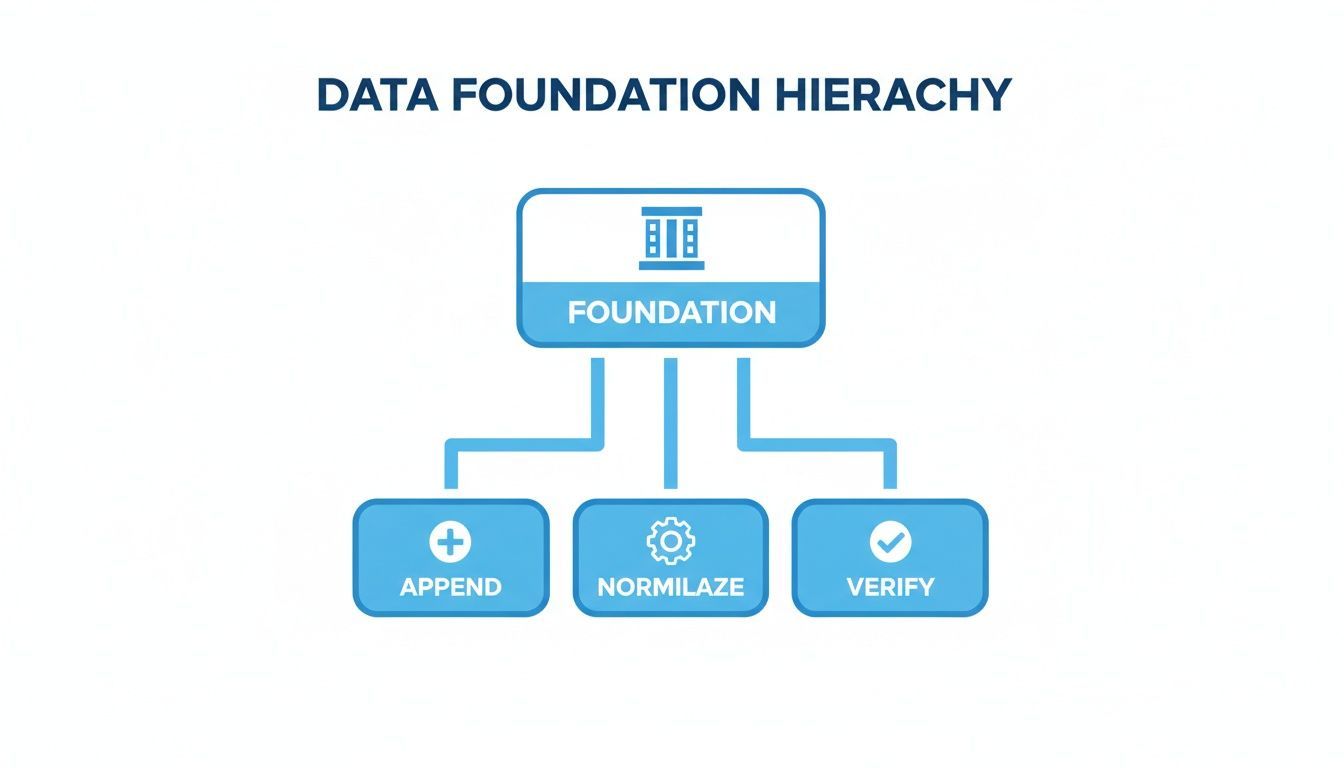
This hierarchy shows that a solid data foundation is built through a series of essential steps, each one adding more reliability and value to your business intelligence.
Empowering Marketing with Precision
For marketers, data enrichment is the key to unlocking smarter, more targeted campaigns that actually generate ROI. It’s the difference between a "spray and pray" approach and one of surgical precision, making sure the right message hits the right person at the right time.
The numbers don't lie. Research shows that data enrichment can boost data accuracy and completeness by up to 25%, which directly improves the quality of leads flowing into your outbound campaigns. Some marketers have even seen revenue jump by as much as 40% by using AI-powered enrichment to fine-tune their strategies.
Key Takeaway: Enriched data allows marketers to create hyper-targeted audience segments, which leads to more relevant campaigns, better engagement rates, and a significant boost in ROI.
This level of detail also supercharges lead scoring models. By enriching leads with firmographic and demographic data as they come in, marketers can more accurately prioritize the most promising prospects. This ensures your sales team only spends time on MQLs that are truly ready for a conversation. You can even see the financial impact of these efforts by using a lead value calculator to connect higher-quality leads to your bottom line.
Establishing a Single Source of Truth for RevOps
Revenue Operations (RevOps) teams are the architects of your entire revenue engine. For them, data enrichment is fundamental. It’s how they establish strong data governance and create the reliable single source of truth that every other team depends on.
When data is properly enriched, normalized, and deduplicated, RevOps can finally build trustworthy dashboards and deliver forecasts that leadership can count on. This reliability ensures that strategic decisions are being made based on clean, dependable data—not guesswork.
Ultimately, data enrichment is far more than a simple data-cleaning task. It's a foundational business strategy that directly fuels operational excellence and accelerates revenue growth by empowering every team with the complete, accurate information they need to succeed.
A Practical Guide to Your Data Enrichment Strategy
Knowing your data needs an upgrade is one thing. Actually putting a plan into action is a whole different ballgame. A real data enrichment strategy isn't about flipping a switch and hoping for the best—it’s a methodical process that starts with a clear roadmap.
Building this plan ensures your efforts line up with actual business goals and deliver real, measurable value from day one. By treating this as a structured project, not just a quick fix, you can turn your messy data from a liability into the strategic asset that fuels your entire revenue engine.
Start with a Comprehensive Data Audit
Before you can improve your data, you have to get painfully honest about its current state. A data audit is the essential first step, giving you a clear baseline of where you’re strong and, more importantly, where you’re weak. Think of it as a brutally honest inventory check for your CRM.
Your goal here is to hunt down the gaps and inconsistencies. How many contact records are missing job titles or company sizes? Are there fields with messy formatting, like ten different spellings for the same country? This audit will shine a bright light on the most urgent problems your strategy needs to solve.
Define Your Goals and Identify Key Data Points
With your audit complete, you can set clear, achievable goals. What, specifically, are you trying to accomplish? Your objectives need to be tied directly to business outcomes, not just vague ideas like "better data."
For example, a solid goal sounds like this: "Increase sales lead qualification rates by 15% by adding company size and industry data to every new record." This kind of clarity helps you focus on the data that truly moves the needle.
Once the goal is set, pinpoint the exact data points that will get you there. If you’re trying to personalize outreach, then job titles and seniority levels are critical. If you're focused on nailing your Ideal Customer Profile, then firmographics like employee count and annual revenue are your top priority.
Don’t fall into the trap of trying to collect every piece of data imaginable. Focus on the specific fields that will have the biggest impact on your sales and marketing effectiveness. This targeted approach keeps your strategy lean, efficient, and cost-effective.
Choose Your Enrichment Approach and Tools
Next up: deciding how you’ll get this done. There are a few common ways to enrich data, and the right one depends entirely on your team's workflow and urgency.
Here are the main methods to consider:
- Manual Enrichment: This is exactly what it sounds like—your team manually researches and adds data point by point. It’s highly targeted but incredibly time-consuming and simply doesn't scale.
- Batch Enrichment: This involves uploading a list (like a CSV) to a service and getting an enriched file back. It's fantastic for a one-off database cleanup but does nothing to keep your data fresh in real time.
- Real-Time Enrichment: Using an API or an integrated tool, data gets enriched automatically the moment a new lead hits your system. This is the gold standard for maintaining ongoing data hygiene and giving your teams up-to-the-minute info.
Choosing the right method often boils down to picking the right technology. To make a smart decision, you'll need to compare the best data enrichment tools on the market and see which one fits your CRM, workflow, and strategic goals.
Integrate and Measure Your Success
The final piece of the puzzle is integrating your chosen solution into your CRM and setting up Key Performance Indicators (KPIs) to track your progress. A seamless integration is non-negotiable; it ensures enriched data flows directly into your system of record without creating extra work for your team.
Once you're integrated, define exactly how you'll measure success. Your KPIs should be a direct reflection of the goals you set in step two.
Common KPIs include:
- Lead Conversion Rate: Are more of your enriched leads turning into qualified opportunities?
- Data Completeness Percentage: What percentage of your most important fields are now filled out?
- Outreach Response Rate: Is your personalized outreach actually leading to more replies and better engagement?
By consistently keeping an eye on these metrics, you can prove the ROI of your data enrichment strategy and justify the investment. This continuous feedback loop allows you to fine-tune your approach over time, ensuring your data remains a powerful and reliable engine for growth.
The Future Is Now: AI and Automation in Data Enrichment
The days of mind-numbing, manual data enrichment are numbered. AI and automation are completely flipping the script, turning what used to be a grueling task into a fast, smart, and continuous process that works at a massive scale. Modern enrichment is no longer just about filling in blank fields; it’s about predictive accuracy and strategic foresight.
AI algorithms can churn through billions of data points in seconds, spotting patterns, predicting missing info, and verifying contact details with a level of precision that was pure science fiction just a few years ago. For any team relying on fresh, accurate data to hit their numbers, this is a total game-changer.
How AI Elevates Data Enrichment
The real magic of AI here is its knack for handling complexity and unstructured data. Instead of being locked into rigid, predefined rules, machine learning models learn and adapt on the fly, uncovering insights that older systems would completely miss. This makes sophisticated enrichment accessible to everyone, not just data science teams.
AI-powered systems are particularly strong in a few key areas:
- Predictive Appending: AI can look at a contact's known details—like their company and job title—and accurately predict missing information, such as their likely seniority or professional skills.
- Advanced Deduplication: Machine learning algorithms can sniff out complex, non-obvious duplicate records that rule-based systems often fail to catch, giving you a much cleaner single source of truth.
- Insight Extraction: Tech like Natural Language Processing (NLP) can scan unstructured text—think job descriptions or company press releases—to pull out valuable, context-rich data points.
This shift eliminates countless hours of manual grunt work, freeing up your sales and marketing teams to focus on what they do best instead of wrestling with spreadsheets. It puts sophisticated data within reach for businesses of all sizes, allowing them to operate with a new level of strategic clarity.
The Financial Impact of Intelligent Enrichment
Moving to AI isn't just about being more efficient; it's a direct line to business growth. The market for AI-powered data enrichment is on track to double from USD 2.5 billion in 2020 to USD 5 billion by 2025 as more companies jump on board. And the results speak for themselves. Companies using AI for enrichment are seeing revenue boosts of up to 40% and improvements in data accuracy by as much as 25%. You can get a deeper look at this trend by exploring the rise of AI in the data enrichment market.
Key Takeaway: AI and automation aren't just making data enrichment faster; they're making it smarter. By uncovering deeper insights and ensuring higher accuracy, this technology provides the clean, reliable data foundation needed for hyper-personalized outreach and predictable revenue growth.
Ultimately, bringing AI into the mix transforms data enrichment from a reactive clean-up project into a proactive, strategic advantage. It ensures every new lead that hits your CRM is instantly layered with accurate, actionable intelligence, empowering your teams to engage more effectively from the very first touchpoint.
Putting Your Data Enrichment on Autopilot
Understanding data enrichment in theory is one thing. Watching it completely change your team’s daily grind is another.
All those concepts—appending, verifying, normalizing—only become game-changers when you automate them. The right tool bridges the gap between manual drudgery and real efficiency, turning a soul-crushing chore into a background process that just works.
Imagine your sales reps never again having to spend hours digging for a prospect’s info. Instead, they grab a complete, detailed profile with a single click, right from a professional networking site or their email. This is what modern data enrichment looks like in the wild. It kills manual data entry and fills your CRM with clean, actionable intelligence from day one.
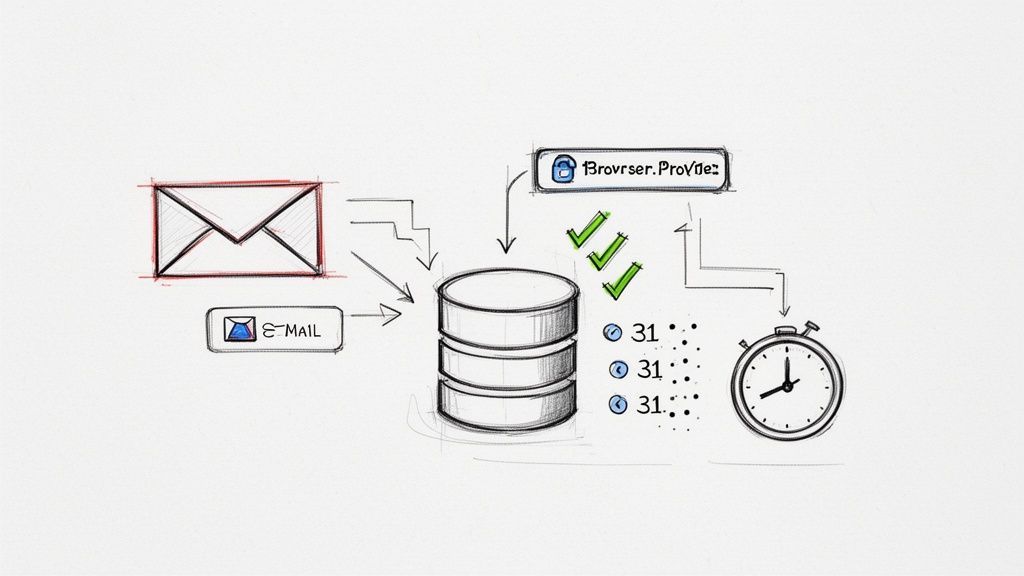
From Manual Effort to One-Click Efficiency
The whole point of a great enrichment tool is to make the process invisible. It should just hum along in the background, instantly layering valuable context onto every new contact. A tool like Add to CRM is built to do just that, solving the exact problems that make manual data handling such a pain.
For sales and marketing teams, this means you can:
- Capture Comprehensive Data Instantly: Instead of just a name and an email, you pull in over 31 essential data points for both people and their companies. Think job title, seniority, company size, industry, location, and even revenue.
- Eliminate Manual Data Entry: The tedious copy-paste routine from a browser into your CRM? Gone. A one-click action handles everything, saving teams an average of 4+ hours per week.
- Ensure Data Accuracy from the Start: With real-time email verification hitting 96% accuracy, you can trust your outreach will land in the right inbox. This protects your sender reputation and gives your engagement a serious boost.
The magic is in the seamless flow—all the critical information gets validated and displayed in one place, ready to sync with your system of record.
Maintaining a Clean and Connected CRM
A smart enrichment tool doesn't just add new data; it also fiercely protects the data you already have. The best solutions are designed to work with your current systems, not against them. Every new piece of information should fit perfectly into your existing workflows.
By automating enrichment, you shift from a reactive "data cleanup" mindset to a proactive strategy of maintaining constant data hygiene. Every single record that hits your CRM is already complete, verified, and formatted correctly.
This hands-off approach is backed by features that keep everything tidy. For instance, seamless integration with over 27 different CRMs ensures your enriched data flows directly where it needs to go. Plus, custom field mapping lets you align the incoming data with the specific fields your team already uses, guaranteeing consistency and stopping data silos before they even start.
Common Questions About Data Enrichment
As teams start digging into data enrichment, a few questions always pop up. Getting straight answers is the first step to building a strategy that actually works, without creating a bunch of new headaches.
Let’s tackle the most common ones so you can move forward with confidence.
What Is the Difference Between Data Enrichment and Data Cleansing?
It’s easy to mix these two up because they often happen together, but they solve different problems.
Think of data cleansing as tidying up the house you already have. It’s about fixing what’s broken—correcting typos in a job title, removing duplicate contacts, and standardizing messy entries like "USA" or "U.S.A" into a clean, consistent "United States."
Data enrichment, on the other hand, is like adding brand-new furniture to that clean house. It’s about adding valuable information you didn’t have before. While cleansing fixes a contact's state, enrichment adds their company's industry, employee count, and annual revenue. You need both, but they serve two very different purposes.
What Are the Most Reliable Data Sources?
The best, most trustworthy data doesn't come from a single magic source. It’s usually aggregated from several reputable third-party providers who pull from a mix of public and private datasets.
The most common sources include:
- Public Records: Think government filings, official business registrations, and other publicly accessible documents.
- Social and Professional Networks: Public information from professional profiles offers great clues about job titles, career history, and skills.
- Third-Party Data Compilers: These are specialized companies that collect, verify, and ethically license huge volumes of business and contact information.
The key is to work with a partner who is transparent about where their data comes from and is committed to accuracy and compliance. High-quality, ethically sourced data is the only kind worth paying for.
How Often Should We Enrich Our Data?
This is a huge one, because B2B data goes stale incredibly fast. People switch jobs, companies get acquired, and phone numbers change. A "one-and-done" enrichment project is a waste of time.
The best approach is a hybrid model: combine real-time enrichment for brand-new leads with periodic batch updates for your existing database. A real-time check gives your sales team fresh data from the very first touchpoint, while a quarterly or bi-annual refresh stops your entire CRM from slowly decaying.
This two-pronged strategy is the most effective way to fight data decay. It keeps your database healthy, reliable, and valuable for the long haul without bogging down your systems.
Stop wasting hours on manual research and start building a cleaner, more actionable pipeline today. Add to CRM turns any professional profile into a complete CRM record in one click, complete with 31 data points and verified contact info. Try it for free.
Start saving time and closing more deals.
Find contact info for your prospects on the #1 business social network and add them to your CRM with 1-click.

 Loading...



Trusted by 1000s of founders, SDRs & more
