What Is a Discovery Call and How Does It Drive Sales
What is a discovery call? This guide explains its true purpose, the questions to ask, and how to master the process to turn prospects into qualified leads.
Published on February 11, 2026
- What a Discovery Call Really Is and Why It Matters
- The Blueprint for a Successful Discovery Call
- How to Prepare for a Flawless Discovery Call
- Powerful Questions That Uncover Real Needs
- Common Mistakes and Red Flags to Avoid
- Turning a Good Call into a Closed Deal
- Your Top Discovery Call Questions, Answered
A discovery call isn't a sales pitch. Think of it more like a doctor's consultation for a business—a conversation where your only job is to diagnose a prospect's challenges long before you ever mention a solution. Your goal is to understand their world—their goals, pain points, and current setup—to see if you can genuinely help.
What a Discovery Call Really Is and Why It Matters
Imagine going to the doctor with a bad headache. You wouldn't want them to just hand you a random prescription without asking a single question. They'd ask about your symptoms, your lifestyle, and your history to figure out what's really going on. A discovery call runs on that same exact principle: its job is to diagnose, not to sell.
This conversation is usually your first real-time interaction after a prospect shows some interest, making it a critical checkpoint. It's your chance to qualify whether they actually fit your Ideal Customer Profile (ICP), build some genuine rapport, and figure out if there's a solid reason to work together. Getting this right saves everyone a ton of time and stops you from chasing leads that were never going to close.
More Than Just a Meeting
At its core, a discovery call is a strategic fact-finding mission that sets the stage for the entire sales process. The main objectives are pretty straightforward:
- Understand the Prospect's World: Get a feel for their day-to-day operations, the real-world challenges they face, and what they're trying to achieve long-term.
- Identify Core Pain Points: Dig deeper than surface-level complaints. What are the root causes of their problems? More importantly, how are those problems impacting the business?
- Qualify the Opportunity: Confirm that they have a problem you can actually solve, the budget to fix it, and the authority to make a final decision.
- Establish a Connection: Build trust by showing you're there to listen and help, not just to push a product down their throat.
Here’s a quick summary of what a great discovery call looks like:
Discovery Call at a Glance
A well-structured discovery call focuses on listening and learning, not pitching. Each part of the conversation has a clear purpose, guiding the discussion from general rapport-building to specific problem identification. This table breaks down the essential components.
| Component | Objective | Key Takeaway |
|---|---|---|
| Rapport & Agenda | Build trust and set clear expectations for the call. | "We're here to see if there's a good fit, not to sell you anything today." |
| Pain Discovery | Uncover the prospect's core business challenges and their impact. | "What's the biggest headache this problem is causing for your team?" |
| Qualification (BANT) | Confirm Budget, Authority, Need, and Timeline. | "Is solving this a priority for you in the next quarter?" |
| Next Steps | Define a clear, mutual path forward. | "Based on this, the next logical step would be a tailored demo with our specialist." |
Ultimately, the goal is to leave the call with a crystal-clear understanding of the prospect's situation and a mutually agreed-upon plan for what happens next.
The Strategic Value of Diagnosis Before Prescription
Jumping straight into a product demo without a proper discovery call is like writing a prescription before the diagnosis. It's not just ineffective; it can completely kill any trust you were trying to build. A good discovery call ensures that when you do present your solution, it's perfectly tailored to the problems the prospect has already told you about. This is a vital step in most outbound sales strategies, where building context is everything.
A discovery call is a make-or-break moment in the B2B sales cycle. In fact, companies that get this right see a massive 93% lift in meeting-to-opportunity conversion. Learn more about optimizing sales discovery on outreach.io.
By focusing on the prospect's world first, you shift the entire conversation from a sales pitch to a collaborative problem-solving session. This approach doesn't just improve your odds of qualifying the right leads—it builds a much stronger foundation for a long-term business relationship. It's the difference between making a quick sale and creating a loyal customer.
The Blueprint for a Successful Discovery Call
A great discovery call feels like a natural, collaborative conversation, but don't be fooled—it's not improvised. The best reps aren't winging it. They're following a proven blueprint that steers the discussion from small talk to a clear, agreed-upon path forward.
This framework is all about purpose and sequence. You start by setting an agenda and building rapport, then dive deep to uncover their real pain points. From there, you qualify the opportunity before cementing the next steps. Each phase builds on the last, creating a logical flow that makes the prospect feel heard, not just sold to.
The Three Pillars of a Discovery Call
You can break down any successful discovery call into three simple, connected phases. This structure keeps the conversation on track and helps you figure out the single most important thing: whether you're a good fit for each other.
- 1. Diagnose: This is the heart of the call. Your goal here is to ask smart, open-ended questions that get to the root of their challenges, goals, and the business impact of their problems. It’s about listening way more than you talk.
- 2. Qualify: Once you understand their pain, you need to find out if you can actually help them. This is where you confirm their budget, who makes the final call, and how urgently they need a fix. We cover this in detail in our guide on how to qualify sales leads.
- 3. Partner: The call should never end without a plan. You'll summarize the key issues you’ve discussed and propose a concrete next step, like a personalized demo or a follow-up with a technical specialist.
This simple flow—diagnose, qualify, partner—is incredibly powerful.
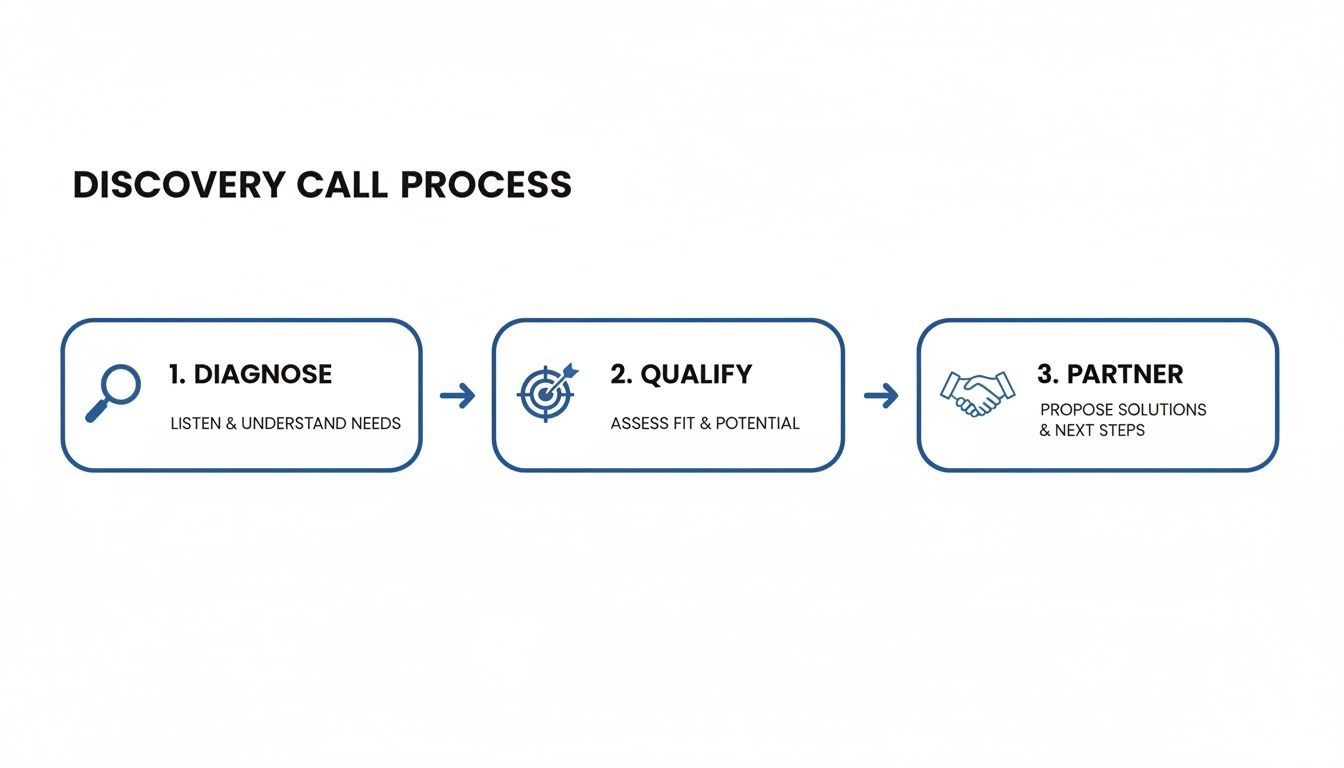
Following this process ensures every conversation is purposeful, moving systematically from understanding the problem to proposing a valuable next step.
Mastering the Talk-to-Listen Ratio
One of the biggest mistakes reps make is dominating the conversation. A discovery call is a two-way street, but the prospect should be doing most of the driving. It’s their story; your job is just to listen and understand it.
The most effective discovery calls have a balanced talk-to-listen ratio. An analysis of thousands of calls revealed that when prospects speak for 60% or more of the time, the call is three times more likely to result in a positive outcome compared to calls where the rep monopolizes the conversation.
This isn't just about being polite. Letting the prospect talk is how you uncover their deeper motivations and quantify the real-world costs of their problems—like an operational bottleneck that's costing them $50,000 a year. They'll give you all the ammo you need to position your solution perfectly.
The Anatomy of a Winning Call Agenda
A clear agenda shows you respect the prospect's time and keeps the discussion from wandering off course. While you need to be flexible, having a reliable roadmap is key.
A Sample Call Flow:
- Intro & Rapport (5 minutes): Start with some genuine small talk to build a human connection. Then, lay out the purpose and agenda for the call. No surprises.
- Deep Discovery (15-20 minutes): This is your prime time. Ask your prepared, open-ended questions to explore their challenges, current setup, and what a "win" looks like for them.
- Qualification (5-10 minutes): Gently probe into budget, timeline, and the decision-making process to make sure the opportunity is real.
- Recap & Next Steps (5 minutes): Briefly summarize what you heard and propose a clear, mutually agreed-upon next action. This solidifies the path forward and keeps the momentum going.
By following this blueprint, you turn a rambling chat into a strategic conversation. It not only gets you the information you need but also builds the prospect's confidence that you're the one who can solve their problems.
How to Prepare for a Flawless Discovery Call
The best discovery calls are won long before you ever pick up the phone.
Walking into a call unprepared is like trying to navigate a new city without a map—you might get there eventually, but you’ll probably take a few wrong turns and waste a lot of time. Just a few minutes of smart prep can turn a generic chat into a conversation that actually lands.
This isn't about digging up clever "gotcha" questions. It’s about building a baseline understanding of your prospect and their world. That knowledge lets you skip the obvious stuff and get straight to the problems they actually care about.
Your Pre-Call Research Checklist
Before every single call, block out 15-20 minutes for a research sprint. The goal is simple: gather just enough context to ask intelligent questions and show you've done your homework. A prepared salesperson immediately stands out.
Here’s a quick checklist to guide you:
- Review Their Professional Profile: Where have they worked? What are they posting about? Who do you know in common? Their role and seniority will tell you a lot about their priorities.
- Analyze the Company Website: Dig deeper than the homepage. The "About Us" page reveals their mission, the "Careers" page shows their hiring priorities, and the blog or news section flags recent announcements.
- Look for Trigger Events: Did they just get a round of funding? Hire a new executive? Launch a big product? These events almost always create new challenges you can help solve.
- Understand Their Industry: What are the big trends or pressures in their market right now? Knowing this helps you frame your solution in a way that resonates on a business level.
This small time investment pays off big. It allows you to tailor your talking points and show you’re genuinely interested in helping them.
Using Modern Tools to Accelerate Preparation
Let's be real: manually researching every prospect and then copy-pasting everything into your CRM is a massive time sink, and it’s easy to make mistakes. This is where modern sales tools become your secret weapon, automating the most tedious parts of prep.
Think of them as a shortcut to deep prospect intelligence.
For example, a tool like Add to CRM can grab a contact from a professional network or email signature and instantly create an enriched record in your CRM. With one click, you get verified contact details, role seniority, company revenue, and more—no manual data entry required.
This image shows how these tools act as a bridge, connecting different data sources directly to your CRM.
This map visualizes how info from multiple platforms can be piped straight into systems like HubSpot, Salesforce, or Pipedrive, killing manual work.
By automating data capture and enrichment, you replace hours of tedious research with a single click. This doesn't just save time; it arms you with the critical insights needed to lead a discovery call with confidence and authority from the very first minute.
Ultimately, great preparation is about being both efficient and effective. When you combine focused manual research with the power of automation, you ensure every discovery call you make is informed, relevant, and set up for success.
Powerful Questions That Uncover Real Needs
The entire discovery call lives or dies by the questions you ask. If you stick to generic, surface-level stuff, you’ll get vague, useless answers. The real magic happens when you ask strategic questions that make prospects stop and think about their own business, revealing the true depth of their challenges.
Think of it less like an interrogation and more like a guided conversation. Your questions are the flashlight, illuminating the dark corners of their current process and helping them see a clearer path forward. Each question should build on the last, painting a complete picture of their world.
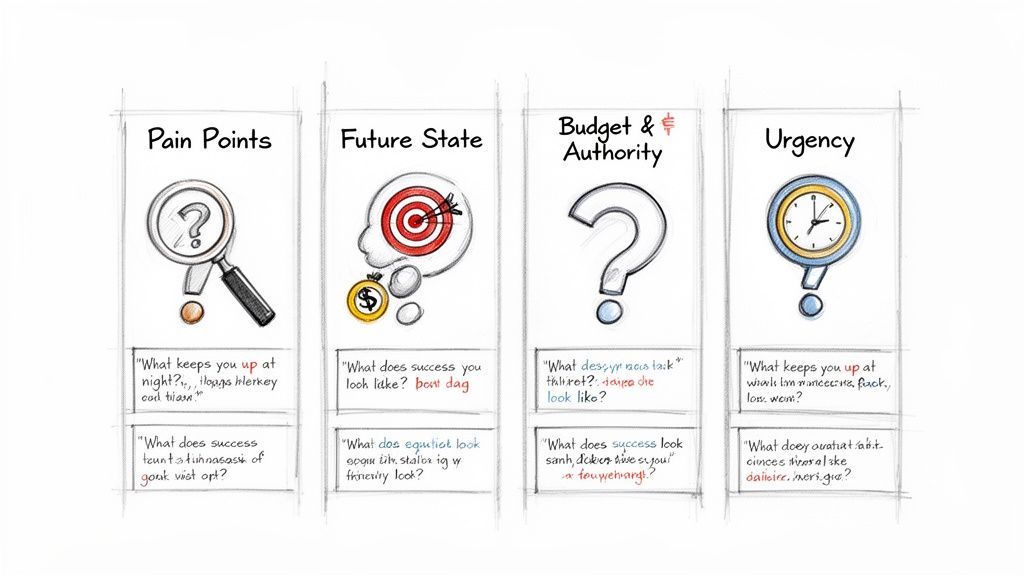
A good framework keeps the conversation flowing naturally without feeling like you're just reading from a script. By grouping questions into logical buckets, you can smoothly transition from one topic to the next and gather everything you need to know.
Uncovering Current Pain Points
First things first: you have to diagnose the problem. Your goal isn't just to hear what's broken, but to understand why it matters. These questions are designed to dig past the surface symptoms and get right to the root cause, forcing the prospect to actually quantify their pain.
"Can you walk me through your current process for [specific task]?" This question is pure gold. It gets them telling a story, and you'll often uncover bottlenecks and frustrations they didn't even realize were "problems."
"What's the most frustrating part of that for you and your team?" This zeroes in on the human cost. Frustration is a powerful motivator for change, and this question gets them talking about the emotional side of the problem.
"If you could wave a magic wand and fix one thing about this tomorrow, what would it be?" A classic for a reason. It cuts through the noise and forces them to name their single biggest priority.
These initial questions lay the groundwork. They confirm a real challenge exists and give you the context to start exploring the bigger picture.
Exploring the Desired Future State
Once you have a firm grip on their current pain, it's time to flip the script and talk about the future. This is where you help them articulate what "better" actually looks like. You're trying to create a gap between where they are today and where they want to be—a gap that your solution is perfectly designed to fill.
Asking future-focused questions transforms the conversation from a discussion about problems into a vision for solutions. You’re not just a vendor; you're a strategic partner helping them map out a path to success.
Here’s how you can help them paint that picture:
- "In a perfect world, what would this process look like six months from now?" This opens the door to their ideal scenario, giving you a crystal-clear target to aim for with your solution.
- "What would achieving that let your team do that you can't do today?" This is how you connect your solution to real business value, like freeing up time for more important work or hitting bigger goals.
- "How would you measure the success of a new solution for this?" This is critical. It uncovers their key performance indicators (KPIs), telling you exactly what metrics they care about most.
A solid question framework helps you move logically through the conversation, from understanding their current headaches to co-creating a vision for their future success. Below is a simple structure that groups questions by their intent, ensuring you cover all the essential bases.
Discovery Question Framework
| Category | Sample Question | Purpose |
|---|---|---|
| Current State | "Can you walk me through how you handle [X] today?" | Uncover the existing process, tools, and people involved. |
| Pain Points | "What’s the most inefficient or frustrating part of that?" | Pinpoint specific, emotionally-charged problems to solve. |
| Impact | "How does that bottleneck affect your team's output/goals?" | Quantify the business cost of doing nothing (time, money, morale). |
| Future State | "If this were solved, what would that enable you to do?" | Help the prospect visualize the ideal outcome and its benefits. |
| Metrics | "How would you measure the success of a new solution?" | Identify the specific KPIs and metrics that matter to them. |
| Budget | "Have you set aside a budget for solving this problem?" | Gauge financial readiness and priority level without being pushy. |
| Decision | "What does your evaluation process for new tools look like?" | Map out the stakeholders, timeline, and steps to get a "yes." |
By moving through these categories, you build a comprehensive understanding of the opportunity, ensuring no critical information is missed.
Clarifying Budget and Decision-Making
Look, understanding their pain and vision is great, but a deal won't happen without money and a signature. You have to ask about the budget and decision-making process. These questions can feel tricky, but they are absolutely non-negotiable if you want to qualify the opportunity properly.
"Have you allocated a budget to solve this problem, or is this something you're exploring for the future?" This is a direct but respectful way to bring up money without demanding a number right away.
"What does the decision-making process for a solution like this typically look like at your company?" This helps you map out all the key players and understand the path to getting a deal signed.
"Besides yourself, who else would be involved in evaluating this?" This simple follow-up prevents you from getting blindsided by a surprise decision-maker late in the game.
Asking these questions shows you're a professional who respects their time and internal processes. When you master this kind of questioning, you’ll consistently run discovery calls that build real rapport and lay a rock-solid foundation for every deal.
Common Mistakes and Red Flags to Avoid
Even seasoned sales pros can make small missteps on a discovery call that completely derail the conversation. Knowing these common pitfalls isn’t just about dodging failure; it’s about proactively steering the call toward a good outcome. When you know what to watch for, you stay in control and keep the discussion on track.
One of the most common—and most damaging—errors is the dreaded "show up and throw up." This is what happens when a rep gets a little too excited and jumps straight into a product pitch the second they hear a hint of a problem. A discovery call is for diagnosing, not prescribing. Pitching too soon screams that you care more about your quota than their actual needs.
That premature pitch immediately shatters any rapport you've built. It turns a collaborative chat into a one-sided monologue, which is a surefire way to lose a prospect for good.
Failing to Actively Listen
Another massive mistake is simply not listening. Active listening isn't just waiting for your turn to talk; it’s about hearing what the prospect is saying, understanding the context, and reading between the lines. When you fail to do this, you miss the most important details and end up asking questions that are completely off the mark.
You can spot poor listening a mile away:
- Interrupting the prospect mid-sentence to correct them or jump to your own conclusion.
- Asking a question they’ve already answered, which instantly shows you weren't paying attention.
- Hogging the conversation, which robs you of the chance to uncover their real challenges.
Remember, the whole point is to make the prospect feel heard and understood. Real listening builds trust and gives you the ammo you need to figure out if you can actually help them.
A discovery call isn't an interrogation; it's an investigation. When you treat it like a checklist to rush through, you gather facts but miss the story. The best reps know that the unspoken context is often more valuable than the direct answers.
Recognizing Red Flags from the Prospect
Just as you can make mistakes, prospects can throw up warning signs that they’re not a good fit. Spotting these red flags early is crucial for qualification—it saves you from wasting weeks chasing a deal that was never going to happen.
Keep an eye out for these potential deal-killers:
- Vague or Evasive Answers: If they can’t clearly explain their pain points or goals, the problem probably isn't big enough for them to spend money on a solution.
- Lack of Engagement: One-word answers, multitasking, or just a general vibe of disinterest usually means they aren't serious or got roped into the meeting against their will.
- No Clear Pain Point: If you can't get them to identify a specific challenge or how it's hurting the business, there's literally no problem for you to solve.
- Refusal to Discuss Budget or Timeline: While it can be a sensitive topic, a flat-out refusal to talk logistics often signals they have no real intention of buying.
Ending Without a Clear Next Step
This might be the most common mistake of them all: ending the call with a weak, non-committal line like, "Great, I'll send over some information." This kills all momentum. Every single discovery call needs to end with a clear, agreed-upon next action that moves the deal forward.
Before you hang up, summarize what you heard and propose a specific next step. That could be scheduling a tailored demo, bringing in a technical expert, or sending over a formal proposal. Get their verbal "yes" to that next meeting on the calendar. A firm next step is the bridge between a good conversation and a real sales opportunity.
Turning a Good Call into a Closed Deal
The call doesn't end when you hang up the phone. A great discovery call creates momentum, and your job is to keep it rolling. What you do immediately after the call is just as important as the questions you asked during it.
This is where promising deals go cold. You had a fantastic conversation, but a slow or sloppy follow-up kills the energy. The trick is to nail two critical steps right away: a value-packed follow-up email and a lightning-fast, accurate CRM update. These actions lock in your understanding and set a professional, organized tone for the entire relationship.
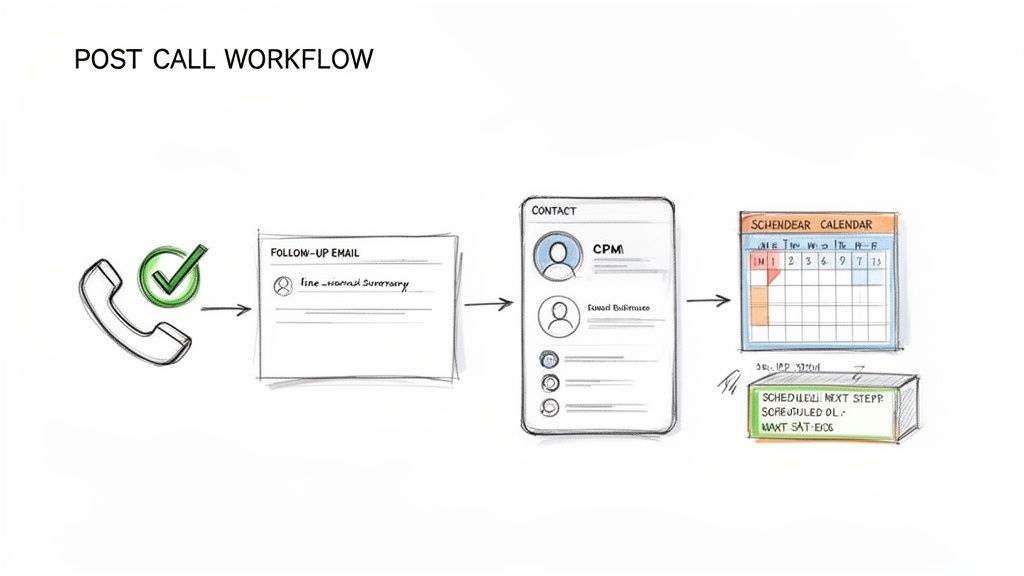
This simple workflow ensures nothing ever falls through the cracks.
Crafting the Perfect Follow-Up Email
Your follow-up email needs to land in their inbox within a few hours. Any longer, and the details (and the excitement) start to fade. This isn't just a courtesy note; it's a strategic move to reinforce the value you just discussed. Keep it short, clear, and focused on them, not you.
A killer follow-up email has just three parts:
- A real thank you for their time and for sharing their insights.
- A quick summary of their biggest challenges and goals, as you heard them. This proves you were listening.
- A clear confirmation of the next steps you both agreed on, including the date and time for the next meeting.
That's it. This structure shows you're on the ball and keeps everyone aligned. It’s part meeting summary, part roadmap.
Why Your CRM Is Your Single Source of Truth
While the email solidifies things with the prospect, your CRM update solidifies the opportunity for your team. This is where you dump every critical detail from the call. In B2B sales, discovery is how you qualify leads against your Ideal Customer Profile (ICP), and your CRM is the official record of that qualification. In fact, reps who ask targeted questions are known to advance 2.5 times more opportunities. You can get more details on the impact of targeted discovery questions from Highspot's guide.
An updated CRM is more than just a database; it’s the central nervous system of your entire sales operation. It makes handoffs to account executives seamless, powers accurate sales forecasts, and gives leadership a clean look at the pipeline.
Manual data entry is a recipe for disaster—it's slow, tedious, and full of typos. Using a tool to capture and enrich contact details directly into your CRM removes those risks. It ensures every key piece of info, from their main pain points to the names of other stakeholders, is mapped correctly.
A clean, accurate CRM record is the only way to understand the true value of each sales lead and make smart decisions. Mastering these post-call steps builds a repeatable process that turns conversations into closed deals. It's the disciplined follow-through that separates the top performers from everyone else.
Your Top Discovery Call Questions, Answered
Even with the best game plan, some questions always pop up when you're trying to nail your discovery calls. Here are quick, straight-to-the-point answers to the most common ones we hear, helping you turn these initial chats into real opportunities.
How Long Should a Discovery Call Be?
Aim for the sweet spot: 30 to 45 minutes. That’s typically enough time to build some real rapport, dig in with good questions, and truly get to the bottom of their challenges without anyone getting meeting fatigue.
If you try to cram it all into less than 30 minutes, the conversation will feel rushed, and you’ll likely miss the crucial details needed to qualify them properly. On the flip side, letting it drag past the 45-minute mark is a good way to lose their attention. Set a clear agenda from the get-go and keep an eye on the clock.
What Is the Main Goal of a Discovery Call?
Here’s the big secret: the main goal isn't to sell anything. It's to figure out if there's a mutual fit. It really boils down to three key objectives that should steer the entire conversation.
First, you need to qualify them against your Ideal Customer Profile (ICP). Are they actually the right kind of customer for you? Second, you have to uncover their genuine pain points and business headaches to see if you can even help them in the first place.
Finally, a great call builds a foundation of trust and establishes your credibility. You’re not just a vendor; you’re a potential partner. The call should end with a clear yes or no on moving to the next step.
How Is a Discovery Call Different from a Sales Pitch?
Think of it this way: a discovery call is a two-way conversation where you’re listening and learning. A sales pitch is a one-way presentation where you’re selling. They serve completely different purposes and happen at different times.
During a discovery call, you should be doing the listening about 60-70% of the time. Your job is to be a doctor, diagnosing the problem. The pitch or demo is when you present the prescription—your solution to the specific issues you just uncovered.
Jumping into a pitch too early is one of the fastest ways to kill a potential deal. It screams, "I don't care about your problems," and can instantly turn off a promising prospect.
What Tools Can Help Me Prepare for Discovery Calls?
Solid prep comes down to having good data and efficient tools. A CRM is non-negotiable for keeping track of every interaction and staying organized. For the initial research phase, professional networking sites are your best friend for getting context on the person and their company.
But the real game-changer is bridging the gap between that research and your CRM without all the manual work. A specialized browser extension, for example, can grab contact details and build out an enriched CRM record with a single click. This slashes your prep time and guarantees you walk into every call armed with accurate, deep knowledge of who you're talking to.
Stop wasting hours on manual data entry and start every call prepared. Add to CRM lets you capture and enrich leads from anywhere on the web with a single click, ensuring your CRM is always accurate and up-to-date. Try it for free and see how much time you can save at https://addtocrm.com.
Start saving time and closing more deals.
Find contact info for your prospects on the #1 business social network and add them to your CRM with 1-click.

 Loading...



Trusted by 1000s of founders, SDRs & more
