Smarter Sales with CRM Data Enrichment
Discover how CRM data enrichment transforms your sales pipeline. Learn practical strategies, tools, and best practices to unlock higher-quality leads today.
Published on January 15, 2026
Your CRM is filled with customer information—names, emails, maybe a phone number. But how much of it is actually useful? And how much of it is still accurate?
Think of your CRM contacts as rough sketches. You have the basic outline, but you're missing the details that bring the picture to life. You know a name, but you don't know their job title, the size of their company, or whether they're even the right person to talk to.
This is where CRM data enrichment comes in. It's the art of turning those rough sketches into full-color, detailed portraits.
What Is CRM Data Enrichment Anyway?
CRM data enrichment is the process of taking your existing, often incomplete, CRM records and layering on valuable information from external, third-party sources. It's not just about fixing typos or adding a missing area code. It's about strategically adding new dimensions to your data, transforming a simple contact list into a powerful intelligence engine.
This process breathes life into static records, turning them into dynamic profiles that fuel smarter, faster business decisions. It's the difference between knowing a name and truly knowing your customer.
From Incomplete Data to Actionable Insight
At its core, CRM data enrichment solves a problem that plagues every single revenue team: data decay.
Customer data goes stale—fast. People change jobs, companies get acquired, and phone numbers get disconnected. Some studies show that B2B data decays at a staggering rate of over 30% per year. Left unchecked, your once-valuable CRM quickly becomes a minefield of outdated, unreliable information.
Without enrichment, your team is flying blind. They waste hours on low-value tasks like:
- Manual Research: Scouring professional networks and company websites just to find a correct job title or phone number.
- Chasing Ghosts: Crafting the perfect email only to send it to someone who left their job six months ago.
- Flawed Segmentation: Lumping high-value prospects into the wrong marketing campaigns because you're missing key firmographic data like industry or company size.
Enrichment automates the tedious work of filling in those blanks, giving your team the context they need to engage effectively. If you want to dive deeper into the basics, check out our complete guide on what data enrichment is and how it works.
"A CRM without enriched data is like a map with no street names. You know the general area, but you have no clear path to your destination. Enrichment provides the turn-by-turn directions your sales team needs to close deals faster."
The Building Blocks of an Enriched Profile
So, what kind of intel are we talking about? CRM data enrichment appends a wide range of data points that help you build a complete picture of your prospect.
This typically includes:
- Contact Data: Verified work emails, direct-dial phone numbers, and social media profiles.
- Demographic Data: Job titles, seniority levels, and professional responsibilities.
- Firmographic Data: Company name, industry, employee count, annual revenue, and location.
- Technographic Data: The technology stack a company uses, which is perfect for identifying integration opportunities or competitive openings.
By piping this information directly into your CRM, you equip your team to act decisively. No more guessing games. Every interaction is backed by accurate, relevant, and up-to-date intelligence. This shift—from reactive data cleanup to proactive data enhancement—is a game-changer for any modern sales or marketing team.
The Real-World Value of Enriched Data
Let’s move beyond the theory. The real magic happens when you see how enriched CRM data actually performs in the wild. Investing in high-quality data isn't just a checkbox for your operations team; it’s a direct lever for revenue and efficiency. When you transform a basic contact record into a full-blown customer profile, you unlock tangible returns across your entire go-to-market strategy.
The core idea is simple: empower your teams to make smarter, faster decisions. Sales reps stop wasting precious hours on manual research or chasing down dead-end leads. Instead, they can pour that energy into what they do best—building relationships and closing deals.
This shift has a massive impact on the key performance indicators (KPIs) that really matter.
Here’s a look at how a CRM contact evolves from a rough sketch into a detailed, actionable portrait.
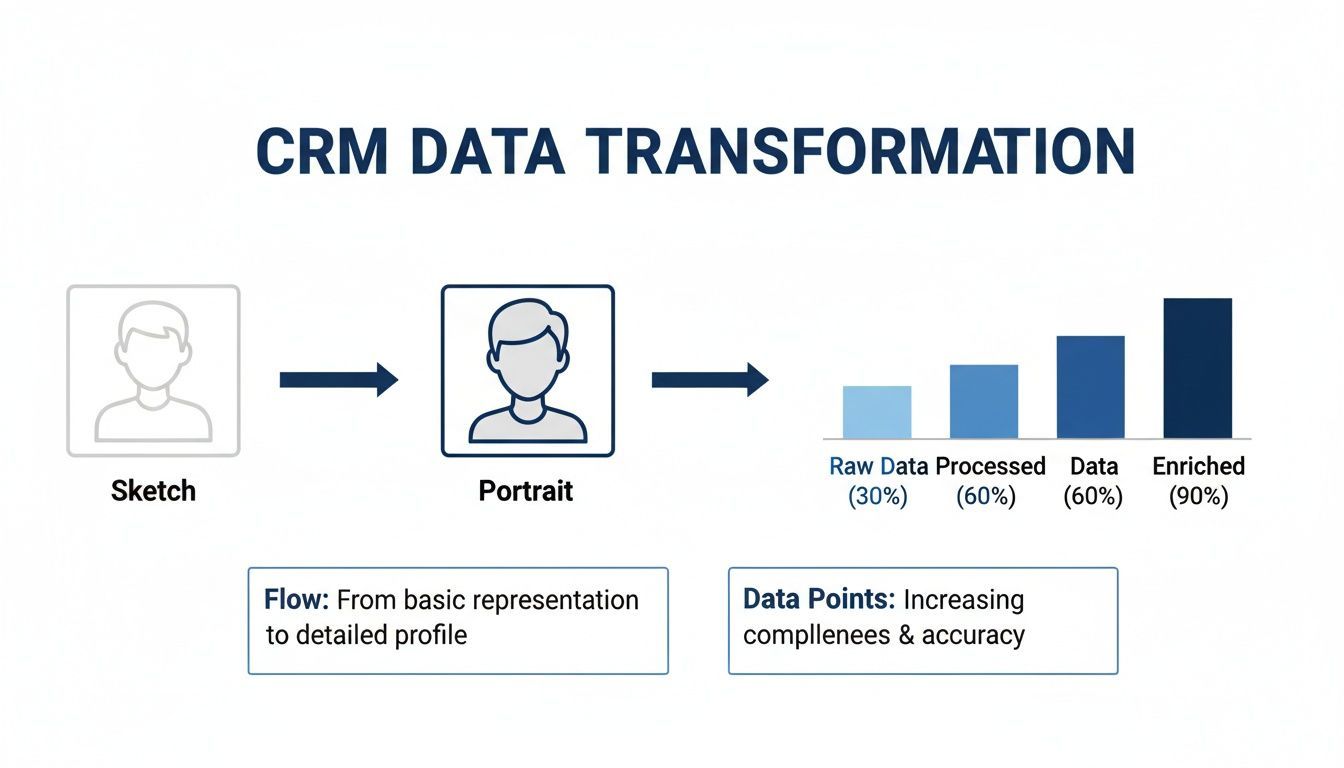
This journey from a simple name and email to a rich profile shows how each layer of verified data turns a basic record into a valuable asset.
Supercharge Your Sales And Marketing KPIs
With enriched data, fuzzy goals become sharp, measurable metrics. Teams can instantly spot and prioritize their best-fit accounts, craft outreach that actually gets replies, and dramatically shorten the sales cycle. These aren't just small tweaks; they're fundamental upgrades to your entire commercial engine.
Consider these direct outcomes:
- Higher Conversion Rates: When marketing campaigns are aimed at the right job titles in the right industries, they resonate. When sales reps have direct-dial numbers and verified emails, they connect with decision-makers on the first try. The result? A serious lift in conversions.
- Shorter Sales Cycles: With complete company data at their fingertips, reps can qualify leads in minutes, not hours. They can tailor their pitch from the very first call, hitting on specific pain points and speeding up the journey from prospect to paying customer.
- Increased Customer Lifetime Value (CLV): Knowing a customer’s company size, tech stack, and annual revenue opens the door for smarter upselling and cross-selling. You stop guessing and start anticipating their needs, which boosts long-term value.
To put the impact into perspective, the table below shows the kind of measurable improvements you can expect when you move from a standard, unenriched CRM to one powered by a consistent data enrichment strategy.
Impact of CRM Data Enrichment on Key Sales KPIs
| Metric | Before Enrichment (Industry Average) | After Enrichment (Expected Improvement) |
|---|---|---|
| Lead Conversion Rate | 1-3% | 5-10% or higher |
| Sales Cycle Length | 90+ days | Reduced by 15-20% |
| Email Bounce Rate | 10-15% | Under 5% |
| Sales Rep Productivity | 35% of time spent selling | 50%+ of time spent selling |
These figures aren't just hypotheticals; they represent the shift from working harder to working smarter, backed by data you can actually trust.
This strategic advantage is why the global market for these solutions is booming. The data enrichment tool market, a key segment of CRM data enrichment, was valued at $697 million and is expected to hit $1,087 million by 2032. This growth is driven by a simple need: sales teams want to turn sparse contact lists into goldmines of insight. You can dive deeper into the market trends in this detailed industry report.
A sales team using enriched data can filter their entire CRM for VPs of Engineering at SaaS companies with over 200 employees in seconds. This isn't just a time-saver; it’s a strategic weapon that focuses resources where they will have the greatest impact.
From Wasted Effort to Winning Plays
Without enrichment, your sales and marketing teams are flying blind. Bad data creates frustrating and expensive problems that quietly drain resources and tank morale.
Implementing a consistent CRM data enrichment strategy tackles these pain points head-on:
- Slash Email Bounce Rates: Data decay is relentless. People change jobs, and emails go stale. Real-time verification ensures your messages actually land in the inbox, protecting your sender reputation and maximizing your campaign’s reach.
- Eliminate Manual Data Entry: Those hours spent digging through professional networks for a prospect's job title or phone number? They’re gone. This frees up reps to spend more time selling and less time doing administrative grunt work, directly boosting productivity.
- Perfect Your Lead Scoring and Routing: With reliable data points like seniority and company size, you can automatically score leads and route them to the right rep. High-value opportunities get immediate attention, and nothing slips through the cracks.
Ultimately, the value of enriched data is about replacing guesswork with certainty. It lets your team engage the right person, with the right message, at the right time. This level of precision is no longer a luxury—it’s the new standard for any team serious about growth.
Comparing Your Data Enrichment Options
Once you realize you need better data, the next question is always, "Okay, so how do we get it?" Not all enrichment methods are created equal, and the right approach boils down to your team's size, speed, and budget.
Think of it like fueling a car. You could fill it up bit by bit with a gas can, drive to the station for a full tank every few weeks, or have a magical system that tops it off continuously as you drive. Each gets the job done, but the experience—and efficiency—is worlds apart.
Each method of CRM data enrichment serves a different purpose, with its own trade-offs in effort, cost, and timeliness. Let's break them down.
The Traditional Path: Manual Enrichment
Manual enrichment is exactly what it sounds like: a sales rep or researcher Googling missing info and typing it into the CRM by hand. It’s the original method. For a tiny team or a one-off task, like prepping for a single huge sales call, it can feel straightforward enough.
But this approach breaks down the second you try to scale. It’s painfully slow, riddled with human error (typos, anyone?), and wildly inconsistent. When you hear that reps spend a huge chunk of their day on non-selling activities, manual data entry is almost always the main culprit.
- Pros: Requires no special tools and works for super-specific, one-time research tasks.
- Cons: Extremely inefficient, impossible to scale, and a high risk of typos and errors. It also creates data silos because every rep gathers info a little differently.
- Best For: Solo founders or very small teams with minimal lead flow who only need to research a handful of high-value accounts.
The Periodic Update: Batch Enrichment
Batch enrichment is a massive step up from the manual slog. Here, you export a list of contacts from your CRM, send it to a third-party service, and get back an updated file loaded with enriched data. You then upload that file back into your CRM, updating hundreds or thousands of records at once.
This is a great way to do a periodic data health check-up, maybe once a quarter or every six months. It helps fight the natural decay of your database and keeps your records from getting completely stale. The catch? The data is only as fresh as your last update. If a contact changes jobs the day after your batch run, that info will be wrong in your system for months.
The core limitation of batch enrichment is latency. In a fast-moving market, a three-month-old data point can be just as useless as a three-year-old one. It’s a snapshot in time, not a live feed.
The Modern Solution: Real-Time Enrichment
Real-time enrichment is the gold standard for today's sales and marketing teams. It’s fully automated and enriches data the moment it's needed. When a new lead hits your web form or a rep adds a contact, an integrated tool instantly appends dozens of verified data points to that record on the spot.
This ensures every new entry in your CRM is complete and accurate from the get-go. No more manual research, no more stale data. For example, a tool like AddToCRM lets a user create a fully enriched contact from a professional profile in a single click, instantly providing verified emails and company details.
This on-demand capability is what unlocks true sales velocity, giving reps fresh intelligence they can act on immediately.
Comparing Enrichment Methods
| Method | Speed & Efficiency | Data Freshness | Scalability |
|---|---|---|---|
| Manual | Very Low | Variable | None |
| Batch | Moderate | Periodic | High |
| Real-Time | Instant | Continuous | Very High |
Understanding Your Data Sources
No matter which method you choose, the quality of your enrichment is only as good as the data source behind it. There are three main types, and the best tools usually blend them together.
First-Party Data: This is the information you collect yourself—think website forms or product sign-ups. It's high-quality because it comes straight from the source, but it's almost always incomplete.
Second-Party Data: This is just another company's first-party data that you get through a partnership. It can be useful for specific campaigns but is often limited in scope.
Third-Party Data: This is the big one. Data providers aggregate information from countless public and private sources, compiling massive datasets. They cross-reference everything for accuracy and then make it available through enrichment tools.
For most businesses, a top-tier third-party provider is the most reliable and efficient path to comprehensive CRM data enrichment. The leading tools achieve pinpoint accuracy by verifying data against multiple sources in real time, making automated, real-time enrichment the clear winner for any modern revenue team.
Your Step-By-Step Prospecting Workflow
Theory is great, but talk doesn't close deals. This is your playbook for turning enriched data into a real-world prospecting engine.
We're going to walk through a modern, efficient workflow that helps sales reps, founders, and business developers get hours back every week. How? By killing off tedious manual research and mind-numbing data entry.
This process transforms prospecting from a slow, frustrating grind into a fast, smart, and repeatable system. Forget toggling between ten browser tabs and your CRM. This is how you start moving with speed and precision.
The image below lays it all out—from finding a prospect on a professional network to having their fully loaded profile in your CRM, ready for outreach.
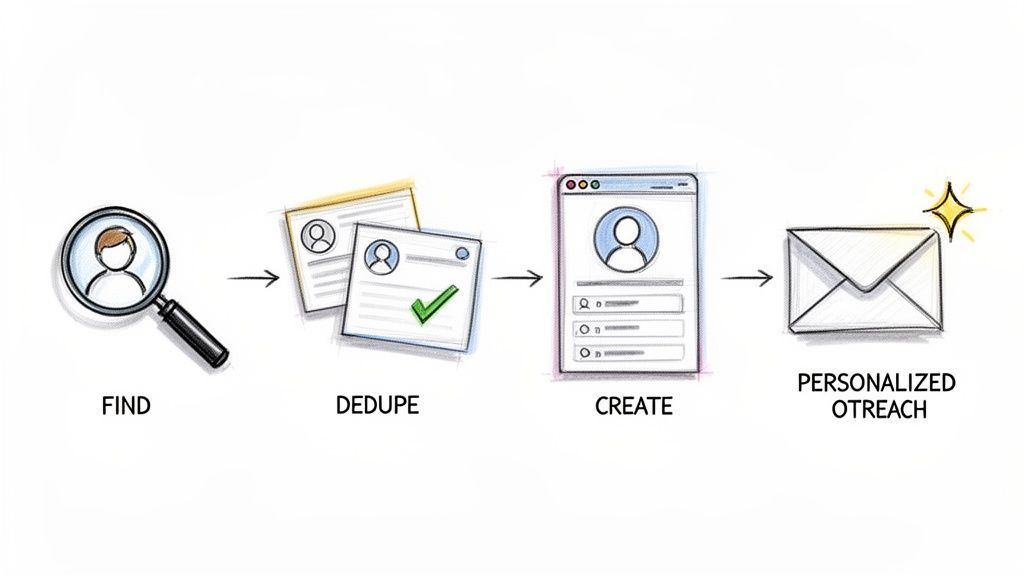
This shows how the right tools slot directly into your day, handling all the heavy lifting of data capture and verification while you focus on selling.
Step 1: Identify Your Ideal Prospect
Your workflow kicks off where your best prospects hang out—usually professional networking sites or right in your inbox. You spot an individual who perfectly matches your ideal customer profile (ICP). Their job title, industry, and company are a dead ringer for who you help.
Instead of immediately opening another tab to start digging, this is where you get smart. You've found your target; now you just need a clean, fast way to capture their info.
Step 2: Instantly Check Duplicates and Enrich
With your prospect in sight, a real-time enrichment tool takes over. One click is all it takes. The system instantly scans your CRM to check if a record for this person or their company already exists. This crucial de-duplication step stops embarrassing double-outreach and keeps your database spotless.
If they're new, the tool creates a new record on the spot. But it doesn't just add a name and title. It populates the contact with dozens of verified data points in seconds.
The goal is zero manual data entry. You’re not just saving a contact; you’re creating a fully formed, intelligence-rich profile. This is the entire point of modern CRM data enrichment.
Step 3: Craft Hyper-Personalized Outreach
Now for the payoff. Your new CRM contact is complete with a verified email address, a direct-dial phone number, and detailed company info. This is the fuel for outreach that actually gets a reply.
Use these fresh data points to make your message impossible to ignore:
- Reference their specific role: Mention their responsibilities or seniority.
- Acknowledge their company’s status: Refer to recent funding, company size, or their tech stack.
- Choose the right channel: With a direct number and a verified email, you can connect where they’re most likely to respond.
This level of detail makes your outreach stand out from the generic, automated junk that floods every decision-maker's inbox.
Step 4: Segment for Targeted Campaigns
Finally, use all that new firmographic data to segment prospects for broader campaigns. With accurate industry, location, and company size data, you can build laser-focused lists for marketing automation, event invitations, or specific sales plays.
This kind of proactive segmentation ensures every prospect gets communication that's actually relevant to them, which dramatically lifts campaign performance. By focusing on efficiency at the top of the funnel, you set the stage for better results across the entire sales cycle. Automating these tasks is a game-changer; you can dive deeper in our guide on how to automate data entry.
This streamlined workflow is driving major market growth. The market for customer data enrichment solutions is projected to hit $4.58 billion by 2030, all thanks to the demand for tools that turn basic contact info into actionable intelligence. Companies that adopt these AI-driven platforms report up to 40% higher revenue by using real-time insights to make better decisions and personalize their approach. You can learn more about these market findings on Grand View Research.
How to Manage Your Data Responsibly
All that powerful new data comes with some serious responsibility. While CRM data enrichment can supercharge your pipeline, it also means you have to be incredibly careful with how you manage that information.
Getting this right isn't just about dodging legal bullets. It's about building trust with your customers and protecting the integrity of your most valuable asset: your data. A sloppy approach can quickly spiral into compliance nightmares, a tarnished brand, and a CRM you can no longer trust. The goal is to move forward with a clear game plan that balances results with responsibility.
Building a Strong Data Governance Framework
Think of data governance as the official rulebook for how data is collected, stored, used, and secured in your company. It’s what keeps everyone on the same page, ensuring consistency and accountability. Without it, you get data chaos.
It's like the foundation of a house—you can't build anything stable on a shaky base. A solid governance framework makes sure every piece of enriched data serves its purpose without creating unnecessary risk.
Here are the essential pillars to put in place:
- Establish Clear Data Ownership: Someone has to be in charge. Assign specific people or teams to be responsible for the quality of data in different parts of your CRM. When a sales ops manager "owns" the contact data, they become accountable for its accuracy and compliance.
- Set Data Quality Standards: Define what "good data" actually looks like for your business. This means setting standards for completeness (which fields are mandatory?), accuracy (how do we verify info?), and timeliness (how often do we refresh data?).
- Perform Regular Data Hygiene: Data gets old, fast. Schedule regular clean-ups to merge duplicates, fix typos, and get rid of outdated records. This isn't a one-and-done project; it’s an ongoing process, like weeding a garden.
Navigating Compliance with GDPR and CCPA
Data privacy laws like Europe's General Data Protection Regulation (GDPR) and the California Consumer Privacy Act (CCPA) have completely changed the game. Getting it wrong can lead to eye-watering fines—up to 4% of global annual revenue for certain GDPR violations.
These regulations are built on a simple, fair principle: people have a right to know what data you have on them and how you're using it. Your enrichment strategy must respect this from day one.
This means you can't just scrape data from anywhere and call it a day. The source of your enriched information is critically important. Using a compliant enrichment tool is non-negotiable, as it handles the heavy lifting of ensuring the data you get is sourced both ethically and legally.
Your Compliance Checklist for Data Enrichment
To keep your strategy on the right side of the law, build your process around these core ideas. This will help you create a system that drives growth while respecting everyone's privacy.
- Use Legitimate and Transparent Data Sources: Only work with enrichment providers who are upfront about where their data comes from. They should be using publicly available information and business directories, not data harvested without consent.
- Process Data for Legitimate Interest: Under GDPR, you need a "legitimate interest" to process data. For B2B sales and marketing, this often covers activities like identifying potential business customers and reaching out with relevant offers that could help their company.
- Respect User Consent and Opt-Outs: Make it dead simple for people to opt out of your communications. Your CRM and marketing platforms must be set up to honor these requests instantly and across the board. No excuses.
- Practice Data Minimization: Just because you can get a data point doesn't mean you should. Only collect and enrich the data you actually need for a specific, legitimate business purpose. Piling up extra data "just in case" is a liability.
By weaving these practices into your daily operations, you build a responsible CRM data enrichment ecosystem. It's one that not only fuels your sales engine but also builds a brand that people trust.
Choosing the Right Data Enrichment Tool
Picking a CRM data enrichment tool is a big deal. It's a decision that will either supercharge your team's efficiency or bog them down in bad data. The market is crowded with options, all claiming to have the best, most accurate info. Let's cut through that noise.
This isn't just about finding the tool with the longest feature list. It's about finding the right tool for your specific team, your CRM, and your stage of growth. A solid checklist is the best way to make a smart choice that actually helps you hit your goals.
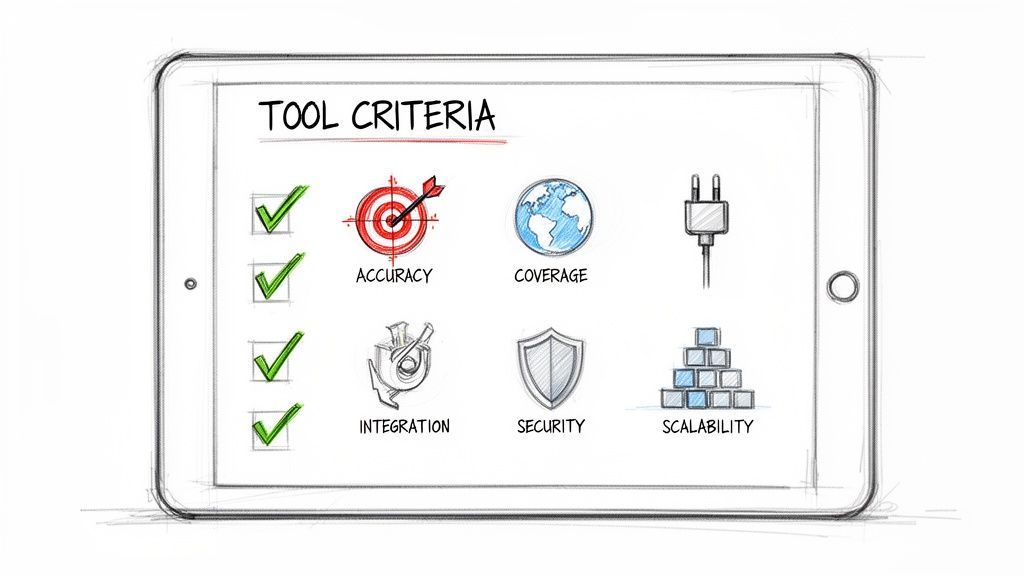
Data Accuracy and Verification
The whole point of enrichment boils down to one thing: accuracy. Let's be clear—bad data is way worse than no data. It leads to bounced emails, wasted calls, and a serious hit to your company's credibility.
You need to ask providers tough questions about how they verify their information. Look for tools that offer real-time verification, especially for things like email addresses. Any provider worth its salt will be upfront about its accuracy rates, and you shouldn't settle for anything less than 95% for verified emails.
Data Coverage and Depth
Next up, how deep does the data well go? Does the tool actually have the specific information your team needs to qualify leads and write outreach that doesn't sound generic? A massive database is useless if it's missing contacts in your target industry or region.
Think about both the number of contacts and the richness of their profiles. You'll want to check for essentials like:
- Contact Info: Verified work emails and, ideally, direct-dial phone numbers.
- Firmographics: Company size, industry, revenue, and location.
- Demographics: Job titles, seniority, and specific roles.
Seamless Integration and Usability
The best tool is the one your team actually uses. It has to plug right into your existing CRM, whether that's Salesforce, HubSpot, or something else. A clunky, complicated tool just creates friction, and reps will drop it in a heartbeat.
Find a solution that slots directly into your team's day-to-day grind. For example, a simple browser extension that lets reps enrich a contact's profile with a single click is a game-changer. It stops them from having to jump between tabs, saving precious time.
A seamless workflow is non-negotiable. If the tool forces your team to change their process, they won't use it. The right solution should feel like a natural extension of their existing habits, not a disruption.
Compliance and Security
Like we talked about earlier, you're responsible for the data you handle. Your chosen provider must be fully compliant with global privacy laws like GDPR and CCPA. Ask them directly about where their data comes from—they should have a clear, ethical answer.
Security is just as critical. This tool will be connected to your customer database, so look for providers with rock-solid security protocols, like SOC 2 compliance, to ensure your information is kept safe.
Scalability and Pricing
Finally, think about where your company is headed. Does the pricing model grow with you, or does it punish you for scaling? Watch out for confusing pricing tiers or long-term contracts that lock you in without any flexibility.
The ideal tool meets your needs today but also has a clear path for when you grow. Look for transparent, tiered pricing that lets you start small. If you're ready to start comparing the top players, check out our guide on the best data enrichment tools on the market.
Common Questions About CRM Data Enrichment
As you gear up to bring data enrichment into your workflow, a few questions are bound to pop up. It's only natural. This last section tackles the most common ones head-on, giving you clear, straightforward answers to build your confidence.
Think of it as your quick-reference guide for any lingering uncertainties.
How Often Should I Enrich My CRM Data?
The best answer? Real-time. The gold standard is having data enriched the instant a new contact is created or an old one is opened. This guarantees your team is always working with the freshest information possible, right when they need it.
If you’re running a batch process instead, you should aim for a quarterly refresh at the very least. B2B data decays at a staggering rate of roughly 30% per year. Wait any longer, and your team is making calls and sending emails based on stale, unreliable info.
Is Data Enrichment Compliant With Privacy Laws?
Yes, as long as you partner with a compliant provider and stick to best practices. Reputable data enrichment tools pull their information from publicly available and legitimate business sources, all while operating within frameworks like GDPR and CCPA.
The whole game is about transparency and legitimate interest. Your provider needs to be upfront about where their data comes from, and you must use it for valid business reasons—like contacting a prospect who squarely fits your ideal customer profile. And, of course, always honor opt-out requests.
What Is the Difference Between Cleansing and Enrichment?
This is a critical distinction, and it’s simpler than it sounds.
Data cleansing is all about fixing what you already have. It's about correcting typos in a name, standardizing state abbreviations ("CA" instead of "Calif."), and merging duplicate records. Think of it as tidying up your database.
Data enrichment, on the other hand, is about adding what’s missing. It appends new, valuable details like a contact's job title, their company's annual revenue, or a verified phone number to create a much fuller profile. Cleansing maintains your data; enrichment enhances it.
Can Enrichment Tools Integrate With Any CRM System?
For the most part, yes. Modern enrichment tools are built for flexibility and play nicely with others. The top solutions offer seamless connections to major CRMs like Salesforce, HubSpot, and Zoho, usually through a simple browser extension or a direct API hookup.
Before you commit to a tool, just double-check that it has a solid, well-supported integration with your specific CRM. A smooth connection is the key to an automated workflow that your team will actually want to use every day.
Ready to stop wasting time on manual data entry and start closing deals with accurate, actionable intelligence? AddToCRM is a one-click Chrome extension that enriches contacts directly from professional networks and email, syncing verified data to your CRM instantly. Learn more and try AddToCRM for free.
Start saving time and closing more deals.
Find contact info for your prospects on the #1 business social network and add them to your CRM with 1-click.

 Loading...



Trusted by 1000s of founders, SDRs & more
