How to Find Someone by Phone Number for B2B Sales
Learn how to find someone by phone number using proven B2B prospecting methods. Uncover names, job titles, and company data with our guide to smart sales.
Got a phone number but no name? You can usually figure out who it belongs to with a quick search on Google, a peek at social media, or by using a reverse phone lookup service. These tricks can turn a simple string of digits into a full prospect profile, complete with names, job titles, and some much-needed professional context.
Why Finding Someone by Phone Is a B2B Sales Superpower
A phone number without a name is a dead end. For any sales team, it's a locked door to a potential opportunity. But what if you could turn that single piece of data into a complete, actionable prospect profile?
That’s where the skill of finding someone by phone number becomes a game-changer in modern B2B prospecting. It’s all about moving beyond cold, anonymous digits to connect with the actual decision-makers.
In today's sales world, prospects are more informed and harder to reach than ever. Being able to identify who's behind a number gives your team a massive advantage. It's not just about getting a name; it’s about understanding their role, their company, and whether they're even the right person to talk to. This simple first step transforms your outreach from a shot in the dark to a well-aimed conversation.
If you want to sharpen your overall process, it's worth exploring different outbound lead generation strategies to see how this fits in.
The Growing Importance of Accurate Contact Data
The demand for reliable contact verification has created a huge industry. The reverse phone number lookup market is on track to hit a $2 billion valuation by 2025 and is expected to grow at an impressive 15% CAGR through 2034.
What's driving this? An urgent need for identity verification to fight fraud and filter out bad leads. In fact, businesses using these services have reported up to a 30% improvement in lead quality. That's a huge deal when you consider that 25-40% of database contacts decay every single year.

The goal is simple: turn every number into a warm conversation. By mastering how to find someone by phone number, you build a cleaner, more effective sales pipeline from the very first interaction.
Benefits of Mastering This Skill
Successfully identifying a contact from their number gives sales pros a few key advantages. It lets you:
- Personalize Your Outreach: Knowing a prospect's name, title, and company helps you tailor your message and build rapport instantly.
- Increase Efficiency: You waste less time calling wrong numbers or talking to the wrong people, focusing your energy on qualified leads.
- Improve Data Hygiene: By verifying and enriching contact information, you make sure your CRM remains a reliable source of truth, not a graveyard of outdated data.
This guide will walk you through the smart tools and techniques to unlock that door, turning anonymous numbers into your next big opportunity.
Uncovering Clues with Search Engines and Social Media
Before you drop any cash on specialized tools, your first move should always be to use the powerful, free resources you already have. Think of it like a little digital detective work. With the right strategy, you can often find someone just from their phone number using nothing more than a search engine and some social media digging.
This manual approach is perfect for those one-off lookups or when you’re working with a tight budget. More often than not, it gives you that first breadcrumb you need to identify a key prospect and start building a real profile.
Mastering Google Fu for Prospecting
Just pasting a phone number into Google can sometimes get you a hit, but using smart search operators gives you a massive advantage. These simple commands force the search engine to get specific, cutting through all the irrelevant noise online.
One of the most effective tricks is to wrap the phone number in quotation marks. For example, searching "(555) 123-4567" tells Google to look for that exact sequence of numbers. This one move can instantly pull up web pages, public business directories, or even old forum posts where the number was listed.
You can also layer in other details you might know:
"[Name]" + "(555) 123-4567"to see if a specific person is tied to that number."VP of Sales" + "(555) 123-4567"to check if it's connected to someone with that title.
By using precise search operators, you're not just searching; you're interrogating the web for specific answers. This targeted approach dramatically increases your chances of finding a direct link between the number and a professional identity.
Discreetly Searching Social and Professional Networks
Social networks can be a goldmine for contact info, provided you know where and how to look. Plenty of professionals list their contact details right on their public profiles without a second thought.
Start with professional networks. Just pop the phone number into the platform's main search bar. If a user has that number listed in their contact info and has it set to public, their profile might just show up. It’s a subtle but incredibly effective way to find a direct link to a prospect. You can learn more about this in our complete guide to finding someone on professional networks.
This method takes a bit of patience, since the information isn’t always public. But when it works, you get a highly accurate match straight from the source. It’s a quiet but powerful tactic to have in your B2B prospecting toolkit.
While free methods are great, tools like Truecaller and Whitepages have massive databases—Whitepages alone covers 260 million US contacts, and Truecaller handles over 1 billion identifications daily. Even a quick search on Reddit can be useful; crowd-sourced reports often link nuisance numbers to telemarketers, helping sales reps filter out bad leads early. You can discover more insights about how reverse phone lookups fill data gaps on serviceobjects.com.

Turn LinkedIn® profiles into CRM contacts
Add to CRM finds verified emails, phone numbers, and job titles on LinkedIn® — then adds them to your CRM in one click.
Start Free Trial


 Trusted by 2,500+ users4.7
Selecting the Right Reverse Phone Lookup Service
When your free searches on Google and social media hit a dead end, it's time to bring in a specialist. Sure, free methods are fine for the occasional one-off search, but they just don't cut it for a sales team that needs reliable data at scale. This is where professional reverse phone lookup services become a non-negotiable part of your prospecting toolkit.
But here's the catch: not all services are created equal, especially in the B2B world. A tool designed to help you find an old college roommate is worlds away from one built to identify the VP of Engineering at a target account. Understanding the difference is crucial.
Consumer vs. Professional B2B Tools
Consumer-focused lookup services, like Whitepages, are mostly for personal use. They typically scrape public records and old phone directories to give you basic details like a name and a general location. While occasionally useful, they're missing the professional context you need for B2B prospecting.
Professional B2B platforms are a different beast entirely. They're built for sales intelligence, providing way more than just a name. You can expect to find verified job titles, company information, and direct work contact details—the kind of data that turns a cold call into a warm conversation.
For a B2B sales team, the goal isn't just finding a person; it's finding the right person. A professional service helps you do exactly that by providing the role-specific context that consumer tools miss.
Key Features to Look for in a B2B Service
As you start evaluating tools to find people by their phone numbers, zero in on the features that will actually make your sales process better. Here's what I'd consider non-negotiable:
- Data Accuracy and Depth: Look for platforms that cross-reference multiple data sources. You need more than a name—the best services provide job titles, company size, industry, and sometimes even the tech stack they're using.
- CRM Integration: A great tool doesn't just find data; it makes that data easy to use. Seamless integration with your CRM (think Salesforce or HubSpot) is a must-have. It cuts out hours of manual data entry and keeps your database from turning into a mess.
- Privacy Compliance: In the age of GDPR and CCPA, using a compliant tool isn't optional. Make sure any service you choose sources its data ethically and follows major privacy regulations. It’s about protecting your company's reputation and avoiding hefty fines.
The manual process is simple enough, as this flowchart shows, but it's what professional tools add on top that makes all the difference.
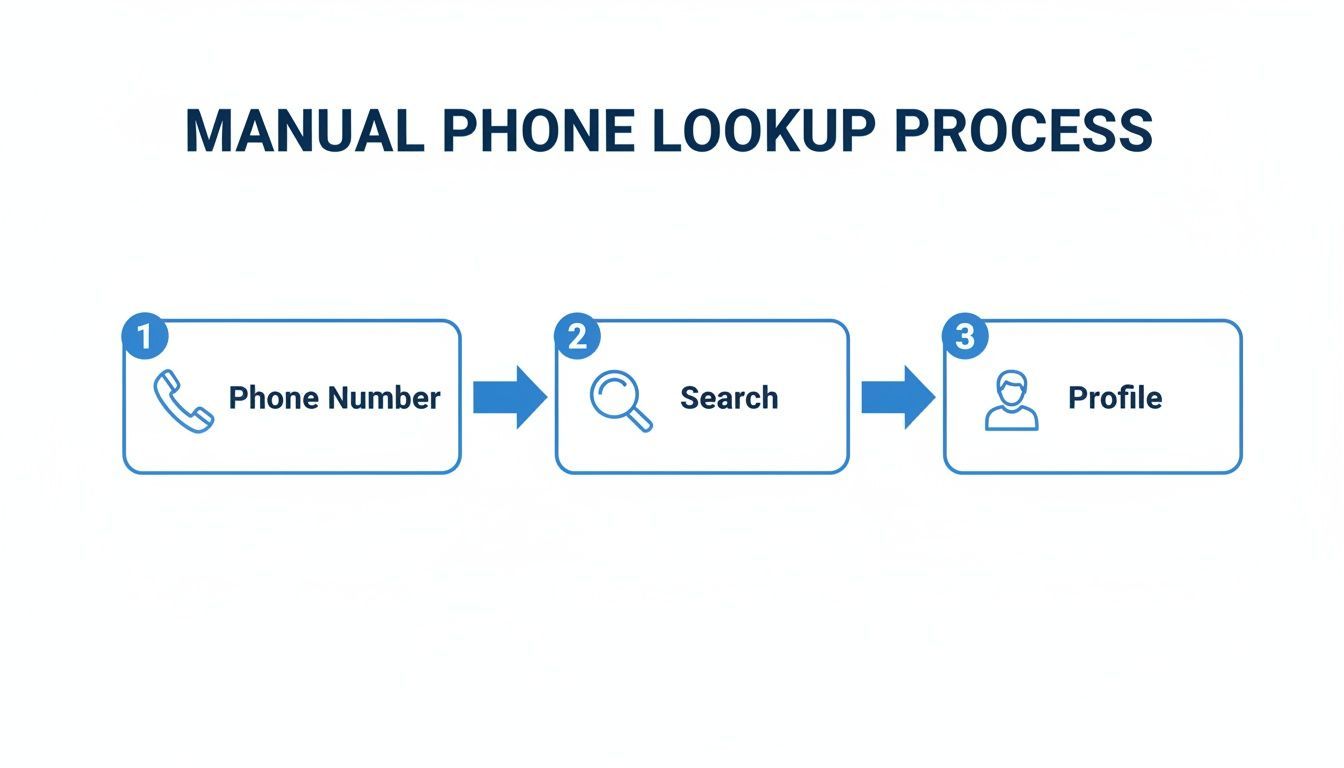
While the manual flow gets you a name, a professional service supercharges this process by layering in rich B2B intelligence right when you view the profile.
To help you decide, here’s a quick breakdown of the different approaches you can take.
Comparing Reverse Phone Lookup Methods for B2B
| Method | Best For | Typical Cost | Data Provided | CRM Integration |
|---|---|---|---|---|
| Search Engines | Quick, one-off searches for public numbers. | Free | Publicly available info, social profiles, news mentions. | None |
| Social Media | Finding individuals who publicly share their number. | Free | Name, profile, connections, sometimes company. | Manual |
| Consumer Lookups | Finding personal info on individuals (not B2B). | Free to low-cost subscription. | Name, address, relatives, carrier info. | Unlikely |
| B2B Data Platforms | Sales teams needing accurate, enriched lead data at scale. | Subscription-based (per seat/credits). | Name, title, company, work email, firmographics. | Yes (Native) |
Ultimately, the right choice comes down to your team’s specific needs. If you're only doing a handful of lookups a month, a basic approach might be enough. But if your sales team is running serious outbound campaigns, investing in a platform with deep data and solid CRM integration will deliver a far greater return. The time saved and the improvement in lead quality will quickly pay for the tool itself.
Turning Contact Data into CRM Gold
Okay, so you found a name for that phone number. Great start. But that’s only half the job.
The real win is getting that raw contact info into your CRM seamlessly, turning it into an asset your sales team can actually use. This is where modern prospecting tools completely change the game. They get rid of the soul-crushing, error-prone task of manual data entry.
Instead of flipping between browser tabs to copy and paste a name, title, and company, you can zap a freshly identified contact into a complete CRM record with one click. We’re talking about turning a minutes-long task into a matter of seconds.
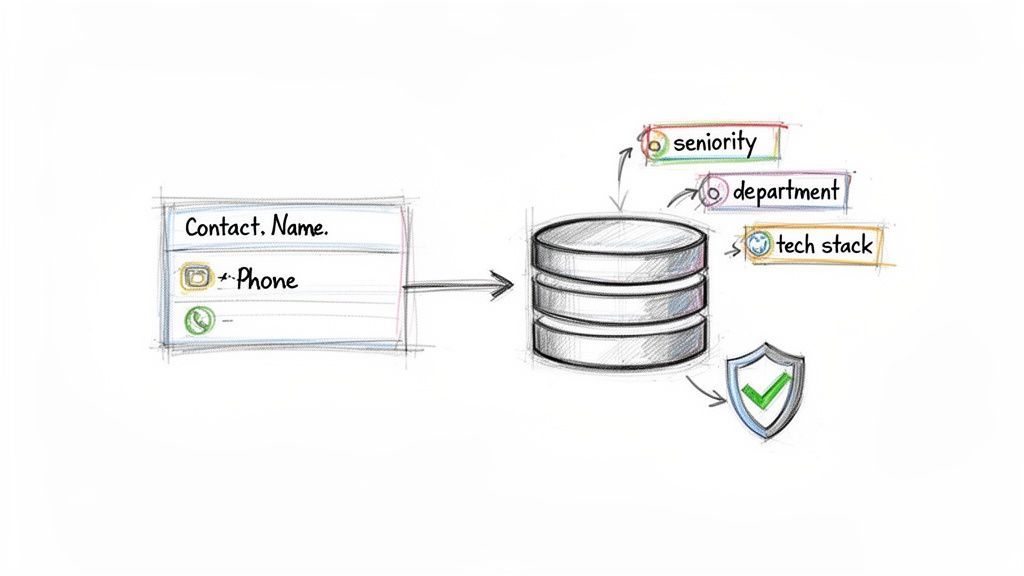
From Simple Contact to Rich Profile
The magic here isn't just about saving time—it’s about the depth of data you can add instantly. Imagine turning a simple name and number into a rich profile with over 30 data points.
This process, known as data enrichment, layers crucial B2B context on top of the basic contact details. Here’s a taste of what you can add automatically:
- Professional Details: Seniority level, department, and specific job title.
- Company Firmographics: Company size, industry, location, and annual revenue.
- Technology Stack: The software and tools the company currently uses.
Having this information the moment a lead enters your CRM is huge. It allows for immediate, highly relevant personalization from the very first touchpoint. You can check out our guide on the best data enrichment tools to see how different platforms compare.
Maintaining Pristine Data Hygiene
Every sales and RevOps leader knows the agony of a messy CRM. Duplicate contacts, incomplete records, and stale information can torpedo sales efforts and lead to some seriously embarrassing outreach mistakes. This is exactly why the best tools put data hygiene first.
Data decay is a silent killer of sales pipelines, with 30% of business data going stale yearly. Reverse phone lookup services can reverse that trend, boosting CRM accuracy by 40% and saving teams over $50K annually in bad leads.
Built-in duplicate checking is non-negotiable. Before adding a new contact, a good tool will scan your CRM to see if that person or company already exists, preventing redundant entries. This simple feature is the foundation of a clean, reliable database.
On top of that, custom field mapping ensures all this rich, new data lands exactly where it belongs. You can align the tool's data points with your specific CRM fields, whether they're standard or custom. This guarantees consistency across all your records and makes sure your team can actually use the information for segmentation, scoring, and reporting without any extra cleanup.
Navigating Data Privacy and Ethical Outreach
Once you’ve successfully put a name to a number, the real work begins. Your next move isn't just about making the call—it's about making sure your outreach is both legal and ethical. In a world governed by strict rules like the General Data Protection Regulation (GDPR) and the California Consumer Privacy Act (CCPA), prospecting responsibly isn't just good manners; it's mandatory.
Getting this wrong can lead to eye-watering fines and, maybe worse, torching your brand's reputation before you even get a chance to introduce yourself. The key is to shift your mindset from simply collecting data to handling it with respect. This approach doesn't just keep you compliant—it builds the trust you need for a genuine conversation.
Understanding Key Privacy Regulations
You don't need a law degree to get the basics right. For B2B prospecting, most regulations boil down to a few core ideas. One of the most important concepts, especially under GDPR, is "legitimate interest."
This is the legal justification that often allows you to process personal data for business purposes (like sales outreach) without getting explicit consent first. But it's not a free pass. You can only lean on it if your business interest doesn't stomp on the individual's rights. You have to be ready to justify why your outreach is relevant and necessary for both your business and the prospect.
Here are the essential pillars of compliant outreach:
- Transparency: If someone asks, be ready to tell them who you are, why you’re calling, and where you found their info. Hiding your data sources is a massive red flag.
- Purpose Limitation: Use the contact information only for the specific, legitimate reason you found it. Don't dump a number from a targeted sales search into a generic marketing newsletter without permission.
- Data Minimization: Only collect and store what you absolutely need. If a name and phone number are enough for an initial call, don't go digging for extra personal details.
Following these practices ensures your prospecting is both effective and ethical. It’s about building a foundation of trust that protects your reputation and makes prospects more receptive to what you have to say.
Actionable Steps for Compliant B2B Outreach
Navigating privacy laws can feel intimidating, but it really boils down to respectful, clear communication. Your outreach should always give the prospect control over their own data.
A crucial piece of this is providing a clear and easy way for them to opt out. This isn't just a legal checkbox; it's a sign of respect that can actually protect your brand's image, even with someone who isn't a good fit. Make sure your process for handling opt-out requests is fast and flawless.
Finally, always document where you sourced your data and the legal basis you're using for outreach. This internal record-keeping is your safety net if you ever need to demonstrate compliance. By building these ethical habits into your workflow, you can confidently turn that phone number into a compliant, trust-based conversation.
29+ CRMs supported. Try free for 7 days
Add to CRM finds verified emails, phone numbers, and job titles on LinkedIn® — then adds them to your CRM in one click.
Start Free TrialTrusted by 2,500+ users4.7Common Questions About Phone Number Prospecting
Even when you have the best tools, you’ll inevitably run into questions when trying to find someone by phone number for professional outreach. Let’s tackle some of the most common concerns and roadblocks sales pros hit.
Getting these right is the difference between an effective, respectful prospecting engine and one that just creates headaches.
Is It Legal to Find Someone by Their Phone Number for Sales Outreach?
The short answer is yes, it’s generally legal for B2B purposes. But you absolutely must operate within the rules of privacy regulations like GDPR and CCPA.
For B2B outreach, you can often work under the principle of "legitimate interest." This just means you have a valid, relevant business reason to contact the person. Think of it this way: if you're selling marketing automation software to a VP of Marketing, there's a clear professional alignment.
This isn't a free pass, though. Your outreach has to be genuinely relevant to their job, and you must always give them an easy way to opt-out.
Using data from compliant, professional sources and being transparent are non-negotiable. It’s the foundation of ethical prospecting that protects both your prospect and your business.
What Is the Most Reliable Way to Find a Professional's Contact Details?
A quick Google search might give you a hit now and then, but it's not a real strategy for a sales team that needs consistent results. It’s slow, unreliable, and often turns up outdated personal numbers instead of work contacts.
For B2B prospecting, the most dependable method is using a specialized sales intelligence platform or a browser extension built for this.
These tools don’t just scrape public websites. They pull from, and cross-verify, data across multiple trusted sources to build an accurate professional profile. You get verified job titles, company details, and direct work phone numbers and emails—a level of reliability that free public searches just can’t touch.
How Can I Avoid Adding Duplicate Contacts to My CRM?
Duplicate contacts are a quiet killer of sales productivity. They create messy data, lead to confusion, and result in multiple reps accidentally chasing the same lead. It’s a bad look.
The best way to prevent this chaos is to use a tool with built-in duplicate detection.
Modern sales extensions, for example, will automatically check your CRM before you save a new contact or company. If a record for that person or organization already exists, it’ll flag it, stopping you from creating a redundant entry. This feature is absolutely essential for keeping your database clean and ensuring your team stays coordinated.
Ready to turn anonymous phone numbers into actionable leads without the manual work? Add to CRM is a Chrome extension that finds verified contact data for over 220 million professionals and adds them to your CRM in one click. Start your free trial today and save hours on prospecting.
Start saving time and closing more deals.
Find verified contact info for your prospects on LinkedIn®, Gmail and Outlook — and add them to your CRM with 1-click.

 Loading...Trusted by 2,500+ founders, SDRs & more