CRM Data Entry Statistics 2026: Email Find Rates, Verification, and Prospecting Habits
Original 2026 data from Add to CRM: real email and mobile find rates, verification outcomes, CRM fragmentation, and when prospecting actually happens.
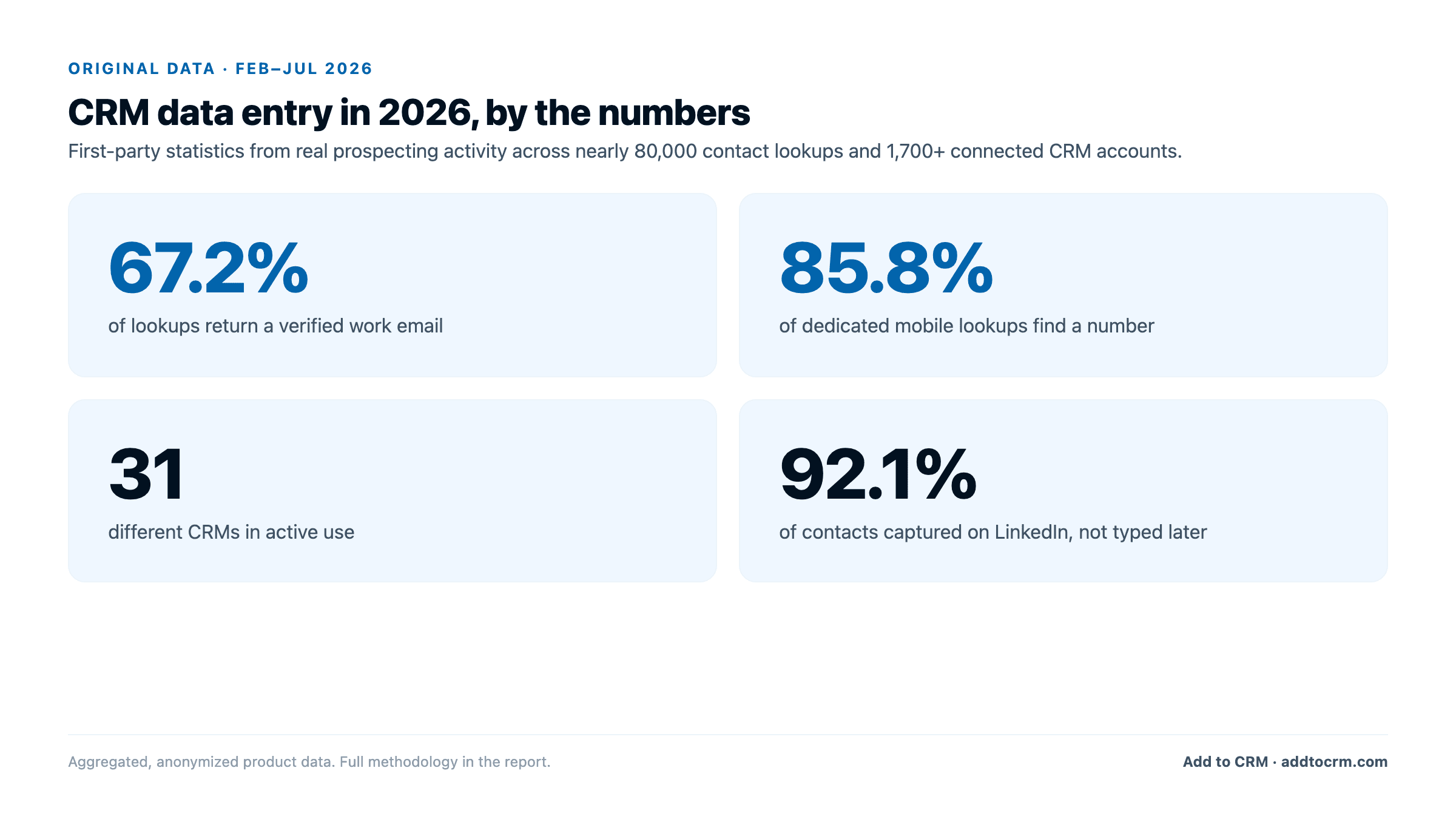
Most statistics pages about CRMs and prospecting recycle the same handful of survey numbers from year to year. This page is different: every figure below is first-party data, measured from real prospecting activity inside Add to CRM between 1 February and 31 July 2026 — nearly 80,000 contact lookups, more than 50,000 email verifications, and 1,700+ connected CRM accounts. No survey answers, no vendor estimates: this is what actually happened when salespeople looked up contacts and saved them to their CRMs.
All figures are aggregated and anonymized; no personal data is published. The full methodology, including definitions and known biases, is at the bottom of the page.
Key findings
- 67.2% of contact lookups returned a verified work email in 2026 — the real-world email find rate across nearly 80,000 lookups (Add to CRM data, Feb–Jul 2026).
- 85.8% of dedicated mobile lookups returned a verified mobile number — mobile data is more findable than most teams assume, when you explicitly ask for it.
- 12.5% of email addresses that users verified — about 1 in 8 — came back undeliverable or risky, the addresses that quietly damage sender reputation when lists go unchecked.
- Prospecting teams used 31 different CRMs in 2026 — CRM usage is far more fragmented than the big-two narrative suggests. (We deliberately publish no per-CRM breakdown; see the methodology.)
- 92.1% of contacts were captured in the LinkedIn context — on a profile, a company page, or in a conversation — versus under 2% from Gmail and Outlook combined.
- Prospecting is a midweek sport: Tuesday and Wednesday carry 45.3% of the week's contact adds, weekends just 5.6%, and the single busiest hour is Wednesday 14:00 UTC.
- The median active user saved 4 unique new contacts per week to their CRM; the top 10% of users saved 30 or more.
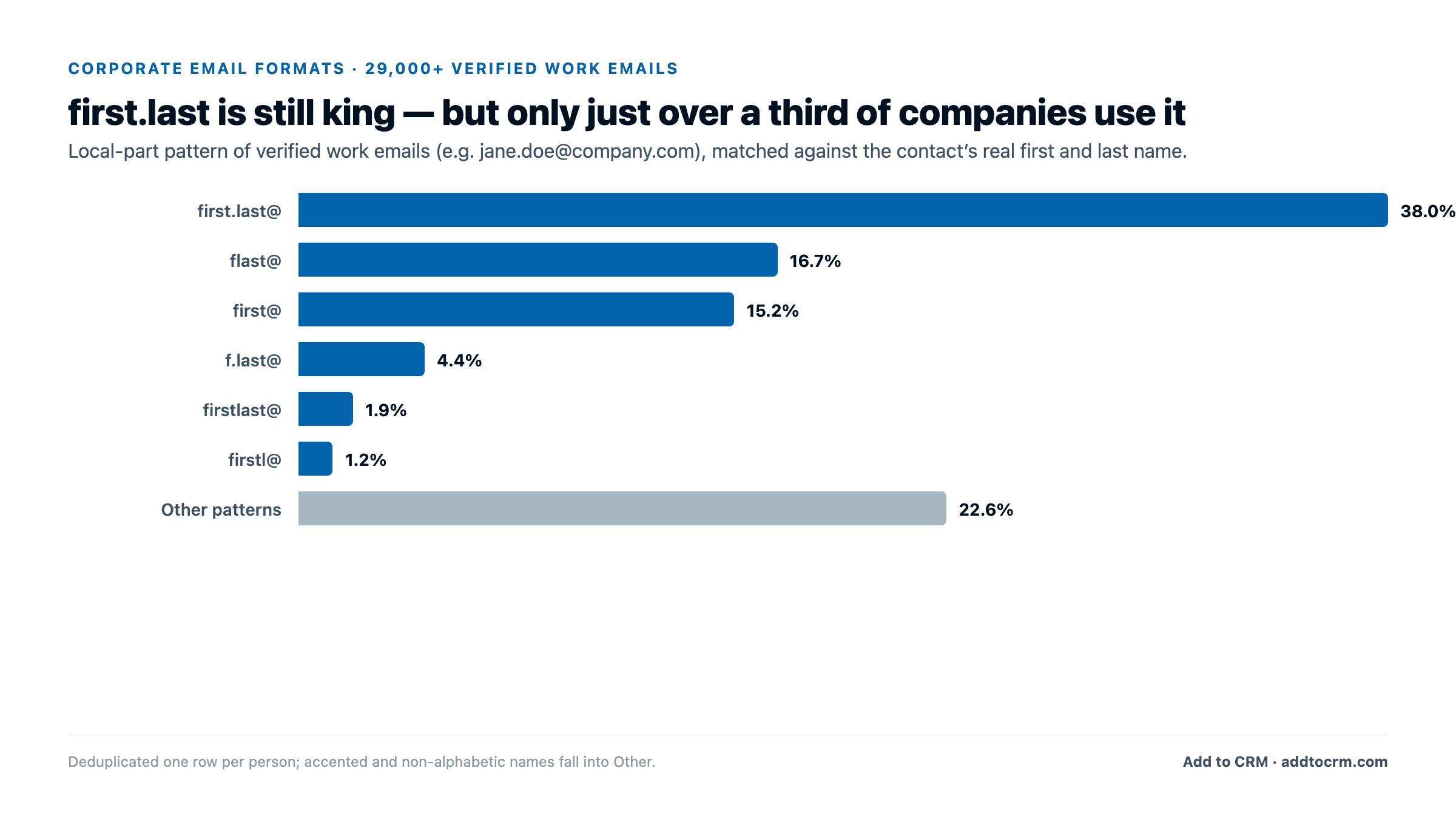
- first.last (jane.doe@company.com) is still the most common corporate email format, at 38.0% of 29,000+ verified work emails.
The CRM long tail is real: 31 CRMs in active use
Analyst market-share charts make the CRM market look like a two-horse race. Connection data tells a different story about the teams who actively prospect: across 1,700+ Add to CRM accounts with a connected CRM, 31 different CRMs are in live use — established suites, newer relationship-focused tools, industry-specific systems, and a meaningful slice of spreadsheet- and database-style tools doing full CRM duty.
A deliberate note on what we are not publishing: which CRMs those are, or in what proportions. Our user base is shaped by where Add to CRM has marketplace listings and partnerships, so a per-CRM breakdown from our data would say more about our own distribution than about the market — and we'd rather publish no league table than a misleading one. The finding that survives that bias, because it doesn't depend on which CRMs sit where, is the shape: small and mid-market sales teams spread across dozens of CRMs, and any tooling or outreach strategy that assumes "everyone is on the big two" misses a large slice of working sales teams.
Where contacts actually get captured
When a salesperson decides someone belongs in the CRM, where does that moment happen? Overwhelmingly at the source — while looking at the person — not later at a keyboard.
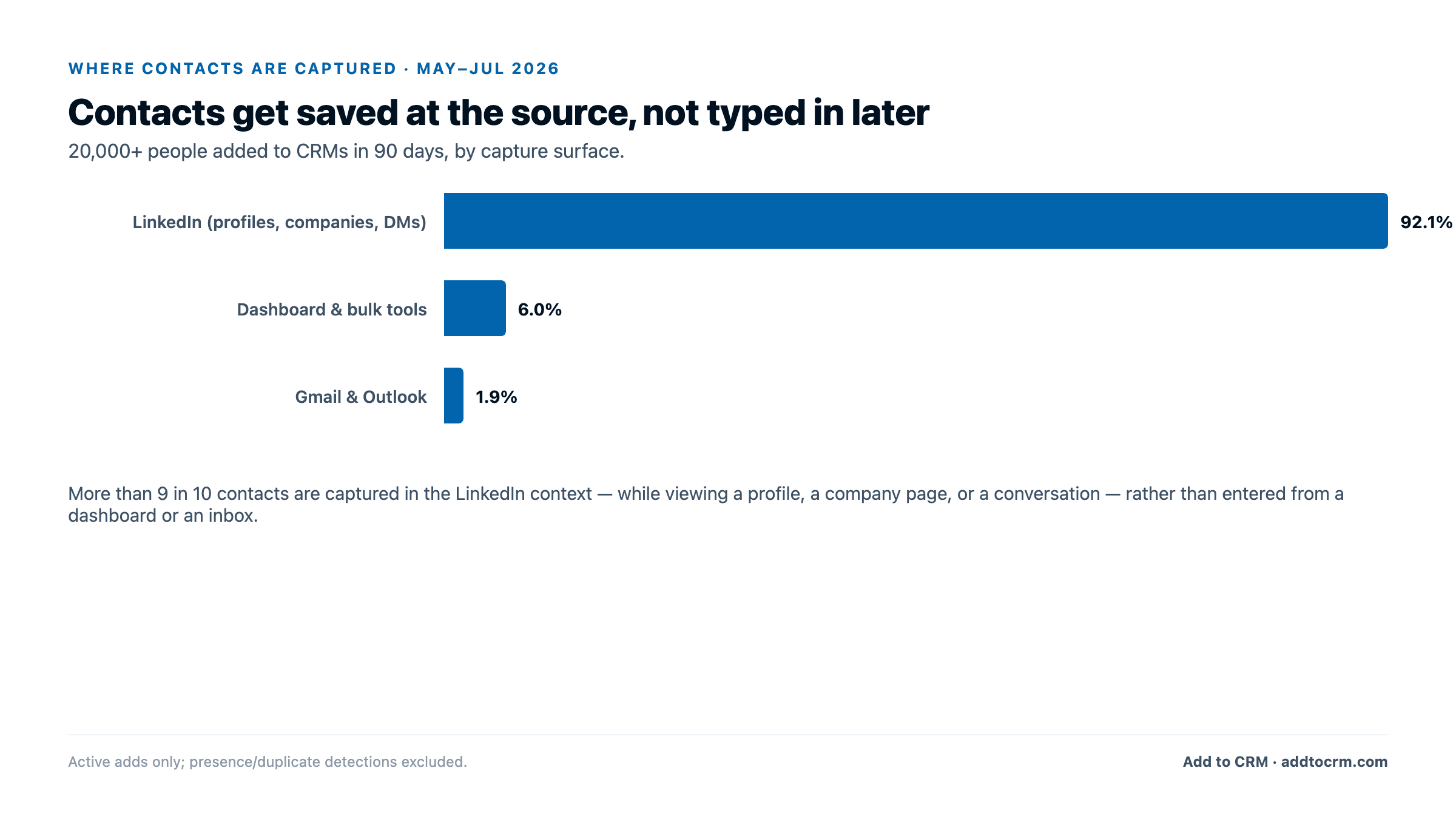
| Capture surface | Share of people added (90 days, May–Jul 2026) |
|---|---|
| LinkedIn (profiles, company pages, DMs) | 92.1% |
| Dashboard and bulk tools | 6.0% |
| Email inboxes (Gmail + Outlook) | 1.9% |
Across 20,000+ people added in the 90-day window, more than 9 in 10 were captured in the LinkedIn context. Prospecting in 2026 is a browser workflow: the decision to save a contact happens while reading a profile or a conversation, and any data-entry step that interrupts that flow is where CRM hygiene goes to die.
The email find rate, honestly measured: 67.2%
Industry marketing pages routinely cite coverage rates north of 90%. Coverage — whether a database contains a person — is not the number a salesperson experiences. What matters at the moment of prospecting is the find rate: when you look up a real person, how often do you end up with a verified work email in hand?
Across nearly 80,000 lookups between February and July 2026, the answer was 67.2% — about two in three lookups.
| Month (2026) | Email find rate |
|---|---|
| February | 80.4% |
| March | 73.6% |
| April | 62.8% |
| May | 61.3% |
| June | 67.4% |
| July | 68.5% |
The monthly figure moved between 61% and 80% with the mix of industries, geographies and seniority levels being prospected — which is itself a finding: find rates are not a fixed property of a tool, they are a property of who you look up. Two definitions worth pinning down (both expanded in the methodology):
- Find rate (this stat): the share of lookup attempts that returned a verified work email, including repeat lookups served from cache — the service-level rate a user actually experiences.
- Verification accuracy (a different stat): how reliable the returned emails are. Emails surfaced by Add to CRM go through a verification step first, which is why find rate sits below headline coverage claims — unverifiable guesses are dropped rather than handed to you.
Verification: 1 in 8 emails would have bounced
Verification is where email lists quietly live or die. Across more than 50,000 verifications requested by users in the window:
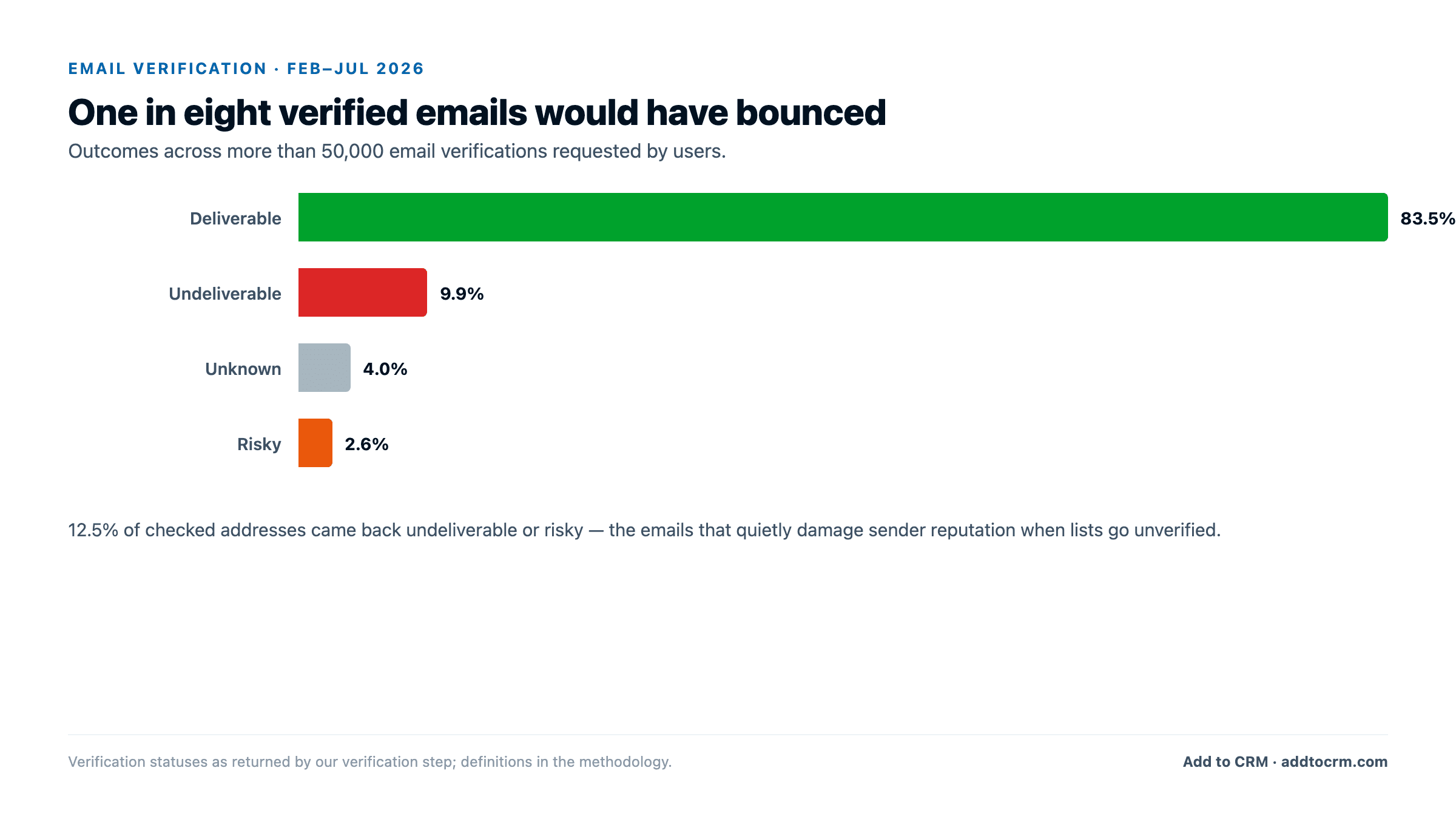
| Verification outcome | Share |
|---|---|
| Deliverable | 83.5% |
| Undeliverable | 9.9% |
| Unknown | 4.0% |
| Risky | 2.6% |
12.5% of checked addresses — about one in eight — were undeliverable or risky. Those are the addresses that bounce, spike your bounce rate, and erode sender reputation until otherwise-good emails start landing in spam. If your team imports lists without a verification step, roughly an eighth of that list is working against you.
What is a good email bounce rate?
Most deliverability guides recommend keeping your bounce rate under roughly 2% — sustained rates above that make mailbox providers treat your whole domain with suspicion. Our data shows how hard that is to hit without a verification step: across 50,000+ checks, 9.9% of addresses were outright undeliverable and a further 2.6% risky. In other words, an unverified list starts at roughly six times the commonly recommended bounce threshold before you've sent a single email.
The practical reading of our numbers:
- Under 2% bounces is realistic when every address passes verification first — the 83.5% that verify as deliverable are the list you actually send to.
- Around 12% effective risk is what raw, unverified lists carried in our dataset — the undeliverable (9.9%) plus risky (2.6%) share.
- "Risky" is a judgment call: those 2.6% (catch-alls and low-confidence addresses) may deliver, but each one gambles a little sender reputation. High-volume senders should cut them; a founder sending ten carefully chosen emails a week can accept the risk.

Turn LinkedIn® profiles into CRM contacts
Add to CRM finds verified emails, phone numbers, and job titles on LinkedIn® — then adds them to your CRM in one click.
Start Free Trial


 Trusted by 2,500+ users4.5
Mobile numbers: 85.8% findable — when you ask
Mobile numbers have a reputation as the scarce asset of B2B data. Our numbers say otherwise — with a catch. When users ran a dedicated mobile lookup (an explicit, opt-in step, separate from standard email enrichment), 85.8% of 29,000+ lookups returned a verified mobile number.
The catch is the qualifier: these are deliberate lookups on contacts a user actively wanted to call, not a blanket rate across every profile ever viewed. The honest takeaway is narrower and more useful: when a mobile number matters enough to ask for it, you get one about six times out of seven.
When prospecting happens: Tuesday–Wednesday, early afternoon UTC
Across 36,000+ one-by-one contact adds (bulk imports excluded, so this reflects live human behavior):
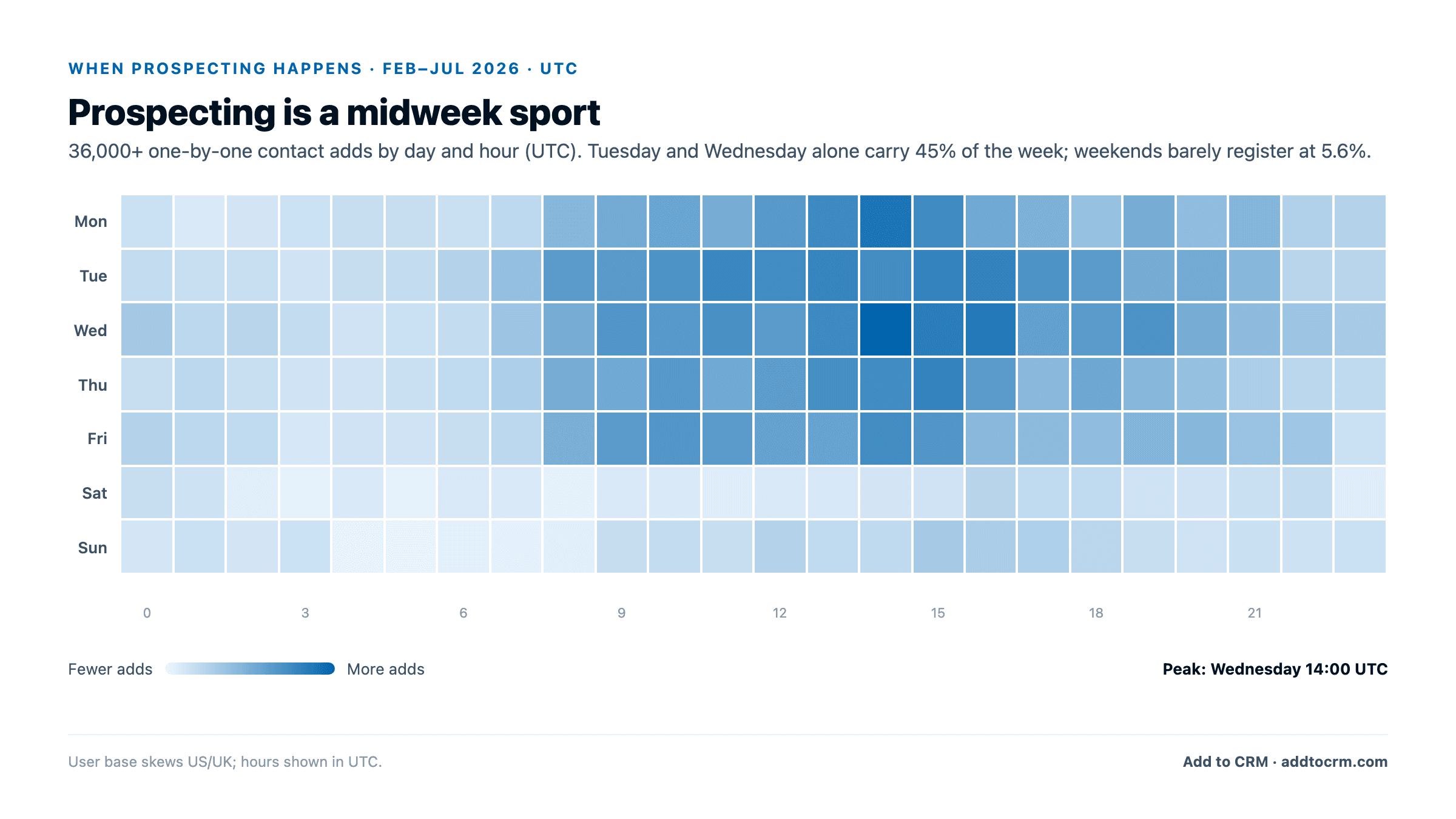
| Day | Share of weekly adds |
|---|---|
| Monday | 16.7% |
| Tuesday | 22.0% |
| Wednesday | 23.3% |
| Thursday | 16.7% |
| Friday | 15.7% |
| Saturday | 2.1% |
| Sunday | 3.5% |
- Tuesday and Wednesday together carry 45.3% of the week's prospecting.
- 13:00–16:59 UTC accounts for 35.3% of daily volume; the single peak hour is Wednesday 14:00 UTC (mid-morning on the US East Coast, mid-afternoon in the UK).
- Weekends barely exist in prospecting: 5.6% of weekly adds combined.
Hours are UTC and our user base skews US/UK, so read the pattern rather than your own wall clock. But the pattern is emphatic: prospecting concentrates hard in the midweek, early-afternoon band — which also means the inboxes you are prospecting into are most crowded with everyone else's outreach at exactly those times.
When is the best time to send cold emails?
An honest framing first: our dataset measures when salespeople prospect — when they look people up and save them to the CRM — not which send times earn replies. Treat what follows as market intelligence about your competition, not a send-time experiment.
What the data shows clearly: prospecting activity piles into a narrow band. Tuesday and Wednesday, 13:00–17:00 UTC, is when the sales world does its outbound groundwork, peaking Wednesday 14:00 UTC — mid-morning on the US East Coast, mid-afternoon in the UK. Two inferences follow:
- The midweek-afternoon inbox is the most contested real estate of the week. Outreach built during peak prospecting hours tends to get sent in the same window — so a cold email landing Wednesday afternoon competes with everyone else's Wednesday afternoon email.
- The underused windows are real: Mondays, Fridays and early mornings see a fraction of the activity. If your open rates sag midweek, the contrarian slots give each email more room to breathe.
And one conclusion the data supports unambiguously: timing is a second-order lever. A verified email sent at the "wrong" hour beats a bounced one sent at the perfect hour — see the verification numbers above.
Corporate email formats: first.last is king, but only just over a third
From 29,000+ verified work emails matched against each contact's real first and last name:
| Format | Example | Share |
|---|---|---|
| first.last | jane.doe@company.com | 38.0% |
| flast | jdoe@company.com | 16.7% |
| first | jane@company.com | 15.2% |
| f.last | j.doe@company.com | 4.4% |
| firstlast | janedoe@company.com | 1.9% |
| firstl | janed@company.com | 1.2% |
| Other patterns | — | 22.6% |
first.last remains the single most common corporate email format at 38.0% — but that means 62% of companies use something else. The "first" format (jane@) at 15.2% reflects how much of the prospecting universe is small companies, where first-name addresses are the norm. If you guess formats instead of verifying them, the majority of your guesses have worse-than-coinflip odds on any single unfamiliar company. (Looking for a specific company's pattern? Our free email format lookup covers exactly this.)
Cadence: the median prospector adds 4 contacts a week — the top 10% add 30+
How much does an individual salesperson actually feed their CRM? Per active user (someone who added at least one contact that week), the weekly distribution of unique new contacts added:
| Percentile | Unique contacts added per week |
|---|---|
| 25th | 1 |
| Median | 4 |
| 75th | 12 |
| 90th | 30 |
| Mean | 13.1 |
The mean (13.1) sits far above the median (4) because prospecting volume is heavily skewed: a minority of high-volume users — SDRs working systematic lists — add 30, 50, or several hundred contacts a week, while the typical user is a founder or account owner saving a handful of genuinely relevant people. Both are real prospecting; averages that don't show the split flatter nobody.
29+ CRMs supported. Try free for 7 days
Add to CRM finds verified emails, phone numbers, and job titles on LinkedIn® — then adds them to your CRM in one click.
Start Free TrialTrusted by 2,500+ users4.5What this means for sales teams
Three practical conclusions fall out of this data:
- Budget for the find-rate gap. If your outreach plan assumes an email for everyone, a third of your list-building time disappears into lookups that return nothing usable. Teams that measure their real find rate (and route no-email contacts to other channels, like the 85.8%-findable mobile path) plan honestly; teams that budget on coverage claims come up short.
- Verify before you send — an eighth of your list is a liability. The 12.5% undeliverable-or-risky share is remarkably stable and remarkably destructive. Verification is the cheapest deliverability insurance that exists.
- Capture at the source, because that's where capture actually happens. 92% of contacts get saved in the moment, from LinkedIn. Whatever CRM you run — and with 31 in active use, there's a good chance it isn't one of the giants — the data-entry step has to live inside the prospecting flow, not after it.
Methodology
Source. Aggregated, anonymized product usage data from Add to CRM, a Chrome extension and dashboard that captures contacts from LinkedIn, Gmail and Outlook into 29+ CRMs. No personal data is published; no figure in this report can be traced to an individual or a single company.
Windows. Email find rate and verification outcomes: 1 February – 31 July 2026. Prospecting rhythm: same window, one-by-one adds only (bulk imports excluded). Capture surface and weekly cadence: 1 May – 31 July 2026. CRM count: snapshot of connected accounts as of 1 August 2026. Mobile find rate: 15 March – 31 July 2026 (full coverage of the dedicated mobile-lookup pipeline). Email formats: full deduplicated contact cache as of 1 August 2026.
Sample sizes (rounded down): ~79,800 contact lookups · ~50,700 email verifications · ~36,100 single contact adds · ~20,900 people added in the 90-day window by 500+ active users · ~29,200 verified emails for the format analysis · ~29,200 dedicated mobile lookups · 1,745 connected CRM accounts.
Definitions.
- Lookup: a request to find contact details for a specific person (from a profile, a conversation, or a name-and-company pair). Repeat lookups served from cache count as lookups — the rate shown is what a user experiences, not a per-provider benchmark. Attempts blocked before any search ran (out of credits, inactive subscription, plan gating) are excluded.
- Email find rate: share of lookups that returned a verified work email.
- Verification outcomes: results of explicit, user-requested email verifications ("deliverable" / "undeliverable" / "risky" / "unknown" as returned by the verification step). This is the health of addresses users chose to check — a different measure from the accuracy of emails the product itself surfaces, which are filtered through verification before being shown.
- Capture surface: the surface a contact was saved from. Active adds only; automatic detections of contacts that already existed in the CRM are excluded.
- Active user (cadence): a user who added at least one contact in a given ISO week. Contacts are counted once per person per account (deduplicated), so re-saving the same person does not inflate the number.
- Email format: the local-part pattern of a verified work email matched against the contact's first and last name, alphabetic characters only; accented and non-Latin names conservatively fall into "Other".
Aggregation rules. Percentages rounded to one decimal. Named CRM cells require at least 25 accounts; smaller cells are grouped as "Other". Day/hour figures are UTC.
Known biases, stated. CRM-usage figures reflect Add to CRM's user base, and our marketplace listings and partnerships shape which CRMs our users arrive from — which is exactly why we publish only the aggregate count (31 CRMs) and no per-CRM breakdown or ranking. The user base skews US/UK, small and mid-market B2B sales. Mobile find rate covers deliberate, opt-in mobile lookups, not all contacts. Monthly find-rate movement reflects who was being prospected as much as data quality.
About this data / how to cite
Add to CRM is a Chrome extension that adds contacts from LinkedIn, Gmail and Outlook to 29+ CRMs in one click, enriching each contact with a verified work email and 20+ data points. This report draws on anonymized usage across its 2,500+ users; see how it works or the pricing page for the product itself.
Cite this report as: Add to CRM, "CRM Data Entry Statistics 2026", addtocrm.com/blog/crm-data-entry-statistics. We update it annually; the numbers above are the February–July 2026 edition. Journalists and writers: you are welcome to reuse any statistic or chart on this page with a link back to this report as the source.
Start saving time and closing more deals.
Find verified contact info for your prospects on LinkedIn®, Gmail and Outlook — and add them to your CRM with 1-click.

 Loading...Trusted by 2,500+ founders, SDRs & more