Mastering Efficiency in Sales for Lasting Growth
Unlock peak performance with our guide to efficiency in sales. Learn proven frameworks, tools, and metrics to streamline processes and accelerate revenue.
When people talk about efficiency in sales, their minds usually jump to working harder or pulling longer hours.But that’s not it. It’s about getting better results with smarter, more focused effort.
True efficiency turns your sales operation from a bunch of individual reps trying their best into a finely tuned system built for predictable growth.
What Sales Efficiency Really Means Today
Let's ditch the old-school mantra of "doing more with less." That's a fast track to burnout and sloppy work.
Instead, picture a Formula 1 team. The driver is a superstar, sure, but the win comes from the whole package: a lightning-fast pit crew, brilliant engineers, and a perfect race strategy all working as one.
That’s the modern blueprint for efficiency in sales. It’s about building a connected system where every single piece—every process, every tool, every person—is geared toward one thing: closing deals. We're moving past brute force and building a smarter sales engine.

The Three Pillars of Modern Sales Efficiency
At its heart, this high-performance system is built on three pillars. If you neglect one, the whole operation starts to drag.
- Optimized Processes: This is your team’s playbook. A rock-solid sales process lays out a clear, repeatable path from that first "hello" to a signed contract. It kills the guesswork and keeps everyone consistent.
- Intelligent Automation: This is where you hand off all the repetitive, soul-crushing admin tasks. We know reps spend a huge chunk of their day on non-selling activities. Automation frees them up to do the one thing they're paid to do: sell.
- Data-Driven Decisions: This pillar is about using real-time data from your CRM and other tools to steer the ship. Instead of going with your gut, you can see exactly what’s working, spot bottlenecks, and make sharp decisions that actually improve results.
Seeing these concepts in action makes all the difference. Some companies have made massive gains by dialing in these areas, like in this Case Study: Anchoring Sales Efficiencies in B2B Manufacturing.
Why This Shift Matters Now
Look, the point of all this isn't just to save a few minutes here and there. It's about generating real, tangible business results. When you focus on these core areas, you directly move the needle on the metrics that matter.
The real purpose of efficiency is to shorten sales cycles, increase win rates, and drive predictable revenue growth. It's about turning your sales operation into your most powerful and reliable competitive advantage.
When your processes are tight and your team is backed by smart tech and clear data, the entire sales motion just gets faster. For instance, a huge goal is to shrink the time it takes to turn a lead into a customer, which you can learn more about by understanding the average sales cycle for your industry.
This guide will walk you through exactly how to build that kind of system for your own team.
The Four Metrics That Measure Sales Health
You can't improve what you don't measure. If you want to seriously boost your sales efficiency, you have to move beyond guesswork and start digging into the hard numbers.
Think of your sales operation as a high-performance engine. Before you can tune it for more power, you need to plug in the diagnostics and understand the readings. These four metrics are your diagnostic toolkit—they give you a clear, practical way to check the health of your sales engine.
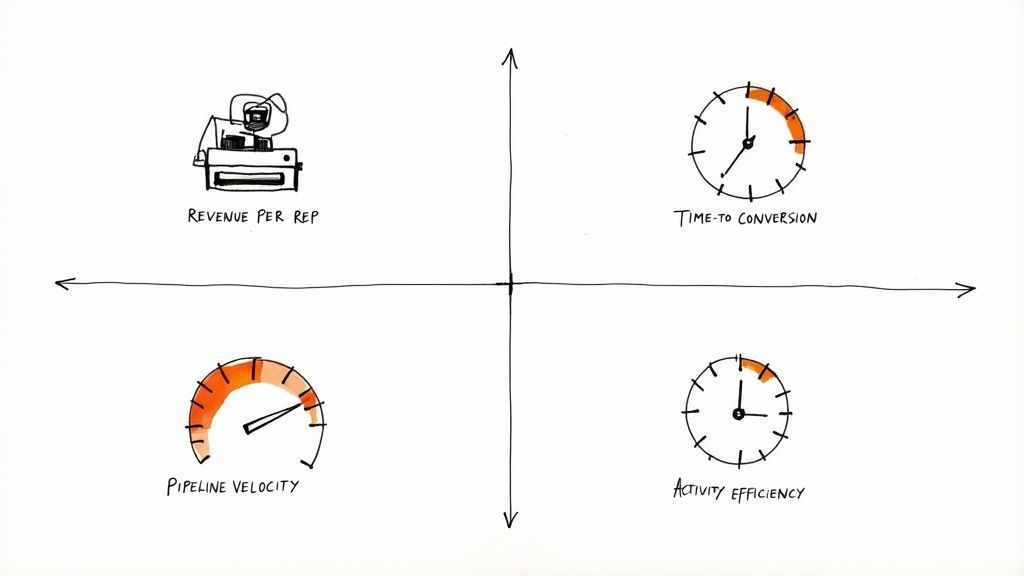
This approach lets you pinpoint exactly where the weaknesses are in your operation. It helps you focus your efforts where they'll actually make a difference. Let's break each one down.
Revenue Per Rep: The Horsepower
First up is Revenue Per Rep. This is the raw horsepower of your sales engine. It tells you the average revenue each salesperson brings in over a set period, like a month or a quarter. It's the most direct measure of individual output and the overall team's muscle.
A high Revenue Per Rep means your team is closing valuable deals and firing on all cylinders. But if that number is low or dropping, it might signal problems with training, the quality of leads you're feeding them, or the sales process itself.
Time-to-Conversion: The Acceleration
Next is Time-to-Conversion, which is your engine’s 0-to-60 acceleration. This metric tracks the average time it takes for a new lead to become a paying customer. A short conversion time means your sales process is lean and effective, moving prospects through the pipeline with little resistance.
If this number is too high, it's a massive red flag. It means deals are probably getting stuck somewhere, follow-ups aren't happening, or your pitch just isn't landing right away. Shortening this cycle is one of the fastest ways to improve efficiency in sales.
By tracking Time-to-Conversion, you can identify the bottlenecks that are slowing down your entire sales motion. Fixing those delays translates directly into faster revenue and healthier cash flow for the business.
Pipeline Velocity: The Top Speed
Think of Pipeline Velocity as your engine's top speed on the track. It measures how fast deals are moving through your pipeline and how much value they represent, giving you a complete picture of your sales health.
The formula generally looks something like this: (Number of Opportunities x Average Deal Size x Win Rate) / Length of Sales Cycle
A high velocity tells you that you have a healthy, fast-moving pipeline. A slow one suggests deals are stagnating or your win rate is too low. If you're looking to get a quick read on your team's output, our sales team productivity calculator can offer some valuable insights.
Activity Efficiency: The Fuel Economy
Finally, we have Activity Efficiency. This is your engine's fuel economy. It measures the return on effort for your team’s daily grind—the calls, emails, and meetings they conduct. This isn't about doing more work; it's about making sure the work they're doing actually moves the needle.
For instance, how many calls does it take to book one meeting? And how many meetings turn into a real opportunity? Answering these questions helps you figure out which activities are high-impact and which are just busywork.
To really dial in your sales machine, you need to track these metrics consistently. They provide a clear, data-driven path to identifying problems and celebrating what's working.
Here’s a quick-glance table breaking down why each one is so crucial.
Key Sales Efficiency Metrics and Their Business Impact
| Metric | What It Measures | Why It Matters |
|---|---|---|
| Revenue Per Rep | The average revenue generated by each salesperson over a specific period. | Directly reflects individual and team productivity. It helps set realistic quotas and identify top performers. |
| Time-to-Conversion | The average time it takes to turn a lead into a paying customer. | Exposes friction and bottlenecks in the sales cycle. Shortening it means faster revenue and better cash flow. |
| Pipeline Velocity | The speed at which qualified deals move through the pipeline to become revenue. | Provides a holistic view of sales health, essential for accurate revenue forecasting and strategic planning. |
| Activity Efficiency | The return on investment for sales activities (e.g., calls to meetings booked). | Ensures that your team's effort is focused on high-impact actions, not just staying busy. |
By keeping an eye on these four areas, you stop guessing and start making strategic decisions that genuinely improve your sales performance.
Identifying and Removing Sales Bottlenecks
Every sales process, no matter how polished it looks on paper, has hidden friction points that kill productivity and stall good deals. The best way to think about it is to picture your sales pipeline as a highway. A bottleneck is that sudden, infuriating lane closure that causes a traffic jam, slowing everyone down and making the whole trip miserable.
These jams don't just appear out of nowhere. They’re caused by specific, often-ignored snags in your team's daily workflow. The real secret to boosting efficiency in sales is to become a master troubleshooter—someone who can spot these blockages and clear them out for good.
This isn't about pointing fingers at reps for a slow quarter. It's about taking a hard look at the system they operate in and fixing the foundational issues that hold them back.
The Cluttered Workshop: Poor Data Hygiene
Imagine trying to build a beautiful piece of furniture in a workshop that’s a complete disaster. Tools are missing, wood scraps are everywhere, and you spend more time looking for a screwdriver than you do actually building. That’s exactly what it feels like for a sales rep working with poor data hygiene.
A messy CRM is a massive productivity sinkhole. Reps waste precious hours hunting down the right contact info, fixing outdated records, or manually plugging in new leads. It’s not uncommon for reps to spend a huge chunk of their week on manual data entry instead of actually selling.
To clean up the mess, you have to make data hygiene a priority:
- Audit Your CRM Regularly: Block off time to hunt down and merge duplicate records. Make it a routine.
- Establish Clear Entry Rules: Create a simple, non-negotiable standard for how new contacts and companies get entered.
- Use Data Enrichment Tools: Automate the process of updating contact details to keep your information from going stale.
The Foot Messenger: Repetitive Manual Tasks
Now, think back to a time before phones existed, when every message had to be hand-delivered by a messenger. It was painfully slow and unbelievably inefficient. Far too many sales teams still operate this way, forcing reps to perform repetitive manual tasks that a machine could handle in seconds.
This includes things like logging calls, sending routine follow-up emails, or scheduling meetings. Each task might only take a few minutes, but over the course of a week, they add up to hours of lost selling time. That’s time that should be spent building relationships and closing deals.
A core principle of sales efficiency is to automate everything that doesn't require a human touch. Freeing your reps from administrative busywork is one of the highest-impact changes you can make.
Start by listing the most common, repetitive actions your team takes every day. From there, you can find tools and build workflows to handle them, like using templates and sequences for common email follow-ups.
The Missing Map: A Vague Sales Process
Finally, imagine giving someone a destination but no map to get there. They might eventually show up, but not before taking a dozen wrong turns and wasting a ton of time and fuel. A vague or undefined sales process does the exact same thing to your team.
Without a clear, step-by-step playbook, reps are left guessing what to do next. This creates inconsistency, leads to dropped deals during handoffs, and stretches out the sales cycle. Every rep ends up inventing their own process on the fly, making it impossible to measure what actually works.
Here are a few concrete steps to create that map:
- Map Every Stage: Clearly define each stage of your sales cycle, from the first touch to the final close. You can find excellent resources on modern sales prospecting methods to help structure this crucial first stage.
- Define Entry and Exit Criteria: What specific actions must happen before a deal can advance to the next stage? Be explicit.
- Provide Key Resources: For each stage, arm your team with the email templates, call scripts, and case studies they need to win.
By tackling these common bottlenecks—bad data, manual tasks, and a fuzzy process—you clear the road for your team. You remove the friction that’s slowing them down and give them the green light to move deals forward with speed and confidence.

Find verified contact data on LinkedIn®
Add to CRM finds verified emails, phone numbers, and job titles on LinkedIn® — then adds them to your CRM in one click.
Start Free Trial


 Trusted by 2,500+ users4.7
A Framework for Building an Efficient Sales Engine
Once you've identified the bottlenecks slowing your team down, the next move isn't just patching holes. It's about building a system that prevents those holes from appearing in the first place. This requires a proactive, structured approach—not a bunch of quick fixes. A truly high-performance sales engine isn't about finding a single magic tool; it's about architecting a framework that supports every single part of the sales motion.
This framework is your blueprint for a scalable, repeatable, and ridiculously efficient sales operation. It all comes down to four essential pillars: optimizing your process, getting smart with automation, keeping your data pristine, and nailing your outreach sequences. When you focus on these four areas, you give reps their time back to do what they do best: sell.
Pillar 1: Process Optimization
The bedrock of any efficient sales engine is a crystal-clear and universally adopted sales process. Without a playbook, every rep is just winging it, which leads to inconsistent results, bloated sales cycles, and a chaotic pipeline. A well-designed process is like a GPS for your team, guiding them through each stage with clear directions and killing the guesswork.
Start by mapping out every single touchpoint in your customer's journey, from the first "hello" to a closed deal. For each stage, define the specific entry and exit criteria. For example, a deal can't move from "Discovery" to "Proposal" until the rep has confirmed the prospect's budget and knows who makes the final call.
This level of clarity gets everyone on the team speaking the same language and following the same high-impact steps—a non-negotiable for achieving greater efficiency in sales.
Pillar 2: Strategic Automation
With a solid process in place, you can start to see which steps are begging to be automated. The goal here isn’t to replace your reps with robots. It’s to eliminate the soul-crushing, low-value tasks that eat up a shocking amount of their day. Study after study shows that reps spend huge chunks of their time on non-selling activities like data entry and scheduling.
Strategic automation is about giving them that time back. Focus on tasks that are:
- Repetitive: Like logging every call and email in the CRM.
- Manual: Like copying contact info from a profile into a new record.
- Time-Consuming: Like the endless email ping-pong to schedule a discovery call.
By automating these chores, you free up reps to focus on building relationships, understanding customer problems, and navigating complex deals—the stuff that actually generates revenue.
This visual shows some of the most common productivity killers that a well-designed framework helps eliminate.
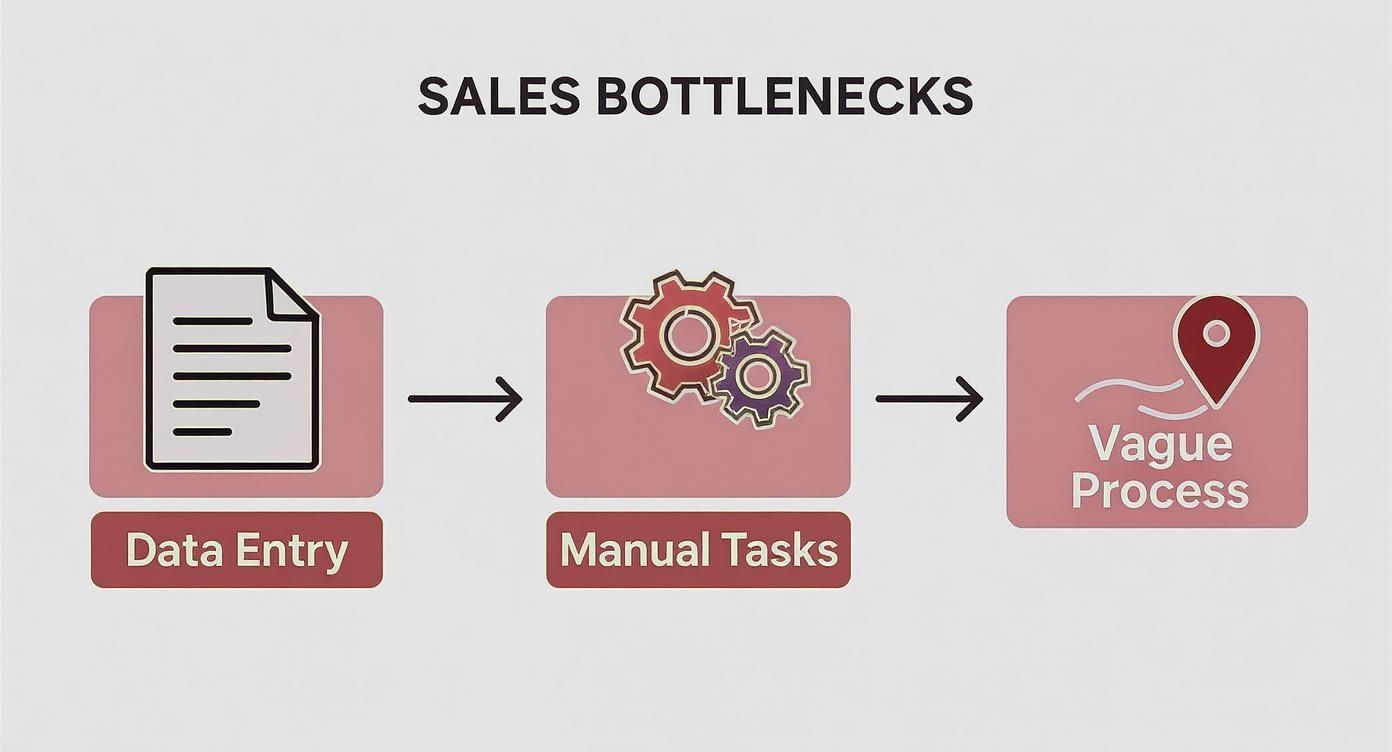
This flow highlights how manual data entry and vague processes create a domino effect, leading to wasted time and stalled momentum that automation and process optimization can solve.
Pillar 3: Data Hygiene and Management
Your CRM is the heart of your sales engine, but its power is completely dependent on the quality of the data inside it. Bad data—inaccurate, incomplete, or outdated—leads to wasted effort, bounced emails, and misguided sales strategies. For any team serious about efficiency, a commitment to data hygiene is absolutely non-negotiable.
This means setting up strict rules for data entry and running regular audits to purge duplicate or stale records. A clean CRM provides a single source of truth, giving reps the confidence to act fast and personalize their outreach with information they can actually trust.
Think of your CRM data as the fuel for your sales engine. If the fuel is dirty, the engine will sputter and eventually break down. Clean, accurate data ensures it runs smoothly and performs at its peak.
Maintaining data integrity isn’t a one-and-done project; it’s an ongoing discipline. It requires both good habits from the team and the right tools to enrich and verify information automatically, ensuring your reps are always working with the freshest intelligence.
Pillar 4: Effective Outreach Sequences
The final pillar ties the other three together into a powerful, proactive outreach system. An outreach sequence is a pre-planned series of touchpoints—emails, calls, social media messages—designed to nurture leads and pull them through the sales funnel. Instead of relying on random, ad-hoc follow-ups, sequences provide a structured and automated way to stay top-of-mind.
Of course, to build a truly efficient sales engine, you need a steady flow of high-quality leads in the first place. You can discover proven B2B lead generation strategies to keep your pipeline full. Once those leads hit your system, your outreach sequences take over, ensuring consistent and timely engagement without requiring manual work from your reps at every single step.
The best sequences are:
- Multi-channel: They engage prospects across different platforms where they live.
- Personalized: They use clean CRM data to feel relevant, not robotic.
- Value-driven: Each touchpoint offers something useful or insightful to the prospect.
- Measurable: They let you track what’s working so you can double down on it and fix what isn’t.
By putting this four-pillar framework into action, you shift from a reactive sales culture to a proactive, system-driven one. You create an environment where processes are clear, tedious tasks are automated, data is reliable, and outreach is effective—allowing your team to achieve maximum efficiency in sales.
Using Technology and AI to Boost Sales Productivity
The right tools are what elevate a good sales process into a great one. Think of them as force multipliers. Building an effective tech stack isn't about collecting the buzziest apps—it's about assembling a specialized toolkit where every piece has a clear purpose but works seamlessly with the others.
That synergy is where real efficiency in sales is born. Instead of chasing shiny objects, focus on the core categories that solve your biggest time-sinks and strategic gaps. A solid tech stack lets your team automate the mundane, uncover deep insights, and spend more time having actual conversations with potential customers.
Building Your Core Tech Stack
A strong tech stack stands on a few foundational pillars. Each one solves a different problem, but together they create a system that supports the entire sales cycle from start to finish.
- Customer Relationship Management (CRM): This is the heart of your entire operation. A well-organized CRM acts as the single source of truth for all customer data, making it non-negotiable for tracking deals and ensuring nothing ever falls through the cracks.
- Conversation Intelligence Software: These platforms record and analyze sales calls to give you data-backed insights into what your top performers are doing differently. They can pinpoint winning talk tracks and highlight coaching opportunities to help lift the entire team’s game.
When these core components are integrated, data flows smoothly between them. Reps get the context they need, right when they need it, and managers can finally make decisions based on reality, not guesswork.
The Impact of AI on Sales Operations
Artificial intelligence is quickly shifting from a futuristic buzzword to a practical tool that delivers real results. Today, AI-powered features are baked into the sales tools you already use, automating tasks and offering predictive insights that were once impossible.
AI is brilliant at sifting through massive datasets to spot patterns, making it the perfect partner for any sales team. For instance, AI algorithms can analyze behavior and demographic data to predict which leads are most likely to convert, helping reps focus their energy on the highest-potential opportunities.
AI isn't here to replace salespeople. It's here to augment their skills by handling the repetitive, data-heavy tasks that humans find tedious, freeing them up to focus on strategy, relationship-building, and closing deals.
The growth of this technology speaks for itself. The global sales automation market is expected to jump from $7.8 billion in 2019 to $16 billion by 2025. Companies that have adopted AI are already reporting a 10-20% bump in ROI, with reps saving about five hours a week by automating routine tasks.
You can dig deeper into these sales automation statistics to see the full picture. This shift makes investing in the right technology a critical step toward making smarter, faster, and more profitable decisions.
Works with 29+ CRMs
Add to CRM finds verified emails, phone numbers, and job titles on LinkedIn® — then adds them to your CRM in one click.
Start Free TrialTrusted by 2,500+ users4.7Measuring the ROI of Your Efficiency Initiatives
Putting new processes and tech in place is only half the battle. To really justify the effort and build a culture that’s always improving, you have to connect those efficiency initiatives directly to business outcomes. Proving the value isn’t just about feeling more productive; it’s about showing a clear return on investment (ROI) through real revenue growth.
This is what closes the loop on your strategy. By measuring the impact, you turn efficiency in sales from a vague goal into a data-driven discipline. It’s the difference between hoping your changes are working and knowing exactly what they’re worth.
Building a Simple Efficiency Dashboard
You don’t need a complicated business intelligence platform to get started. A simple dashboard built right inside your CRM or even a spreadsheet can tell you a lot. Just focus on tracking the key metrics we've been talking about, comparing them month-over-month to spot the trends.
Your dashboard should clearly show:
- Time-to-Conversion: Is the average sales cycle getting shorter?
- Pipeline Velocity: Are deals moving through stages faster?
- Activity Efficiency: Are reps needing fewer activities to land meetings or create opportunities?
- Revenue Per Rep: Is individual output and productivity climbing?
When you visualize this data, the impact of your changes becomes obvious. For instance, after automating data entry, you should see a matching increase in high-value sales activities and, eventually, in revenue per rep. This visual proof is everything when you need to get your team and leadership on board.
The ultimate goal is to draw a straight line from a specific efficiency improvement to a bottom-line result. This is how you prove that investing in smarter processes and tools isn't a cost—it's a revenue-driver.
A Real-World ROI Scenario
Let's walk through a quick example to see how small efficiency gains can stack up into significant financial returns. Imagine your team closes an average of $1 million in new business each quarter, and your average sales cycle is 90 days.
Now, let's say you roll out a new CRM automation sequence and clean up your sales process. After one quarter, you hit two key milestones:
- A 10% shorter sales cycle: It now takes just 81 days to close a deal instead of 90.
- A 15% jump in rep productivity: With less admin work, your reps can effectively manage more opportunities at once.
The faster sales cycle means you recognize revenue sooner, which is great for cash flow. But the real kicker is the productivity gain. A 15% boost in your team's capacity could translate directly into $150,000 in additional revenue booked that quarter.
This simple calculation turns abstract improvements into a rock-solid business case. It proves that mastering efficiency in sales isn't just about saving time; it's a constant cycle of monitoring, analyzing, and tweaking to drive predictable, sustainable growth.
Answering Your Sales Efficiency Questions
Working toward better sales efficiency always brings up a few questions. Let's tackle some of the most common ones that come up when sales leaders start digging into these strategies.
Where Is the Best Place to Start Improving Sales Efficiency?
The best place to start is with a simple time audit. Seriously. Ask your reps to track their hours for a week, or just pull the activity data from your CRM. You need a clear, honest picture of where their day actually goes.
More often than not, you'll find a huge chunk of their time is eaten up by non-selling activities—think manual data entry, prospecting grunt work, or endless internal admin. Once you’ve pinpointed the biggest time sinks, you know exactly where to aim your efforts, whether that’s automating data entry or finding smarter prospecting tools.
How Can Small Businesses Improve Sales Efficiency on a Tight Budget?
You don’t need a six-figure tech budget to see massive gains. Start with the foundational stuff that costs you nothing but delivers huge returns.
First, get your sales process down on paper. A clear, documented process eliminates the guesswork and keeps everyone on the same page. Second, dive into the automation features your CRM already has. Most modern platforms offer basic workflow automation, email templates, and follow-up reminders right out of the box.
Finally, and this is a big one, focus on data hygiene. A clean, accurate contact database makes every single outreach effort more effective.
How Do You Get Sales Reps to Adopt New Efficient Processes?
Adoption boils down to one simple thing: showing reps what's in it for them. Don't just announce a new tool; frame it around how it helps them close more deals and make more money.
Show them how a new automation tool saves them five hours of mind-numbing admin work a week, freeing them up to do what they do best—sell. Get them involved in picking the tools, give them great training, and shout out the early wins to build momentum.
Make it obvious that the goal isn't to micromanage them; it's to help them win.
Ready to eliminate the biggest time-sink for your sales team? Add to CRM turns any online profile or email signature into a clean CRM record in one click, saving your reps hours of manual data entry every week. Start streamlining your prospecting today at https://addtocrm.com.
Start saving time and closing more deals.
Find verified contact info for your prospects on LinkedIn®, Gmail and Outlook — and add them to your CRM with 1-click.

 Loading...Trusted by 2,500+ founders, SDRs & more