7 Best Times to Call for Cold Calling in 2026 for Higher Connection Rates
Discover the 7 best times to call for cold calling. This data-backed guide reveals optimal days, hours, and strategic windows to boost your sales success.
In the world of sales, a great pitch to the wrong person is a missed opportunity. But a great pitch at the wrong time? That’s a guaranteed dead end. While scripts, tone, and value propositions are critical, they are rendered useless if your call lands in a prospect's voicemail or interrupts their most focused moment. The persistent myth that 'any time is a good time' to call has cost sales teams countless hours in wasted effort and missed revenue.
This guide dismantles that myth with data, not anecdotes. We will move beyond generic advice to explore a nuanced, persona-segmented approach to finding the best times to call for cold calling. By analyzing research from platforms like Gong, Outreach, and Salesloft, we'll uncover the statistically proven windows that maximize connection rates, conversation quality, and ultimately, conversions.
You will learn how to strategically plan your outreach for different roles, industries, and specific business contexts. This article breaks down the optimal times to connect not just by day and hour, but by key industry triggers and the psychological state of your prospect.
We will cover seven distinct calling windows, complete with actionable insights for each:
- The peak performance hours from Tuesday to Thursday.
- The optimal Wednesday sweet spot for reaching decision-makers.
- High-context opportunities following industry events.
- Critical timing during quarter-end and year-end buying cycles.
Prepare to transform your call schedule from a game of chance into a strategic weapon, ensuring every dial has the highest possible probability of success.
1. Tuesday to Thursday Peak Hours (9 AM - 11 AM Local Time)
If there's a "golden window" for cold calling, this is it. The most statistically effective time to reach decision-makers falls mid-week, specifically between 9 AM and 11 AM in your prospect's local timezone. This two-hour block from Tuesday to Thursday consistently yields higher connection rates and more productive conversations, making it one of the best times to call for cold calling.
This timing is strategic. By Tuesday, the chaos of Monday's post-weekend catch-up has subsided. Prospects have cleared their inboxes, attended initial planning meetings, and are now focused on executing their core business priorities. Calling during this period positions your pitch when they are most mentally engaged and receptive to new ideas, but before the daily deluge of tasks fully consumes their attention. Conversely, it avoids the pre-weekend "mental checkout" that often begins Thursday afternoon and intensifies on Friday.
Why This Window Works
The effectiveness of this mid-week morning slot is validated by extensive industry data. HubSpot's sales research, for instance, highlights that calls made around 10 AM from Tuesday to Thursday can have answer rates up to three times higher than other periods. Similarly, analytics from platforms like Outreach.io indicate that the 9 AM to 11 AM window often generates over 40% of a sales team's total daily conversations. This isn't just theory; it's a proven pattern of prospect behavior.
Key Insight: Calling during this peak time respects the prospect's natural workflow. You're not interrupting their first coffee of the day or their last-minute dash to finish tasks before the weekend. You're engaging them when their mind is on business improvement.
How to Implement This Strategy
Maximizing this prime calling window requires precision and preparation. It’s not just about dialing, but dialing smart.
- Prioritize Timezone Accuracy: Before scheduling any calls, verify your prospect's location. CRM enrichment tools can automatically append timezone data to contact records, ensuring your 9 AM call isn't an accidental 6 AM wake-up call. Without accurate contact data, including the right phone number, this strategy is ineffective. If you're struggling to source correct details, you can learn how to find business phone numbers to improve your data quality.
- Batch Your Calls: Dedicate these two-hour blocks exclusively to calling. Use your CRM to create a filtered list of high-priority prospects in a specific timezone and work through it systematically. This focused effort prevents distractions and maximizes efficiency.
- A/B Test Your Timing: Don't treat 9 AM to 11 AM as a single block. Test the performance of calls placed at 9:15 AM versus 10:15 AM versus 10:45 AM. You may find that VPs in the tech industry answer more frequently at 9:30 AM, while manufacturing directors are more available closer to 11 AM.
- Prepare High-Value Voicemails: Not every call will connect, even during peak hours. Don't waste a premium time slot on an unprepared pitch or a generic voicemail. Have a concise, value-driven message ready to go that encourages a callback.
2. Avoid Monday Morning (Before 10 AM) Due to Low Engagement
Just as critical as knowing when to call is knowing when not to call. Monday mornings, particularly before 10 AM in the prospect's local timezone, represent a statistical dead zone for cold outreach. This period is notorious for having the lowest connection rates and the least productive conversations, making it one of the worst, not best, times to call for cold calling.
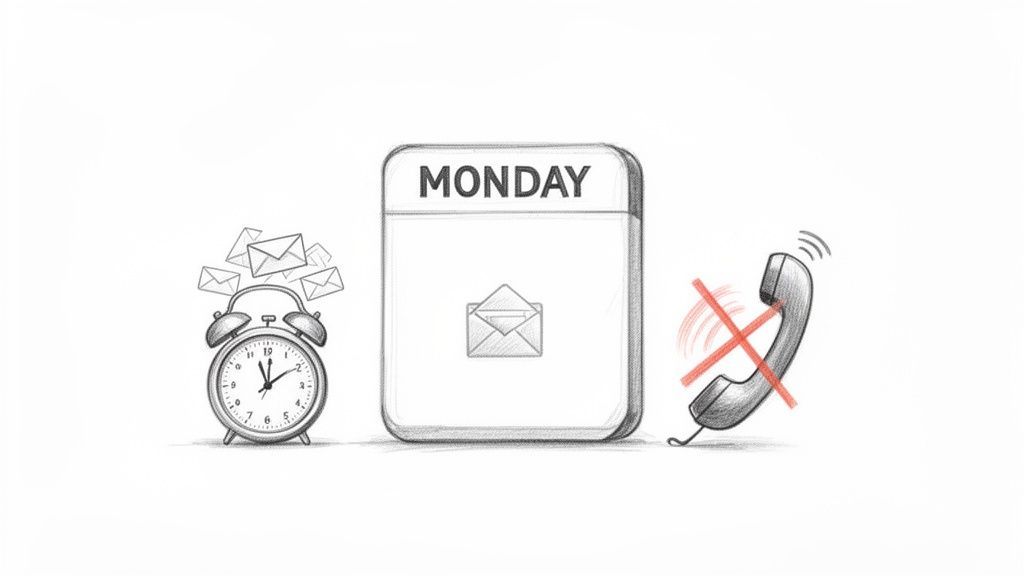
This timing is predictably ineffective. Decision-makers arrive at their desks facing a barrage of weekend emails, urgent internal requests, and a packed schedule of weekly planning meetings. They are in a reactive, problem-solving mode, focused entirely on organizing their week. An unsolicited sales call during this "catch-up chaos" is not just an interruption; it's an unwelcome distraction that is likely to be dismissed immediately, if it's even answered at all.
Why This Window Fails
The poor performance of Monday morning calls is backed by substantial data. Analysis from platforms like Gong.io, covering hundreds of thousands of sales calls, reveals that Monday mornings consistently have the shortest average conversation duration. Similarly, insights from professional networking platforms often show that connection rates on Mondays can be 25-35% lower than those on a mid-week day like Wednesday. The prospect's mindset is simply not geared toward evaluating new solutions or engaging with external vendors.
Key Insight: Calling on a Monday morning forces you to compete with a prospect's most urgent internal priorities. By waiting until Tuesday, you allow them to clear their plate and shift from a reactive to a proactive mindset.
How to Implement This Strategy
Avoiding this window isn't about taking the morning off; it's about reallocating that time to higher-value activities that set up the rest of your week for success.
- Make Monday Your "Admin & Research" Day: Use this time for strategic preparation. Research prospects, verify contact information in your CRM, and build targeted call lists for the peak windows on Tuesday through Thursday. This prep work ensures you hit the ground running when the timing is optimal.
- Leverage Asynchronous Channels: While calling is off the table, Monday morning is a great time to send personalized, low-pressure outreach messages on professional networks or via email. These channels allow the prospect to engage on their own terms once they've settled into their week.
- Schedule Internal Meetings: Reserve Monday mornings for internal team huddles, call strategy sessions, and role-playing exercises. This aligns the team and sharpens skills without wasting valuable prospect-facing time.
- If You Must Call, Do It Late: If a call absolutely must be made on a Monday, schedule it for after 2 PM. By then, the initial weekly fires have been put out, and some decision-makers may be more receptive as they look to finalize their week's agenda.
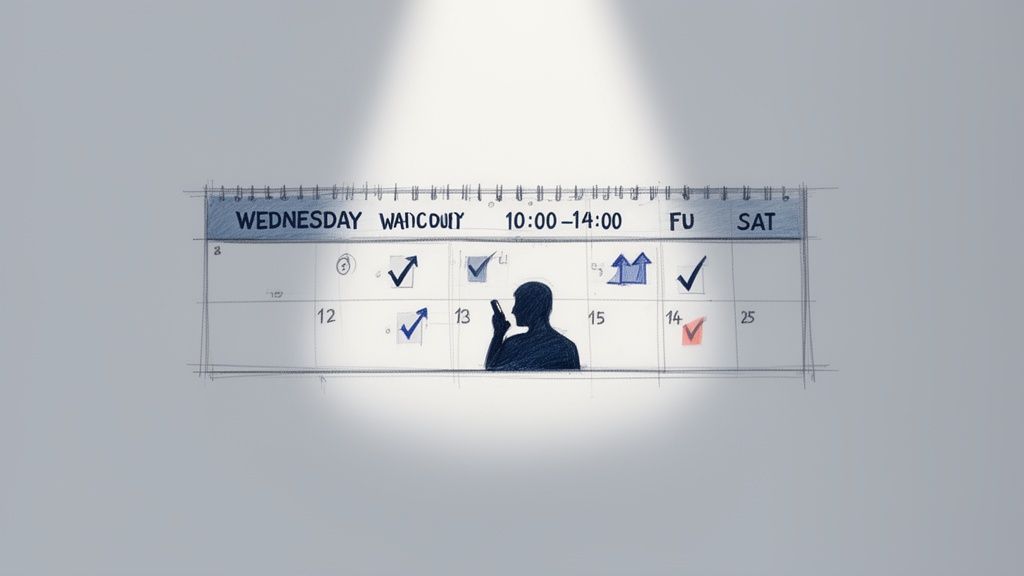
3. Wednesday Sweet Spot (10 AM - 2 PM) for Decision-Makers
While Tuesday and Thursday mornings offer a strong window, many sales experts argue that Wednesday is the single most powerful day for outbound calls. The "sweet spot" on this day, typically from 10 AM to 2 PM in the prospect's timezone, captures decision-makers when they are fully immersed in their work week, focused, and most receptive to strategic conversations. This expanded four-hour block is one of the best times to call for cold calling because it avoids the early-week chaos and the late-week rush.
Psychologically, Wednesday is the peak of the workweek. Prospects have addressed Monday's urgent issues and have a clear view of their goals before the weekend looms. Calling during this period means you're engaging them at their most productive and action-oriented mindset. They are deep into execution mode, making them more likely to consider solutions that can directly impact their weekly and quarterly objectives.
Why This Window Works
The superior performance of Wednesdays is consistently backed by large-scale data analysis. Salesloft's review of over 50 million calls found that Wednesdays often yield the highest connection rates, while Clari's research indicates that calls on this day result in significantly longer conversations. This isn't just about getting an answer; it’s about getting quality engagement. A longer talk time suggests the prospect is genuinely interested, asking deeper questions, and evaluating your proposal more seriously.
Key Insight: Wednesday is the week's strategic center. You're not just an interruption; you're a potential solution arriving precisely when the prospect is most focused on finding ways to achieve their business goals.
How to Implement This Strategy
To capitalize on the Wednesday sweet spot, you must treat it as your prime-time selling opportunity. This requires dedicated preparation and flawless execution.
- Prioritize Your A-List: Reserve this golden window for your most valuable, highest-potential prospects. Build your targeted call list on Tuesday evening so you can start dialing with precision at 10 AM sharp.
- Prepare for Deeper Conversations: Because prospects are more engaged, they often ask tougher, more insightful questions. Have two or three key competitive differentiation points ready to deploy. Be prepared to go beyond your standard script and discuss tangible business outcomes.
- Time-Block for Maximum Output: Schedule back-to-back call blocks within this four-hour window. For instance, create a focused "power hour" from 10 AM to 11 AM to work through your top-tier contacts without a break. This maximizes your chances of connecting when they are most available.
- Record and Analyze Your Calls: Since these calls are often more substantive, recording them is invaluable. Review your successful Wednesday calls to analyze your tone, pacing, and messaging. Identify what resonates most with engaged decision-makers and replicate it.
4. Late Morning (10 AM - 12 PM) Over Early Morning (8-9 AM) for Higher Quality Conversations
While the "early bird" approach works in some industries, B2B sales data reveals a compelling reason to shift your calling blocks later. Targeting the late morning, specifically between 10 AM and 12 PM in the prospect's timezone, often generates higher-quality engagement and more substantive conversations. This window is one of the best times to call for cold calling because it prioritizes discussion depth over sheer connection volume.
This timing is strategic because it aligns with the prospect's peak focus period after their initial morning ramp-up. By 10 AM, most decision-makers have completed their email triage, attended initial stand-up meetings, and established their priorities for the day. They are now in "execution mode" and are more mentally prepared for a business-level conversation, having moved past the administrative fog of the early morning. Calling now avoids the pre-lunch rush while capturing their full attention.
Why This Window Works
The argument for quality over quantity in this time slot is backed by powerful conversational intelligence data. Research from Gong.io, for instance, found that calls placed between 10 AM and 11 AM resulted in an average deal value that was 25% higher than those made from 8 AM to 9 AM. Similarly, Outreach.io analytics show that 10 AM to 12 PM calls average 6-7 minutes in duration, compared to just 4-5 minutes for the 8-9 AM slot, indicating more engaged and meaningful discussions. Enterprise SaaS teams at companies like HubSpot and CloudFlare often reserve this late morning window for high-touch outreach to senior executives.
Key Insight: Calling in the late morning catches prospects after they've planned their day but before they are distracted by lunch or afternoon deadlines. You're not another task to be cleared; you're a strategic conversation that fits into their productive workflow.
How to Implement This Strategy
Leveraging the late morning window requires a disciplined approach that shifts the focus from dialing speed to pre-call preparation.
- Use 8 AM - 10 AM for Preparation: Dedicate the early morning hours to deep research, not dialing. Use this time to review prospect profiles, analyze company trigger events, and craft personalized messaging. Build a "call stack" of 8-10 highly qualified targets so you are ready to dial with purpose precisely at 10 AM.
- Standardize a Later Start: Implement a team-wide policy that active cold calling begins no earlier than 10 AM local time. This gives every rep ample time for research and planning, which is a cornerstone of effective outbound lead generation strategies.
- Stagger Team Start Times: For teams covering multiple timezones, stagger their start times accordingly. An East Coast rep might start their research at 8 AM EST to begin calling at 10 AM EST, while a West Coast rep can use their morning to prep for their 10 AM PST block.
- Focus on Open-Ended Questions: Since this window yields longer conversations, prepare questions that go beyond basic qualification. Ask about strategic priorities, challenges they foresee in the next quarter, and the impact of recent industry trends on their role. This elevates the call from a pitch to a consultation.

Find verified contact data on LinkedIn®
Add to CRM finds verified emails, phone numbers, and job titles on LinkedIn® — then adds them to your CRM in one click.
Start Free Trial


 Trusted by 2,500+ users4.5
5. Avoid Friday Afternoons (After 2 PM) Due to Mental Checkout
Just as there are golden windows for cold calling, there are also "red zones" to avoid at all costs. Topping this list is Friday afternoon, specifically any time after 2 PM in your prospect's local timezone. This period consistently ranks as one of the worst times to call for cold calling, characterized by steep drop-offs in connection rates, conversation quality, and overall prospect engagement.
The reason is simple: mental checkout. By Friday afternoon, decision-makers are shifting their focus from strategic initiatives to operational wrap-up. They are finalizing weekly reports, attending last-minute meetings, and mentally transitioning to the weekend. An unsolicited call during this window is more likely to be perceived as an unwelcome interruption than an opportunity, leading to immediate dismissals or voicemails that go unheard until the following week, by which time any momentum is lost.
Why This Window Fails
This isn't just anecdotal sales wisdom; it's a trend supported by hard data. An analysis of millions of sales calls by Salesloft revealed that Friday afternoons from 3 PM to 5 PM have some of the lowest answer rates of the entire week, often hovering around 15% compared to the 40%+ rates seen on Wednesday and Thursday mornings. Similarly, engagement data from professional networking platforms shows a significant decline in user activity and responsiveness on Friday afternoons, confirming that prospects are simply not in a business-oriented mindset.
Key Insight: Calling during the Friday afternoon red zone disrespects the prospect's end-of-week workflow. You're competing with their desire to finish tasks and start their weekend, making it nearly impossible to capture their full attention or inspire action.
How to Implement This Strategy
Avoiding this period is a strategic choice that conserves your energy and resources for higher-impact activities. Instead of making fruitless calls, pivot your focus to productive, non-disruptive tasks.
- Shift to Asynchronous Outreach: Use Friday afternoons for activities that prospects can engage with on their own time. This is a perfect window for sending personalized follow-up emails, connecting on professional networks, or sharing valuable content like case studies and blog posts that they might review over the weekend or on Monday morning.
- Prioritize Relationship Building: If you must make calls, reserve this time for warm check-ins with existing customers or late-stage prospects with whom you already have a strong relationship. These individuals are more likely to be receptive to a friendly, low-pressure conversation.
- Plan for the Week Ahead: Use this time for strategic planning. Clean up your CRM data, research new target accounts, prepare your call lists for the following week, and refine your scripts. This preparation ensures you can hit the ground running during the peak calling windows on Tuesday morning.
- If You Must Call, Do It Early: If your schedule absolutely requires you to call on a Friday, do so before noon. Friday mornings, particularly between 10 AM and 12 PM, can still yield moderate success as many prospects are still engaged in work before the afternoon slump begins.
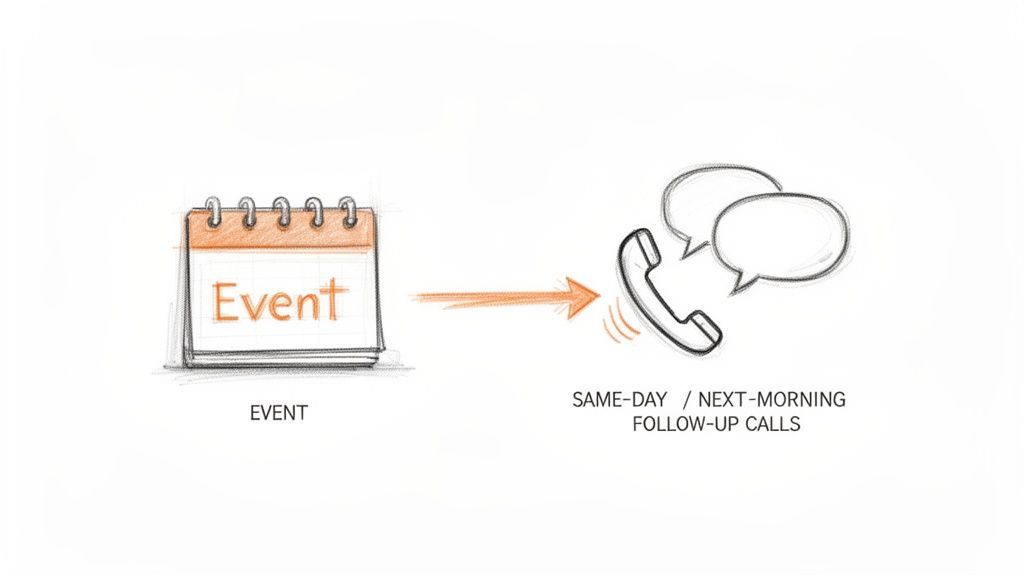
6. Right After Industry Events (Same Day/Next Morning) for Warm Context
One of the most powerful yet underutilized windows for outreach is immediately following a major industry event, conference, or webinar. Calling a prospect the same day or the next morning capitalizes on the recency effect, transforming a cold call into a timely, context-rich conversation. This timing strategy shifts the dynamic because the prospect is already in a "business improvement" mindset, making it one of the absolute best times to call for cold calling.
The logic is simple: prospects attending these events are actively seeking solutions, learning about new trends, and networking with peers. Their minds are focused on the exact industry challenges you likely solve. By reaching out within hours, you insert your solution directly into their current stream of thought, making your call feel less like an interruption and more like a relevant continuation of their professional development.
Why This Window Works
This approach isn't just intuitive; it's backed by compelling performance data. For example, Demandbase research shows that post-webinar follow-up calls can achieve up to four times higher conversion rates than standard cold outreach. Similarly, B2B SaaS companies frequently report meeting conversion rates exceeding 35% from post-conference calls, a massive leap from the typical 8% for traditional cold calls. The community playbook from Pavilion, a private group for high-growth leaders, consistently ranks same-day event follow-up as a top-performing outbound tactic for its members.
Key Insight: An event acts as a shared experience and a natural conversation starter. Referencing it instantly builds rapport and demonstrates that you've done your research, positioning you as a clued-in industry peer rather than just another salesperson.
How to Implement This Strategy
Executing a post-event calling strategy requires speed, relevance, and the right tools to identify and engage attendees efficiently.
- Identify Attendees Quickly: Use professional networking platforms to track events and see who from your target accounts has RSVP'd or is engaging with event-related content. This creates a pre-qualified list of prospects who have signaled interest in a specific topic.
- Reference Specifics: Don't just say, "I saw you attended the conference." Be specific. Open your call with, "I saw your comment on the keynote speaker's post from the SaaS Summit yesterday..." This shows genuine attention to detail.
- Act with Urgency: The value of this context diminishes rapidly. Aim to call or email within 4 to 24 hours of the event's conclusion. This ensures the experience is still fresh in the prospect's mind and you reach them before their regular workload fully resumes.
- Build Event-Triggered Lists: Use your CRM to create dedicated lists or campaigns for event attendees. Tag contacts with the specific event (e.g., "SaaS_Summit_2024") to trigger an automated call sequence for your sales development team, ensuring no warm lead is missed.
7. Quarter-End and Year-End Windows (Last 2 Weeks of Each Quarter/Year)
While most cold calling advice focuses on specific times of the day or week, some of the most opportune moments are tied to the business calendar. The final two weeks of a fiscal quarter or year create powerful, urgency-driven windows. This period is one of the best times to call for cold calling because prospects are highly motivated to meet quotas, spend remaining budgets, and finalize plans.
This timing strategy is about aligning your outreach with your prospect’s financial and operational cycles. As deadlines loom, decision-makers are under pressure to hit targets and are often more open to solutions that can help them achieve their goals or efficiently allocate "use-it-or-lose-it" funds. Your call isn't an interruption; it’s a potential solution arriving at the exact moment of need. This creates a natural synchronization that can significantly accelerate the sales process.
Why This Window Works
The effectiveness of this approach is backed by observable patterns in B2B sales. Enterprise SaaS companies, for example, often target the last two weeks of March, June, September, and especially December for high-velocity deals. Sales intelligence firms have reported that outreach during the fourth quarter (Q4) can convert up to 40% faster than during Q2 or Q3. This isn't just a coincidence; it's a direct result of budget cycles and performance pressure.
Key Insight: Calling at quarter-end taps into a prospect’s built-in urgency. You're not creating the urgency yourself; you're leveraging an existing, powerful business driver that makes them more decisive and receptive to compelling offers.
How to Implement This Strategy
Successfully leveraging these critical windows requires foresight and strategic planning, not last-minute dialing. You must lay the groundwork weeks in advance.
- Plan Ahead: Begin your prospecting 4-6 weeks before the quarter ends. The goal is to identify and qualify key contacts early so you are ready with a warm introduction or a highly relevant pitch when the final two-week crunch time begins. You can learn how to qualify sales leads effectively to build a strong pipeline for these windows.
- Emphasize Immediacy and ROI: Tailor your messaging to address quarter-end pressures. Focus on quick implementation, budget optimization, and immediate value. Prospects need rapid validation, so have case studies, ROI calculators, and streamlined contracts ready.
- Segment and Remind: Use your CRM to tag high-fit accounts for quarter-end outreach. Set automated tasks or reminders for week 9 or 10 of the quarter to flag these prospects, ensuring you don’t miss the opportunity to engage them during the critical closing window.
- Prepare for Rapid Closing: Decision-making can happen extremely fast during this period. Have your contracts, master service agreements (MSAs), and onboarding materials templated and ready for quick deployment to remove any friction from the closing process.
Works with 29+ CRMs
Add to CRM finds verified emails, phone numbers, and job titles on LinkedIn® — then adds them to your CRM in one click.
Start Free TrialTrusted by 2,500+ users4.57-Point Cold-Call Timing Comparison
| Item | Implementation Complexity | Resource Requirements | Expected Outcomes | Ideal Use Cases | Key Advantages |
|---|---|---|---|---|---|
| Tuesday to Thursday Peak Hours (9 AM - 11 AM Local Time) | Low — simple scheduling by local timezone | Standard calling team, CRM scheduling, timezone mapping | Higher connection rates (30–50%) and improved conversation quality | High-volume B2B outbound and sequential decision-maker outreach | Peak prospect availability and focused business mindset |
| Avoid Monday Morning (Before 10 AM) Due to Low Engagement | Low — enforce avoidance policy | Minimal; discipline and scheduling rules | Avoids lowest-performing time; reduces wasted calls | Prep/administrative work, list enrichment, planning | Preserves team energy and frees slots for better times |
| Wednesday Sweet Spot (10 AM - 2 PM) for Decision-Makers | Moderate — requires priority lists and coordination | CRM integration, verified contacts, prioritized A-list | Highest answer rates and longer conversations; better conversion | Targeting C-suite and complex opportunities | Best single-day performance for deep, decision-focused calls |
| Late Morning (10 AM - 12 PM) Over Early Morning (8-9 AM) for Higher Quality Conversations | Low to moderate — adjust start times and team norms | Standard calling team, time for pre-call prep | Higher engagement and longer calls than 8–9 AM | Enterprise/high-touch outreach and detailed qualification | Prospects are triaged and mentally ready; easier execution |
| Avoid Friday Afternoons (After 2 PM) Due to Mental Checkout | Low — avoid/repurpose time slot | Minimal; reassign to follow-ups or prep | Low engagement and low callback likelihood | Follow-up emails, CRM cleanup, relationship maintenance | Prevents low-quality interactions; improves call efficiency |
| Right After Industry Events (Same Day/Next Morning) for Warm Context | High — needs event monitoring and rapid execution | Event attendee data, enrichment tools, rapid CRM tagging | Much higher response rates (3–5x) and shorter sales cycles | Post-conference/webinar follow-up and warm outreach | Warm context increases relevance and eases engagement |
| Quarter-End and Year-End Windows (Last 2 Weeks of Each Quarter/Year) | High — requires advance planning and timing | Analytics, enriched lists, contract templates, coordinated outreach | Faster deal cycles and higher urgency-driven closes | Closing budget-driven opportunities and renewals | Aligns with prospect budget pressure for accelerated decisions |
From Data to Dials: Operationalizing Your Calling Strategy
Mastering the best times to call for cold calling is not a final destination; it's the starting point for a smarter, more efficient outbound engine. Simply knowing that Wednesday from 10 AM to 2 PM is a "sweet spot" is useless without a system to execute and a methodology to validate it for your specific market. The true competitive advantage comes from moving beyond generic advice and operationalizing these data-backed insights into your daily sales workflow.
The core principle threaded through this guide is intentionality. Instead of a high-volume, low-yield approach, you now have a framework to focus your energy where it matters most. By strategically avoiding the Monday morning catch-up chaos and the Friday afternoon wind-down, you've already eliminated countless unproductive dials. This isn't about working less; it's about making your work count more.
Key Takeaways: From Insights to Action
Let's distill the most critical, actionable principles from this guide into a repeatable strategy:
- Start with Data, Refine with Reality: Use the peak windows we’ve identified (Tuesday-Thursday, late mornings) as your baseline. These are statistically proven starting blocks, not unbreakable rules. Your first goal is to implement this baseline consistently.
- Segment and Personalize Your Timing: A one-size-fits-all approach will fail. C-level executives in tech have different schedules than operations managers in manufacturing. Segment your calling lists by persona and industry, then test these time slots against each segment to find your unique patterns.
- Integrate Timing into Your Tech Stack: Your CRM is the brain of your sales operation. Use its features to enforce this strategy. Create timezone-aware call queues, set up automated task reminders for peak windows, and build dashboards that specifically track call outcomes by time of day. Technology should enable your strategy, not complicate it.
- Track Leading Indicators, Not Just Outcomes: Don’t just measure meetings booked. Track connection rates, conversation length, and qualification rates. A high connection rate at 4 PM might yield short, dismissive conversations, while a lower connection rate at 10:30 AM leads to longer, more qualified discussions. These leading metrics tell the full story.
Crucial Insight: The goal isn't just to find the best time to connect; it's to find the best time to have a meaningful conversation. Your metrics must reflect this distinction.
Your Next Steps: Building a Data-Driven Calling Engine
The difference between a top-performing sales team and an average one often lies in their commitment to process and iteration. Understanding the best times to call for cold calling is a powerful lever, and now it’s time to pull it.
- Conduct a Time Audit: For the next two weeks, rigorously track your team's call data against the time windows discussed. Use your CRM to log every dial, connection, and outcome with a timestamp. This creates your personalized performance baseline.
- Build Your "Golden Hour" Playbook: Based on your audit, identify your top one or two "golden hour" blocks. Create a simple playbook for your team: during these hours, all distractions are off, and the sole focus is on high-quality, targeted dials.
- Automate Everything But the Conversation: The time spent researching, enriching contacts, and manually logging data is time not spent calling during peak windows. Use automation tools to prepare your call lists before the golden hours arrive, so your reps can focus exclusively on executing.
Ultimately, this strategic approach transforms cold calling from a frustrating numbers game into a calculated, professional discipline. It empowers your team with the confidence that they are calling the right person at the right time, freeing them to focus on what humans do best: building rapport, asking insightful questions, and solving problems. Stop guessing and start dialing with data-backed purpose.
Tired of wasting precious calling windows on manual research and data entry? Add to CRM automates contact enrichment directly from social profiles, so your team can build hyper-targeted, accurate call lists in seconds. Spend your golden hours having conversations, not doing busy work, by trying Add to CRM today.
Start saving time and closing more deals.
Find verified contact info for your prospects on LinkedIn®, Gmail and Outlook — and add them to your CRM with 1-click.

 Loading...Trusted by 2,500+ founders, SDRs & more